
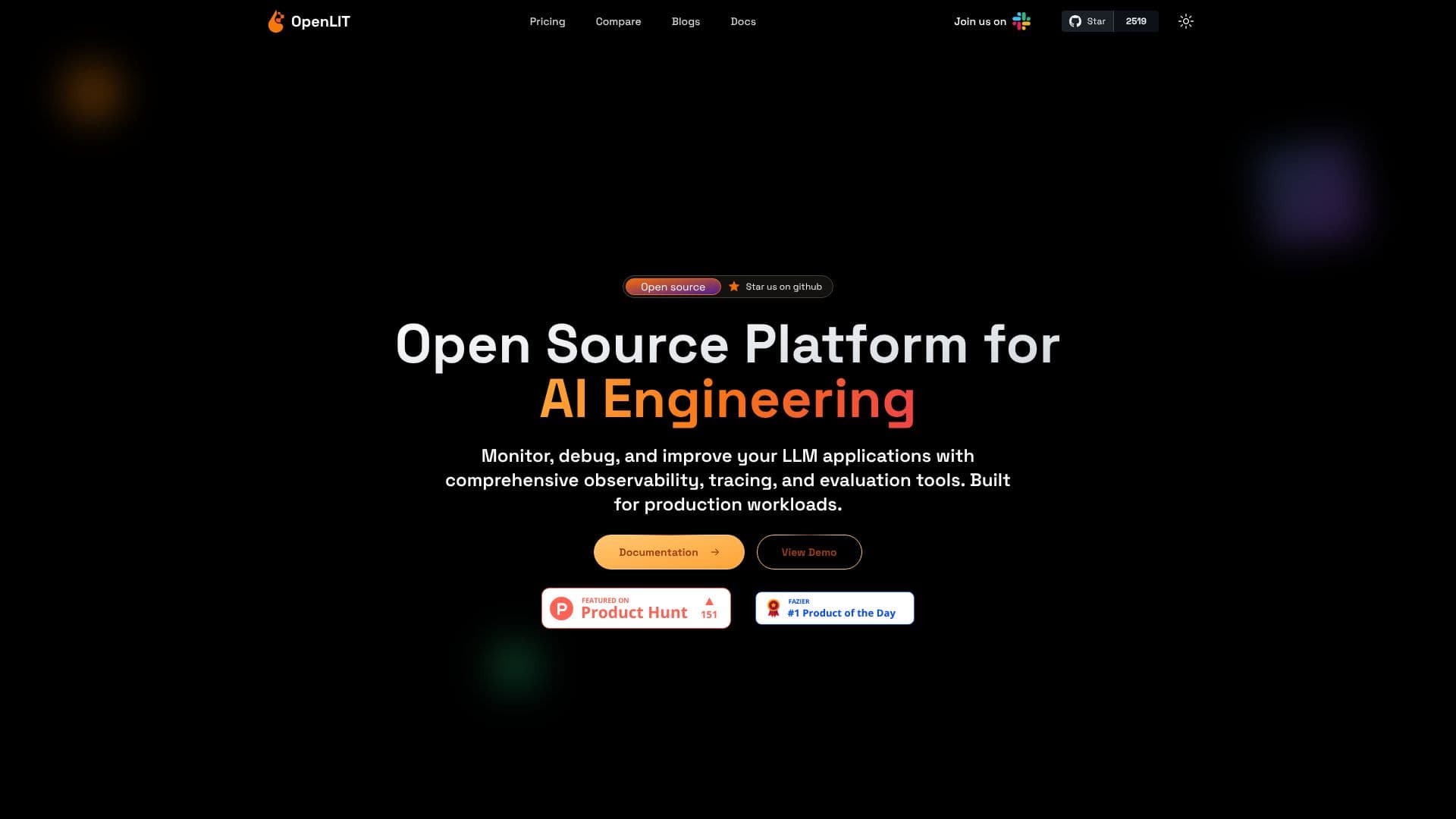
Description
OpenLIT is a powerful open-source platform designed to enhance AI engineering by providing comprehensive observability for GenAI and LLM applications. Built natively on OpenTelemetry standards, it seamlessly integrates with existing observability stacks, allowing developers and engineers to monitor, debug, and improve their AI applications effectively. The platform is engineered for production workloads, offering robust tools for real-time monitoring, tracing, and evaluation.
Read More
Key capabilities of OpenLIT include distributed tracing, which visualizes request flows, identifies bottlenecks, and tracks the complete lifecycle of AI interactions. Its AI model evaluation feature supports both online and offline assessments via a user interface and SDKs, enabling experimentation with prompts and models. Prompt management is centralized, allowing for versioning, deployment, and faster iteration on prompt variations. The real-time monitoring dashboards provide a unified view across different environments, with custom SQL query capabilities for data analysis and flexible widget configurations.
OpenLIT also excels in multi-deployment management, offering a single dashboard to monitor and compare performance metrics across an entire AI fleet. Integration is straightforward, requiring minimal code changes for existing applications and offering zero-code Kubernetes observability through an operator that automatically instruments AI workloads. This makes it ideal for LLM applications, AI agents, vector databases, and various AI frameworks.
The platform is committed to being open-source and free, with a strong emphasis on privacy and avoiding vendor lock-in. It is built for scale with minimal performance overhead and fosters a growing community of developers. OpenLIT supports a wide array of LLM providers, vector databases, and AI frameworks, ensuring broad compatibility and flexibility for users looking to build better, more reliable AI applications.
- CategoryMLOps & Model Deployment
- Pricing ModelOpen Source
- DeploymentSelf-hosted
- PlatformsWeb
OpenLIT's Core Features
OpenTelemetry-native GenAI and LLM observability
Distributed tracing for real-time monitoring
AI model evaluation (online/offline)
Centralized prompt management and versioning
Real-time monitoring dashboards with custom SQL queries
Multi-deployment management for AI fleets
Zero-code Kubernetes observability via operator
Automatic instrumentation for AI applications
Support for major LLM providers and frameworks
Self-hosted and open-source under Apache 2.0
Privacy-first data handling
Production-ready for scalable AI applications
How to use OpenLIT?
Install OpenLit: Use pip install openlit.
Initialize in Application: Import openlit and call openlit.init().
Configure Kubernetes Operator: Deploy the OpenLIT Operator for zero-code instrumentation.
Monitor Deployments: Access unified dashboards for real-time insights.
Evaluate Models: Use UI or SDKs for AI model performance checks.
Manage Prompts: Version and deploy prompts centrally.
Analyze Telemetry: Write custom SQL queries for in-depth data analysis.
OpenLIT's Use Cases
- LLM Application Observability
- AI Agent Monitoring
- Vector Database Tracing
- Prompt Engineering & Management
- Production AI Workload Management
- Kubernetes AI Observability
- AI Model Evaluation