
Description
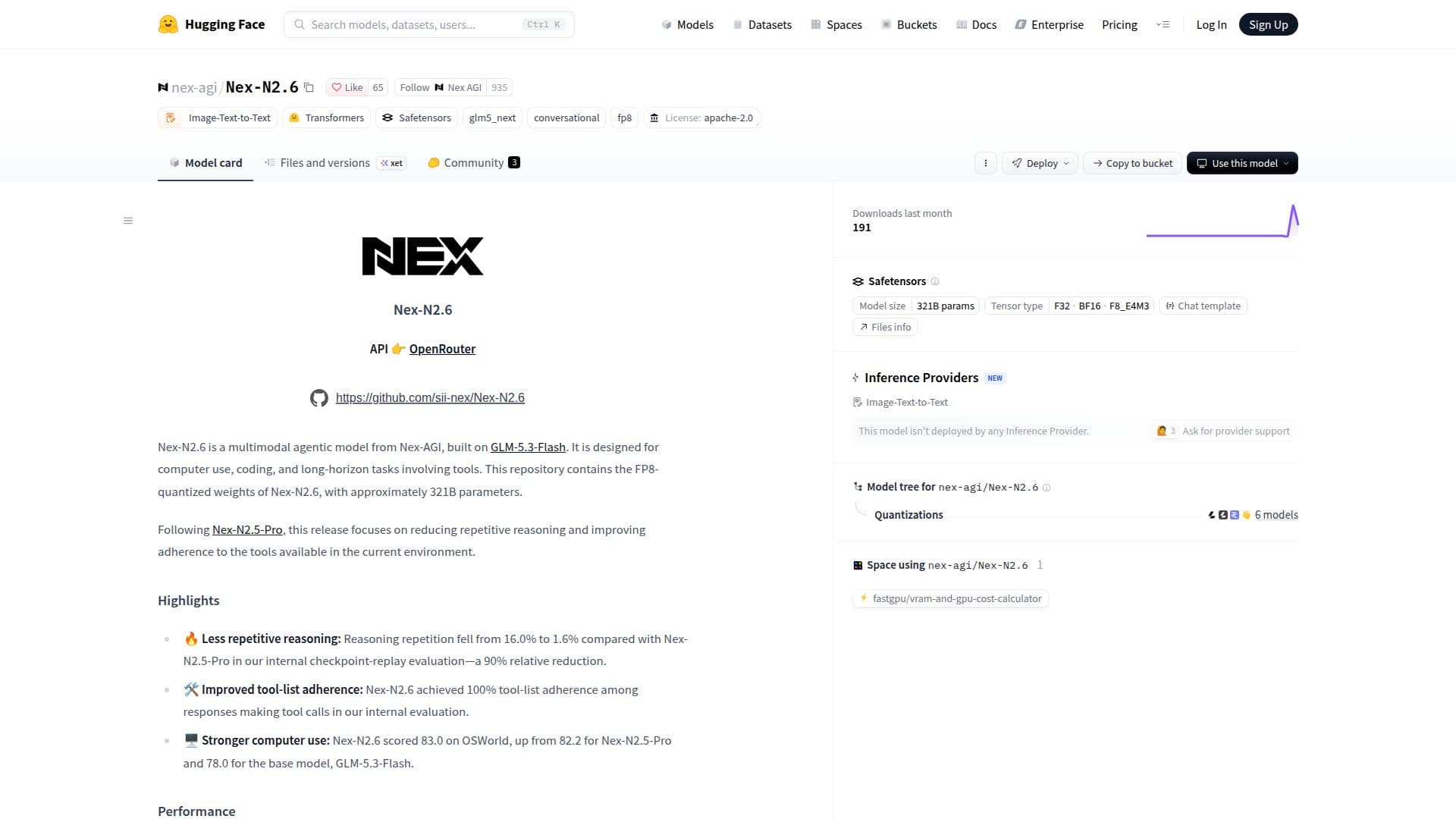
Nex-N2.6 is an advanced multimodal agentic model developed by Nex-AGI, leveraging the foundational GLM-5.3-Flash architecture. This model is specifically engineered to excel in demanding computational environments, including complex coding tasks and long-horizon operations that require sophisticated tool integration and utilization. The current release focuses on delivering enhanced performance by addressing key areas such as reasoning efficiency and tool adherence.
Read More
A significant highlight of Nex-N2.6 is its remarkable reduction in repetitive reasoning. Internal evaluations show a dramatic decrease in reasoning repetition, falling from 16.0% in its predecessor, Nex-N2.5-Pro, to just 1.6%. This represents a 90% relative reduction, indicating a substantial improvement in the model's ability to process information more efficiently and avoid redundant thought processes. Furthermore, the model demonstrates perfect tool-list adherence, achieving 100% in internal evaluations for responses that involve tool calls. This ensures that Nex-N2.6 consistently utilizes only the tools declared in a request, leading to more reliable and predictable outcomes.
In terms of practical application, Nex-N2.6 exhibits stronger capabilities in computer use. It scored 83.0 on the OSWorld benchmark, surpassing Nex-N2.5-Pro (82.2) and the base GLM-5.3-Flash model (78.0). Similar performance gains are observed in other benchmarks, such as Terminal-Bench 2.1, where Nex-N2.6 scored 84.1, and AutomationBench, where it achieved 45.7. These results, reported by the Nex-AGI team, underscore the model's robust performance across various computational tasks.
For deployment, Nex-N2.6 provides FP8-quantized weights, making it suitable for inference runtimes that support GLM-5.3-Flash. Users can self-host the model by following the official SGLang deployment guide, ensuring an FP8-compatible configuration. The bundled chat template supports varying reasoning effort levels (low, high, max) and accommodates image inputs through supported serving runtimes. For tool-based operations, users must supply available tools with each request, with the client or agent framework responsible for executing tool calls and returning results. The Nex community offers a platform for feedback, workflow discussions, and developer connections.
- CategoryAI Models & LLMs
- Pricing ModelOpen source
- DeploymentSelf-hosted
- PlatformsWeb
Nex-N2.6 Highlights
Multimodal agentic model
Built on GLM-5.3-Flash architecture
Designed for computer use and coding
Optimized for long-horizon tasks involving tools
FP8-quantized weights available
321 billion parameters
90% relative reduction in reasoning repetition
100% tool-list adherence in tool calls
Strong performance on OSWorld benchmark (83.0 score)
High scores on Terminal-Bench 2.1 (84.1) and AutomationBench (45.7)
Supports reasoning_effort values: low, high, max
Compatible with image content blocks for image inputs
OpenRouter API integration
Community support for feedback and workflows
Getting Started with Nex-N2.6
Access Model Page: Navigate to the Nex-N2.6 model page on Hugging Face.
Download Weights: Download the FP8-quantized weights of Nex-N2.6.
Configure Runtime: Use an inference runtime with GLM-5.3-Flash support, or self-host using SGLang with an FP8-compatible configuration.
Set Model Path: Replace the model path with the downloaded Nex-N2.6 directory and set `--served-model-name Nex-N2.6`.
Ensure Tokenizer/Processor: Keep the tokenizer, processor, and chat template shipped with the weights.
Send Prompts: Once the OpenAI-compatible server is listening, send prompts, specifying `reasoning_effort` (low, high, max) as needed.
Provide Tools: For tool use, supply the available tools with each request; the client or agent framework will execute calls and return results.
Utilize Image Inputs: For image inputs, use image content blocks supported by your serving runtime.
Nex-N2.6's Use Cases
- Complex Coding Tasks
- Long-Horizon Automation
- Computer System Interaction
- Multimodal Data Processing
- Agentic Workflow Development
- Performance Benchmarking
- Reducing Repetitive Reasoning