Description
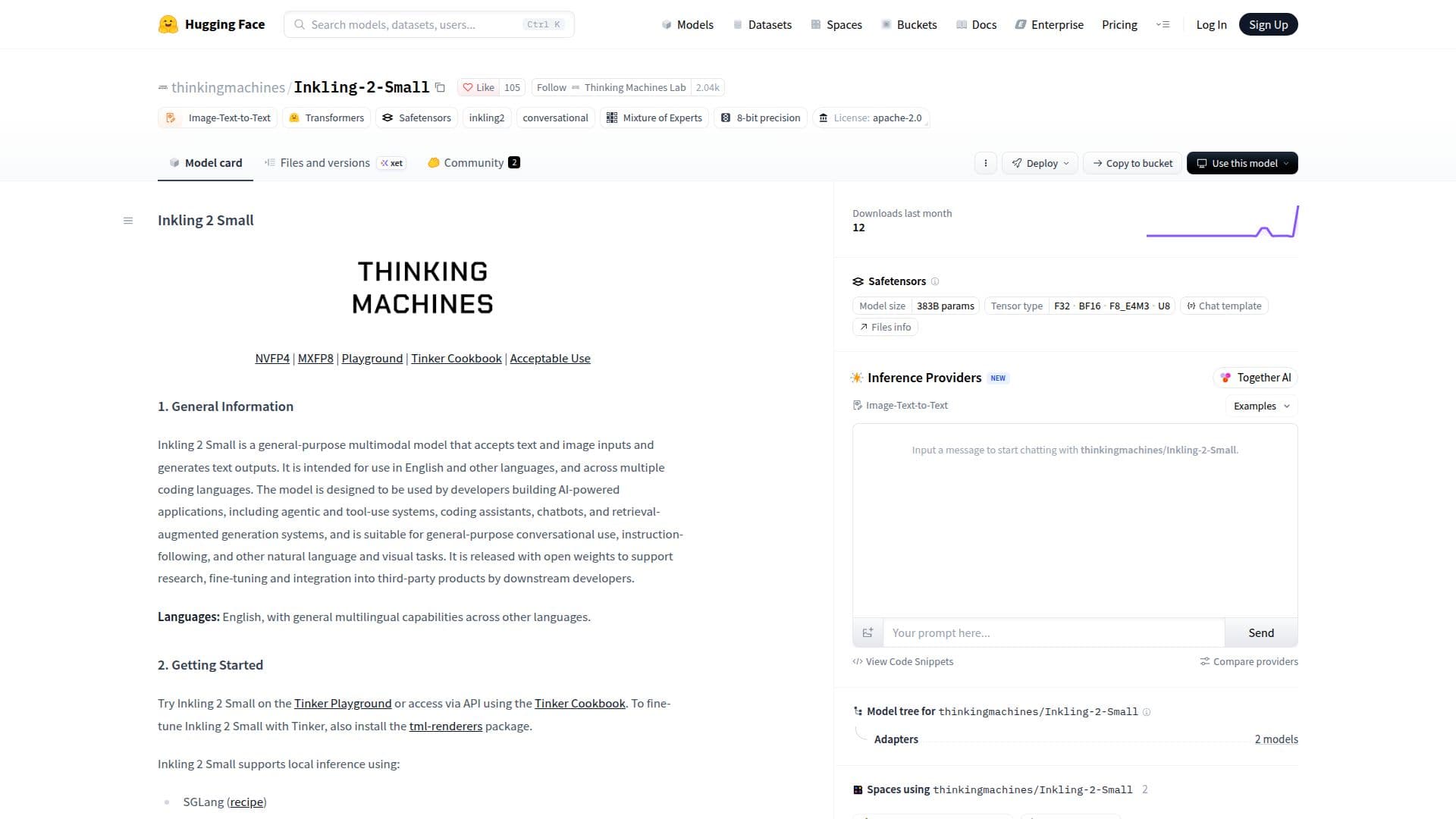
Inkling 2 Small is a versatile multimodal model capable of processing text and image inputs to produce text outputs. It is engineered for broad applicability, supporting English and other languages, alongside various coding languages. The model is specifically aimed at developers who are creating AI-powered applications, such as agentic and tool-use systems, coding assistants, chatbots, and retrieval-augmented generation (RAG) systems. Its design also makes it suitable for general-purpose conversational interactions, instruction-following, and a wide array of natural language and visual tasks.
Read More
Released with open weights, Inkling 2 Small encourages research, fine-tuning, and integration into third-party products by downstream developers. Users can experiment with the model on the Tinker Playground or access it via API using the Tinker Cookbook. For fine-tuning with Tinker, the tml-renderers package is required. The model supports local inference through various frameworks including SGLang, vLLM, TokenSpeed, and Unsloth. Additionally, it can be post-trained with Miles, SkyRL, and Snowflake Cortex Training. API access is also available through third-party inference providers like NVIDIA, Fireworks, Together, Baseten, Nebius, Modal, and Cloudflare.
Hardware requirements for Inkling 2 Small depend on the checkpoint format. The main NVFP4 checkpoint necessitates a GPU cluster with at least 500GB of aggregated VRAM, achievable with configurations such as 2x NVIDIA B300 GPUs or 4x NVIDIA H200 GPUs. The alternative MXFP8 checkpoint requires at least 800GB of aggregated VRAM, met by 4x NVIDIA B300 GPUs or 8x NVIDIA H200 GPUs. The NVFP4 checkpoint is recommended for all use-cases as it is the native precision for the model, offering optimal performance.
Architecturally, Inkling 2 Small is a multimodal autoregressive transformer. It features a 48-layer decoder-only transformer with a sparse Mixture-of-Experts (MoE) feed-forward backbone, where each token is routed to 8 of 384 experts. Its attention mechanism combines local and global layers. The model is natively multimodal, encoding images via a vision transformer and projecting both image and text inputs into a shared hidden space for joint processing by the decoder. It supports a context window of up to 1 million tokens and accepts text in UTF-8 encoding and pixel-based image formats (ideally between 40px and 4096px per dimension). Outputs are generated as UTF-8 encoded text.
Training data for Inkling 2 Small includes a diverse range of content types, such as text, images, and video, sourced from publicly available repositories, third-parties, internal generation, and synthetic augmentation. The data curation process involves cleaning, processing, and modifying datasets, including deduplication and filtering for quality and safety. Safety evaluations were conducted across everyday human-AI interaction and dangerous-capability testing, with mitigations applied to reduce risks. The model's knowledge is limited to its training cutoff, and users are advised to apply human oversight for high-stakes applications due to potential limitations like hallucination and biases from training data.
- CategoryAI Models & LLMs
- Pricing ModelOpen source
- DeploymentCloud, Self-hosted
- PlatformsWeb
Inkling 2 Small Highlights
Multimodal Input: Accepts both text and image inputs
Text Output: Generates UTF-8 encoded text outputs
General-Purpose Model: Suitable for a wide range of applications
Multilingual Capabilities: Supports English and other languages
Multi-Coding Language Support: Works across various coding languages
Open Weights: Available for research, fine-tuning, and integration
API Access: Accessible via Tinker Cookbook and third-party providers
Local Inference Support: Compatible with SGLang, vLLM, TokenSpeed, Unsloth
Post-Training Options: Can be post-trained with Miles, SkyRL, Snowflake Cortex Training
Autoregressive Transformer: Utilizes a 48-layer decoder-only architecture
Mixture-of-Experts (MoE): Sparse feed-forward backbone with 384 experts
Shared Hidden Space: Processes image and text inputs jointly
Context Window: Supports up to 1 million tokens
High Parameter Count: 594B total parameters, 17B active
Getting Started with Inkling 2 Small
Access Model: Visit the Inkling 2 Small page on Hugging Face.
Try Playground: Experiment with the model directly on the Tinker Playground.
Access via API: Use the Tinker Cookbook to integrate the model through its API.
Fine-tune Model: Install the tml-renderers package to fine-tune Inkling 2 Small with Tinker.
Local Inference: Utilize frameworks like SGLang, vLLM, TokenSpeed, or Unsloth for local deployment.
Post-Train: Enhance the model with Miles, SkyRL, or Snowflake Cortex Training.
Deploy with Providers: Access API through third-party inference providers such as NVIDIA or Fireworks.
Configure Hardware: Ensure a GPU cluster with at least 500GB VRAM for NVFP4 or 800GB for MXFP8 checkpoint.
Inkling 2 Small's Use Cases
- Building AI Applications
- Agentic Systems Development
- Coding Assistants
- Chatbot Creation
- Retrieval-Augmented Generation
- General Conversational Use
- Instruction Following
- Visual Tasks
- Research and Experimentation
- Third-Party Product Integration