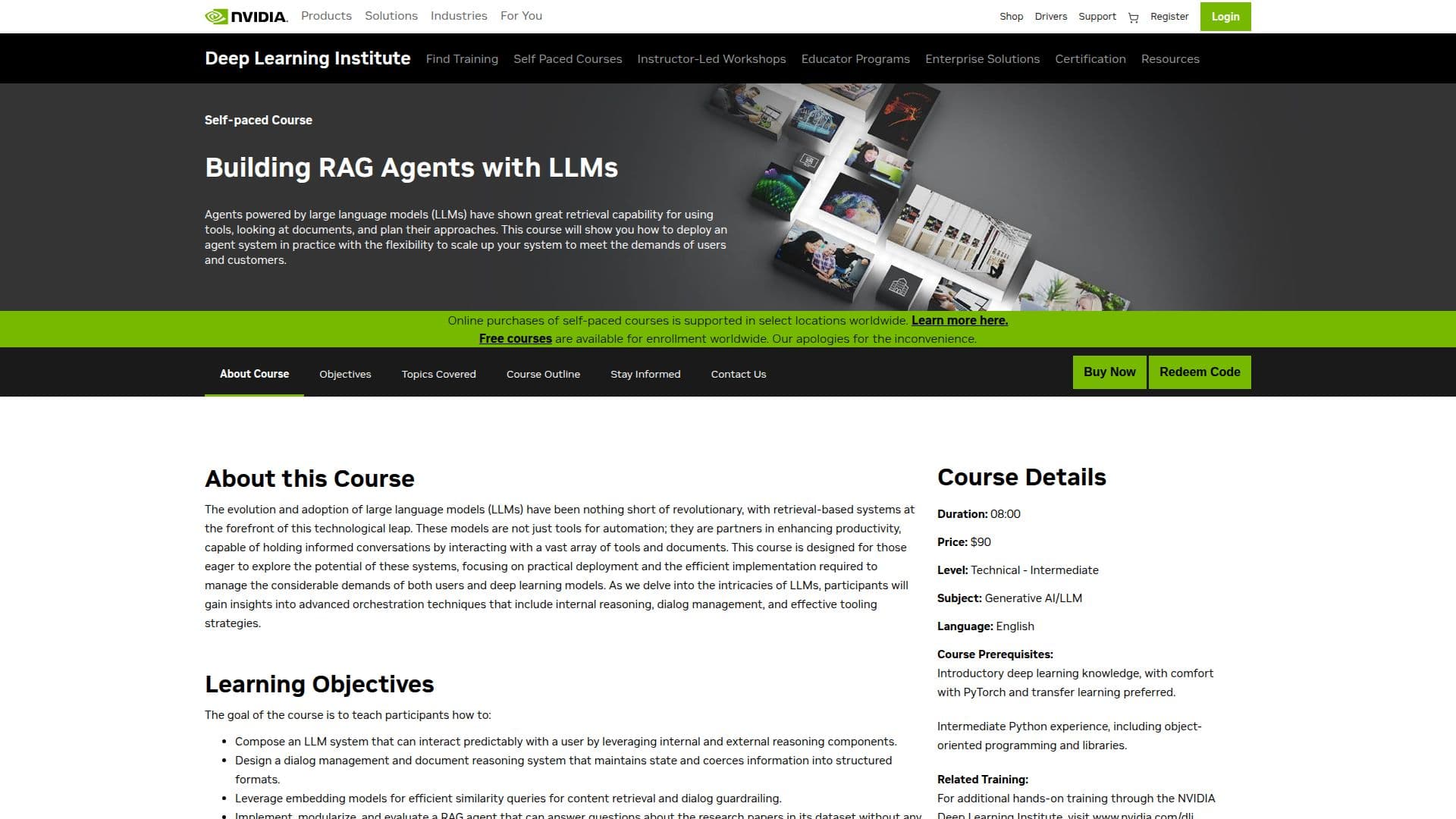
Description
NVIDIA's course, Building RAG Agents with LLMs, delves into the revolutionary evolution of large language models (LLMs) and their application in retrieval-based systems. These models enhance productivity by enabling informed conversations through interaction with various tools and documents. The course is tailored for individuals eager to explore the potential of LLMs, focusing on practical deployment and efficient implementation to manage the demands of users and deep learning models.
Read More
Participants will gain insights into advanced orchestration techniques, including internal reasoning, dialog management, and effective tooling strategies. The course aims to teach participants how to compose an LLM system that interacts predictably with users by leveraging internal and external reasoning components. It also covers designing dialog management and document reasoning systems that maintain state and structure information.
The course includes topics such as LLM Inference Interfaces, Pipeline Design with LangChain, Gradio, and LangServe, Dialog Management with Running States, and Working with Documents. Participants will learn to utilize embeddings for semantic similarity and guardrailing, and implement vector stores for efficient document retrieval. By the end of the workshop, participants will have a solid understanding of RAG agents and the tools necessary to develop their own LLM applications.
The course is suitable for those with introductory deep learning knowledge, familiarity with PyTorch and transfer learning, and intermediate Python experience. It offers a comprehensive understanding of RAG agents, equipping participants with the skills to develop and deploy advanced LLM systems effectively.
- CategoryCorporate Training & E-Learning
- Pricing ModelFree
NVIDIA Building RAG Agents with LLMs's Core Features
Compose LLM systems with internal and external reasoning
Design dialog management systems
Leverage embedding models for similarity queries
Implement RAG agents without fine-tuning
Explore LLM inference interfaces
Design pipelines with LangChain, Gradio, and LangServe
Manage dialog states and integrate knowledge extraction
Utilize embeddings for semantic similarity
How to use NVIDIA Building RAG Agents with LLMs?
Configure: Set up the environment for the workshop
Use: Explore LLM inference interfaces and microservices
Optimize: Design LLM pipelines using LangChain, Gradio, and LangServe
Evaluate: Implement vector stores for efficient document retrieval
NVIDIA Building RAG Agents with LLMs's Use Cases
- Dialog System Design
- Content Retrieval
- LLM Application Development
- Semantic Similarity
- Knowledge Extraction