Description
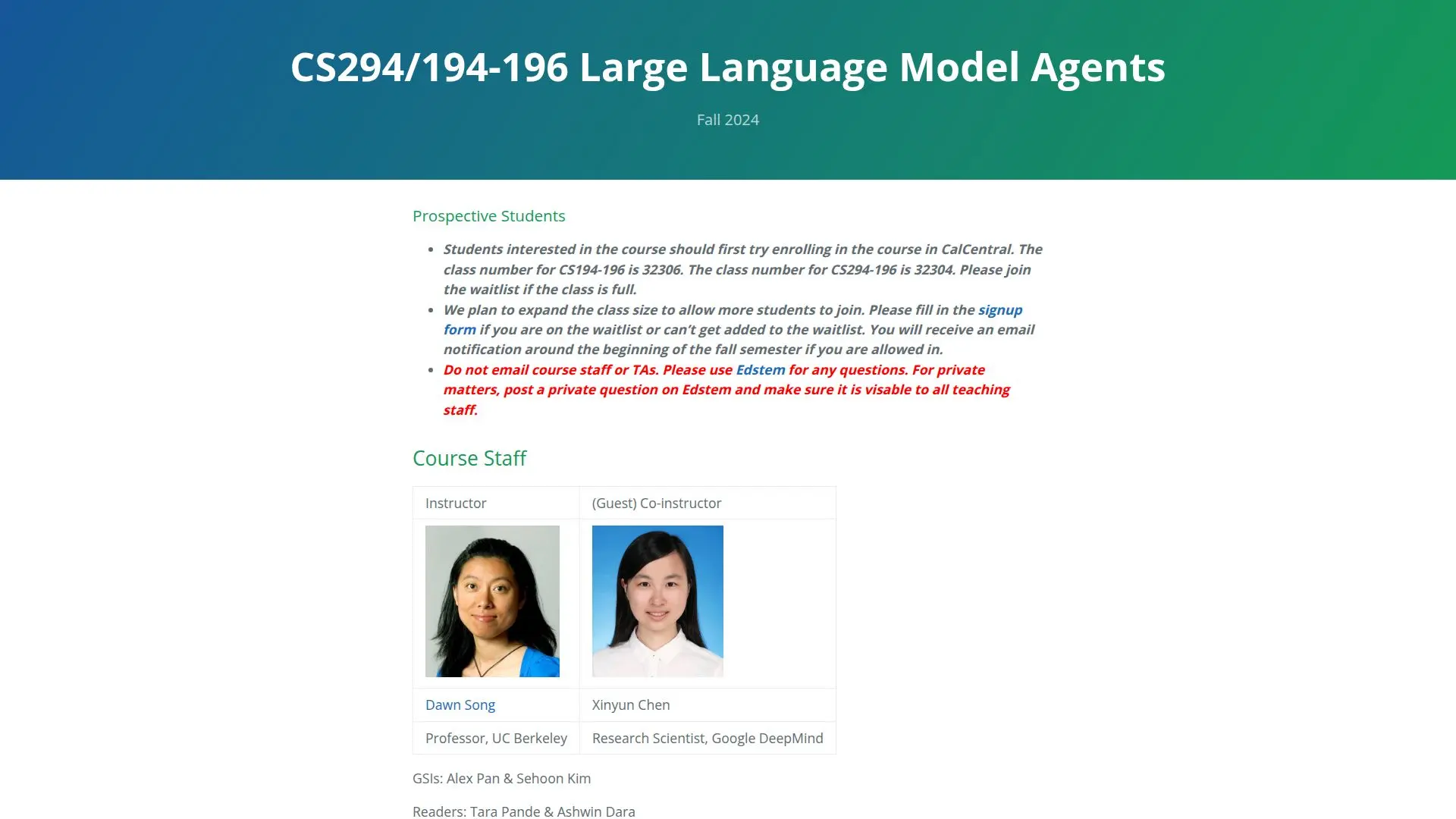
The Large Language Model Agents course offered at UC Berkeley is designed to delve into the revolutionary impact of large language models (LLMs) across various domains. This course focuses on the development of LLM agents, which are poised to transform AI by enabling intelligent task automation and personalization. Students will explore fundamental concepts essential for LLM agents, including the foundation of LLMs, necessary abilities for task automation, and infrastructures for agent development.
Read More
The course covers a wide range of applications for LLM agents, such as code generation, robotics, web automation, medical applications, and scientific discovery. Additionally, it addresses the limitations and potential risks associated with current LLM agents, providing insights into future improvements. Topics include reasoning, planning, tool use, retrieval-augmented generation, multimodal agents, and human-agent interaction.
The course is structured with lectures, guest lectures, and readings that cover various aspects of LLM agents. Students are expected to participate actively and complete assignments based on their enrollment units. The course is suitable for students with a background in machine learning and deep learning, preparing them for the future of AI technology.
- CategoryEducation & Research
Large Language Model Agents Course's Core Features
Foundation of LLMs
Reasoning and planning
Tool use and infrastructure
Retrieval-augmented generation
Code generation and data science
Multimodal agents and robotics
Evaluation and benchmarking
Privacy, safety, and ethics
Human-agent interaction
Multi-agent collaboration
How to use Large Language Model Agents Course?
Enroll: Register for the course via CalCentral
Attend: Participate in lectures and guest lectures
Engage: Complete weekly readings and assignments
Collaborate: Work on projects and labs with peers
Large Language Model Agents Course's Use Cases
- Code Generation
- Robotics
- Web Automation
- Medical Applications
- Scientific Discovery