Description
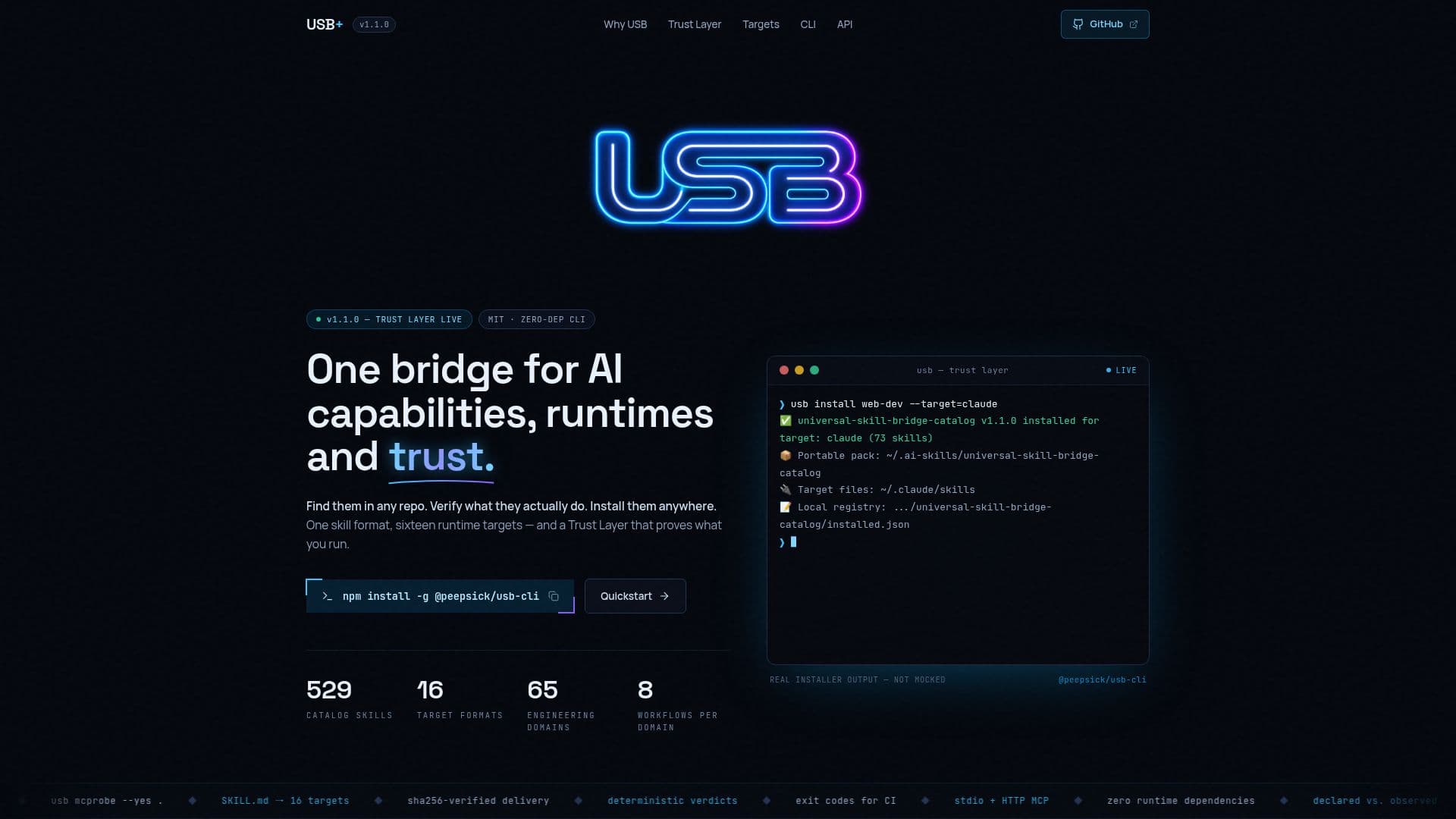
USB+ (Universal Systems Bridge) acts as a crucial link for managing AI capabilities, runtimes, and ensuring trust across diverse environments. It addresses the fragmentation of AI agent capabilities by providing a unified skill format that works with sixteen different runtime targets. This includes 529 catalog skills, spanning 65 engineering domains and offering 8 workflows per domain, making it a comprehensive solution for AI development and deployment.
Read More
The core problem USB+ solves is the lack of a shared unit for installing and reusing AI skills across various runtimes, coupled with the absence of mechanisms to verify what these skills actually do. It consolidates scattered capabilities into one accessible catalog, offering tools like `usb search` and `/api/skills` for discovery. The platform introduces a robust Trust Layer with two distinct commands: `usb secscan` and `usb mcprobe`.
`usb secscan` functions as a Skill Contract Verifier, deterministically checking if a skill's observed capabilities align with its declared contract. It flags any observed capabilities not explicitly declared, providing file:line evidence for every finding. This tool generates a verdict (matches-declaration, purpose-mismatch, excessive-authority, structural-issues, unverifiable) and uses exit codes to gate CI pipelines, ensuring that only new contract violations trigger failures.
`usb mcprobe` offers Runtime Observation, designed to understand what an MCP server actually does upon startup. It finds MCP servers in configurations, completes the protocol handshake (initialize → tools/list → shutdown), and observes capability registrations without ever invoking the tools themselves. This process is dry-run by default and requires interactive confirmation, with reports redacted to protect sensitive information.
USB+ supports both native installations for runtimes like Claude, Cursor, LeoSis, and Hermes, and portable bundles for eleven other targets, eliminating the need for rewrites. The installation process is streamlined, allowing users to install curated presets, entire domains, or single skills, with options to force specific providers or print install scripts without execution. The entire CLI functionality is also exposed via public endpoints, enabling agents, CI pipelines, and scripts to access the catalog, audit data, and install scripts without a Node runtime. This makes USB+ an essential tool for agent engineers, security and platform teams, MCP server authors, framework authors, and auditors seeking verifiable and manageable AI capabilities.
- CategoryAI Agent Builders
- DeploymentCloud, Self-hosted
- PlatformsWeb
USB+ Universal Systems Bridge's Core Features
Universal Skill Format: One format compatible with 16 target runtimes
529 Catalog Skills: Extensive library across 65 engineering domains
Trust Layer: Includes `usb secscan` for contract verification and `usb mcprobe` for runtime observation
Skill Contract Verifier (`usb secscan`): Flags undeclared capabilities with file:line evidence
Runtime Observation (`usb mcprobe`): Observes MCP server behavior without invocation
Zero-Dependency CLI: Command-line interface for skill management and verification
HTTP MCP Server: Public endpoints for catalog, audit data, and install scripts
Native Runtime Installs: Supports Claude, Cursor, LeoSis, Hermes
Portable Bundles: 11 additional target formats for flexible deployment
CI Gate Integration: `usb secscan` exit codes for automated security checks
Interactive Skill Picker: Browse domains, categories, presets, and skills
Offline Skill Removal: Remove installed skills from runtimes with dry-run support
Public API Endpoints: Access catalog, audit, and install scripts programmatically
Redacted Reports: `mcprobe` reports redact sensitive launch lines and env values
Read-Only Repo Cloning: Verifies skills from local paths or Git/GitHub URLs without execution
How to use USB+ Universal Systems Bridge?
Discover Skills: Use `usb search` or browse the public catalog via `/api/skills` to find desired AI capabilities.
Verify Skill Contract: Run `usb secscan` on a skill or MCP config to check if its declared contract matches its observed capabilities, ensuring trust.
Observe Runtime Behavior: Use `usb mcprobe` to find and observe MCP servers in your configurations, understanding their actual startup behavior without execution.
Install Skills: Utilize `usb install` to bridge your machine to the catalog, auto-detecting and installing skills natively into compatible AI runtimes.
Manage Installations: Use the interactive picker to install curated presets, entire domains, or single skills, with options to force specific targets or print install scripts.
Integrate into CI: Implement `usb secscan --baseline` in your CI pipelines to gate deployments, failing only on new contract violations.
USB+ Universal Systems Bridge's Use Cases
- AI Skill Discovery
- Skill Contract Verification
- Runtime Behavior Observation
- Unified AI Skill Installation
- CI/CD Security Gating
- Agent Development
- Security Auditing
- Framework Authoring