
Description
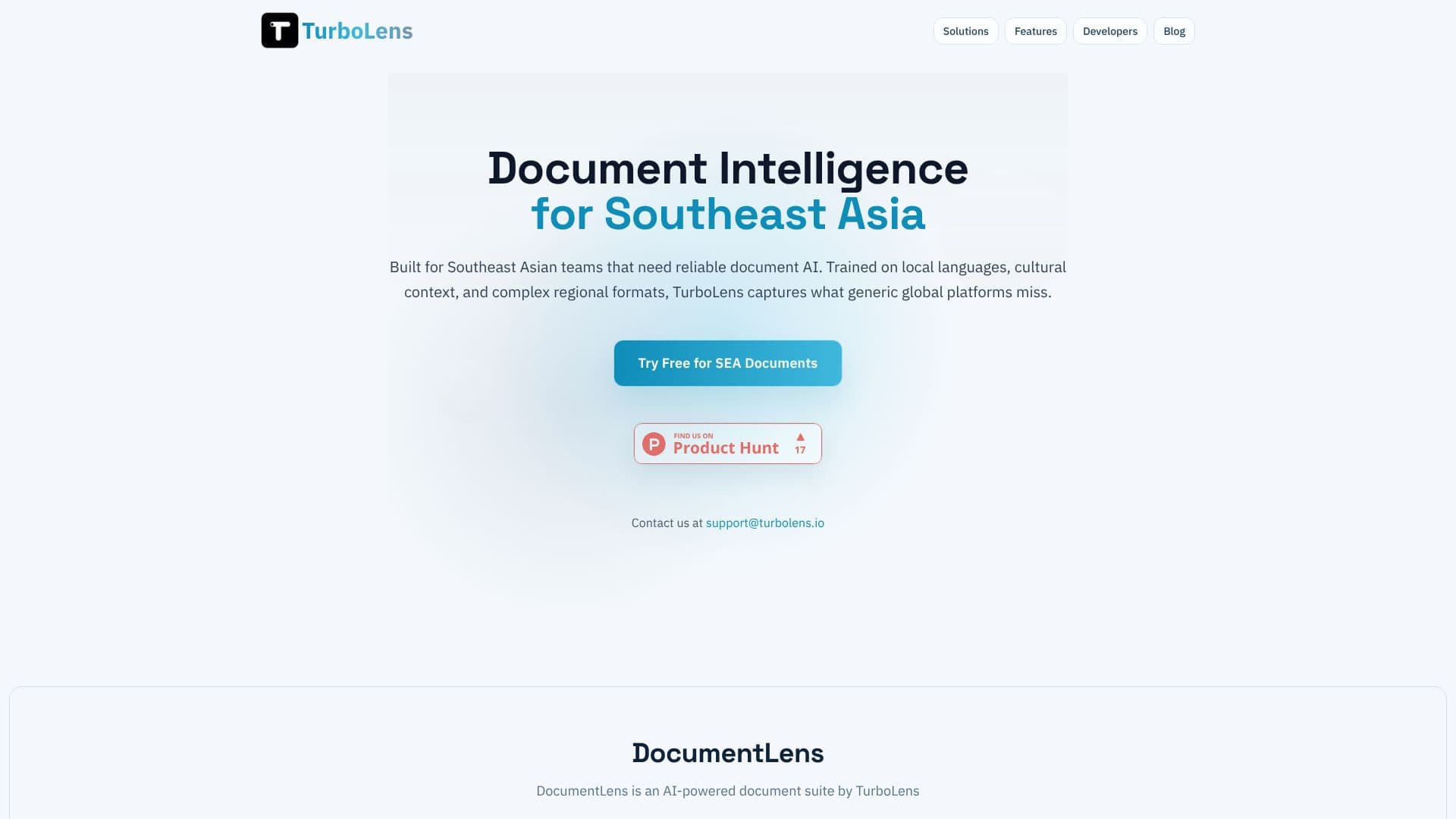
TurboLens now leads with visual forensics: an API that checks whether a submitted image has been manipulated, before it moves into KYC, lending, insurance or other document-processing workflows. Its original specialization, OCR built for Southeast Asian document formats and languages, remains available as a second, connected service.
Read More
The image forgery detection service analyzes an existing image's pixel structure for local manipulation such as splicing, copy-move edits, retouching and altered fields. It returns a real-or-forged verdict, the proportion of tampered pixels, coordinates for suspicious regions, and a visual heatmap that shows a reviewer where an edit likely occurred. TurboLens describes this service as production-ready.
A separate, early-access layer screens whether an image was created or edited by generative AI rather than manipulated by hand. It returns a three-state result, AI-generated, needs review, or likely human-made, with a probability score, designed to support a review workflow rather than issue an automatic accept or reject decision. TurboLens treats forgery detection and AI-image detection as two distinct questions, run and reported separately.
Both checks are meant to run as a single REST API call placed before OCR, extraction or approval, so clean submissions continue automatically while flagged ones are rejected, escalated or queued for human review, with the threshold set by the customer. Once an image passes, TurboLens's document intelligence service extracts structured fields from Southeast Asian invoices, receipts, national IDs and passports, contracts and legal documents, and regional tax or customs forms, built for the specific languages and formats used in the region.
TurboLens is built for teams that need to trust a submitted document image before acting on it: KYC onboarding, catching altered identity documents; lending, spotting manipulated income evidence such as payslips or bank statements; and insurance, checking claim photos and receipts for tampering. It is delivered as an API for developers to integrate rather than as a consumer app, and its AI-generated image detection is explicitly still in early access rather than fully production-ready.
- CategoryFraud Detection
- Pricing ModelContact Us
- DeploymentCloud
- PlatformsWeb
TurboLens's Core Features
Image forgery detection for splicing, copy-move edits, retouching and altered fields
Real-or-forged verdict with tampered-pixel proportion and suspicious-region coordinates
Visual heatmap showing where a likely edit occurred
Early-access AI-generated / AI-edited image detection with a three-state result and probability score
Configurable review routing: accept, reject, escalate or queue for human review
REST JSON API designed to run before OCR, extraction or approval
Specialized OCR for Southeast Asian invoices, receipts and multilingual document layouts
Structured identity-document extraction for Southeast Asian passports and national IDs
Contract and legal-document extraction into structured clauses, parties and dates
Sandbox to test how altered and clean sample images score before integrating
How to use TurboLens?
Get API access: Sign up for TurboLens API credentials.
Submit an image: Send a document page or photo to the API before OCR or approval.
Read the verdict: Check the forgery result, tampered-pixel score and heatmap, or the AI-detection screening result.
Set your thresholds: Decide what your workflow accepts automatically versus escalates for review.
Continue to extraction: Run cleared documents through TurboLens's OCR to pull structured fields.
TurboLens's Use Cases
- KYC document screening
- Lending fraud checks
- Insurance claim review
- Southeast Asian document extraction