Description
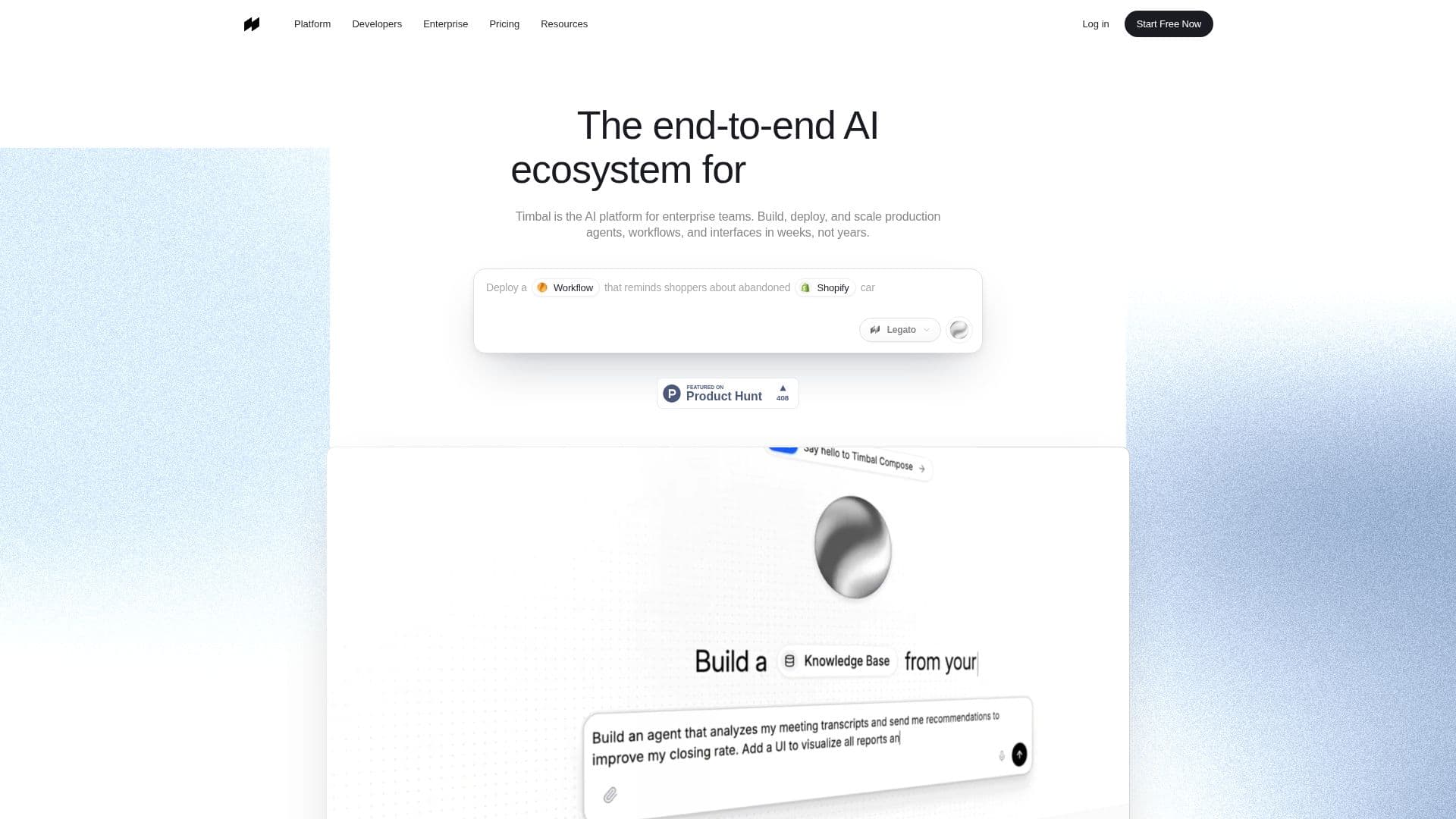
Timbal is the production AI platform that empowers enterprise teams to build, deploy, and govern agents, workflows, and knowledge bases using the models they prefer. With Timbal, users can define behavior in code or through its Studio interface, allowing for seamless integration into various communication channels such as chat, email, voice, and product UIs from a single runtime.
Read More
What sets Timbal apart from other tools like LangChain, Make, or Zapier is its comprehensive production stack. Unlike LangChain, which serves as a framework, or Make and Zapier, which are no-code automation tools, Timbal provides a complete solution. This includes a typed Python framework, a visual Studio for building, a runtime that orchestrates agents and workflows, and governance features for enterprise rollout. Additionally, Timbal integrates smoothly with existing systems, ensuring that teams can leverage their current tools effectively.
Timbal is designed with enterprise deployments in mind. It supports sovereign hosting options, whether in the cloud or on-premise, and allows for customer-owned model API keys. Role-based access controls and full run-level observability ensure that every agent run, tool call, and model invocation is auditable and secure. This level of governance is crucial for enterprises looking to maintain compliance and oversight in their AI operations.
One of Timbal's standout features is its model-agnostic nature. Users can utilize models from OpenAI, Anthropic, Google, Mistral, Meta, or even self-hosted models, switching providers per agent or workflow step without any hassle. This flexibility ensures that teams can adapt to changing needs without overhauling their systems.
Pricing for Timbal is structured to accommodate various users, offering a free tier for individuals and paid plans starting at €25 per month per seat for teams. Custom pricing is available for enterprises requiring specific features such as sovereign hosting or SLAs. Regardless of the plan, users have access to the same agents, workflows, and knowledge bases, paying only for usage and seats rather than for features.
In summary, Timbal is an innovative AI platform that streamlines the development and deployment of AI applications for enterprises. Its robust features, model-agnostic capabilities, and flexible pricing make it an ideal choice for teams looking to harness the power of AI effectively.
- CategoryAI Agent Builders
- Pricing ModelFreemium
- DeploymentCloud, On-Premise
- PlatformsWeb
Timbal's Core Features
Model Agnostic: Yes
Deployment Options: Cloud, On-Premise
Pricing Model: Freemium
Free Tier: Yes
API Available: Yes
Integrations: 100+ native connectors
Role-Based Access Control: Yes
Observability: Full run-level observability
How to use Timbal?
Define behavior: Use code or Studio to set up agents and workflows.
Select models: Choose from various model providers for your agents.
Deploy: Use the single runtime to ship your AI applications to multiple channels.
Monitor: Utilize observability features to track agent runs and tool calls.
Timbal's Use Cases
- Internal Helpdesk Assistant
- Meeting Notes to Action Items
- Recruiting Screen Automation
- Vendor Risk Assessor
- Customer Support Automation