
Description
teneral is an innovative AI agent that embodies an evolutionary design, continuously rebuilding and refining itself through measured generations. Each 'teneral' agent starts from the distilled experience of all previous clones, then evolves independently based on its interactions and environment. The core philosophy behind teneral is to explore how an agent can enhance its capabilities by iteratively reconstructing its own operational framework, with the underlying model remaining fixed while everything around it is subject to change by the agent itself.
Read More
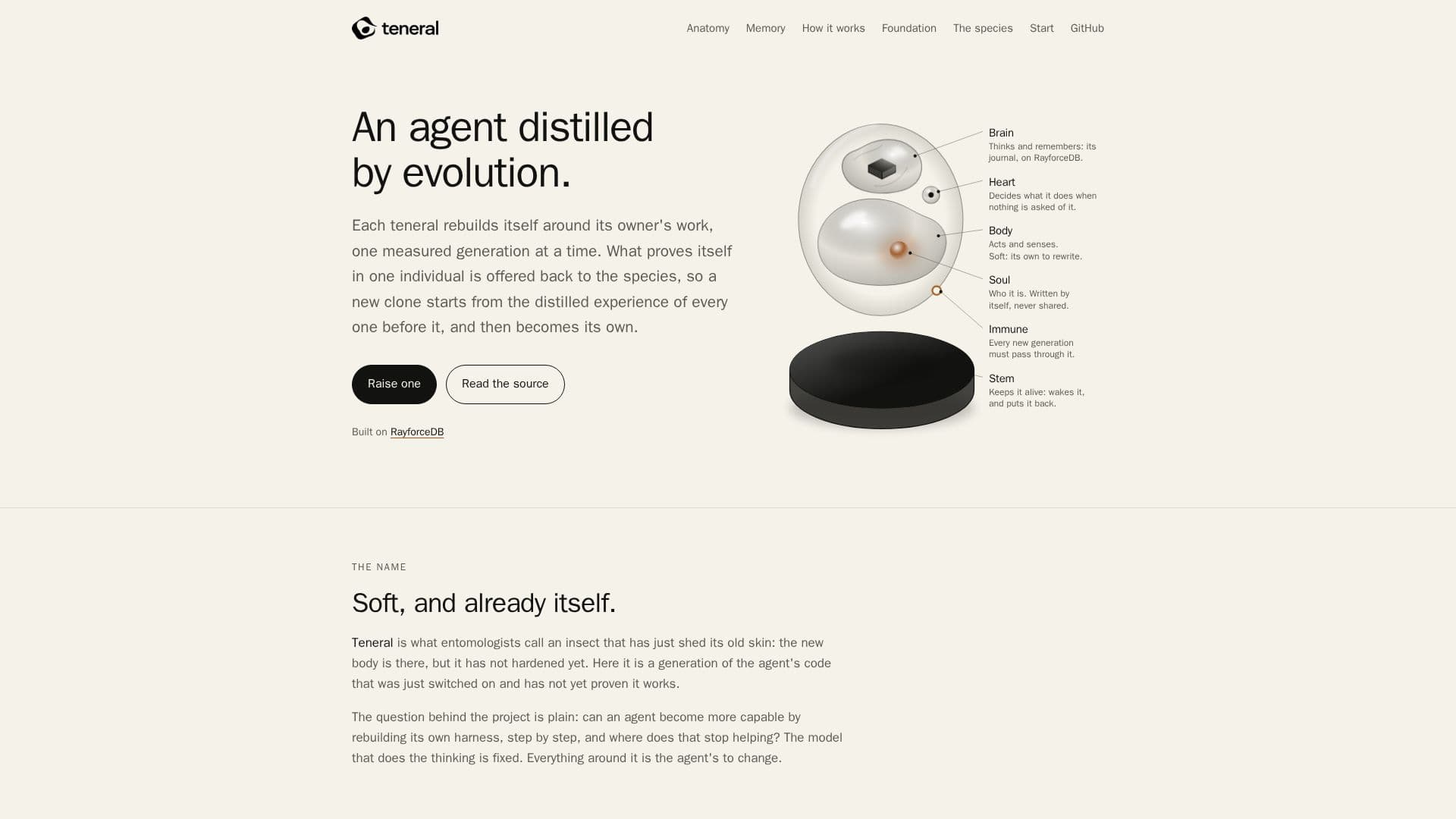
The agent's architecture is structured like an organism, with distinct components: the Brain, Body, Heart, Stem, and Immune system. The Brain handles thinking and memory, including the model it calls, a journal of events, and memory formation. The Body manages actions and senses, encompassing tools, its shell, and communication channels. The Heart drives autonomous actions when idle, such as looking ahead or reviewing its agenda. The Stem is the unsteerable part, responsible for waking, restarting, and rolling back to previous generations if a new one fails. The Immune system governs the acceptance of changes, requiring owner approval and passing gates for each new generation.
One of teneral's most distinctive features is its memory system. Unlike agents that discard old conversations, teneral lives in 'episodes' and forms concise memories of each, in its own words, when idle. Recent events are remembered verbatim, while older memories are briefer. A permanent, unrewritable journal underpins all memories, allowing the agent to search and access any past event. Facts are never changed but replaced by later, sourced facts. The agent also maintains an agenda, ensuring tasks are pursued until completion, and its health status is continuously monitored and reported.
Crucially, teneral's memory is not a separate tool but an integral part of its brain, built on RayforceDB. This SIMD-accelerated columnar database runs as a library within the agent's process, enabling millisecond-fast queries about its past. The journal is organized into daily partitions, with older data mapped from disk and current data held in memory. This foundation ensures stability while the agent's code evolves. The evolutionary process involves the agent editing a copy of itself, committing changes, and requesting mutation. These changes pass through immune gates, including type checks, tests, and owner approval, before being promoted, often on probation.
teneral also supports a 'species' concept, where each individual clone descends from a published main line. Individuals can diverge and evolve independently, but also take updates from the species and offer back beneficial changes as pull requests. This collaborative evolution allows the collective intelligence of the species to grow. The system requires Docker and Git for setup, and once started, the agent runs autonomously, waking to user input, a clock, or messages from other agents. Owners can intervene to approve changes, roll back generations, or pin specific memories, ensuring control over the agent's evolution.
- CategoryAI Agent Builders
- Pricing ModelOpen source
- DeploymentLocal (Docker)
- PlatformsWeb
teneral's Core Features
Evolutionary Self-Rebuilding: Agent continuously rebuilds and refines its own code and harness.
Generational Learning: New clones start with distilled experience from all prior generations.
RayforceDB Foundation: Built on a SIMD-accelerated columnar database for stable, fast memory.
Episodic Memory System: Remembers life in distinct episodes, forming concise memories.
Unrewritable Journal: Maintains a permanent, searchable record of all events.
Idle Memory Formation: Forms memories in its own words when not actively engaged.
Agenda Management: Keeps track of tasks and ideas, pursuing them until completion.
Self-Correction & Rollback: Automatically rolls back to previous generations if a new one fails.
Owner Approval Gates: Requires owner approval for significant changes to its code.
Species Collaboration: Allows individuals to take updates from and offer changes back to a shared species line.
Code Mutation & Testing: Agent edits its own code, commits changes, and passes through immune gates.
Health Monitoring: Continuously monitors and reports its own operational health.
Exam-Based Memory Validation: Sets and answers questions about its memories to validate changes.
Native Dependency Pinning: Ensures consistent execution with specific versions of dependencies.
Docker and Git Integration: Easy setup and management using standard development tools.
How to use teneral?
Set Up Environment: Install Docker and Git on your system.
Initialize Agent: Start teneral for the first time, select a model, and let it read its initial instructions.
Interact with Agent: Communicate with the agent using your words; it will wake and respond.
Approve Mutations: Review and approve proposed code changes or merges from the species using the /approve command.
Monitor Progress: Observe the agent's health and status in the terminal.
Offer Back Changes: Fork the project on GitHub, store a token, and offer beneficial changes back to the species.
Manage Memory: Use /memory to pin stretches of conversation, withdraw facts, or revert to earlier points.
teneral's Use Cases
- Autonomous Agent Development
- Long-Term Memory Systems
- Evolutionary AI Research
- Adaptive Workflow Automation
- Knowledge Management
- Collaborative AI Development
- Robust Agent Deployment