
Description
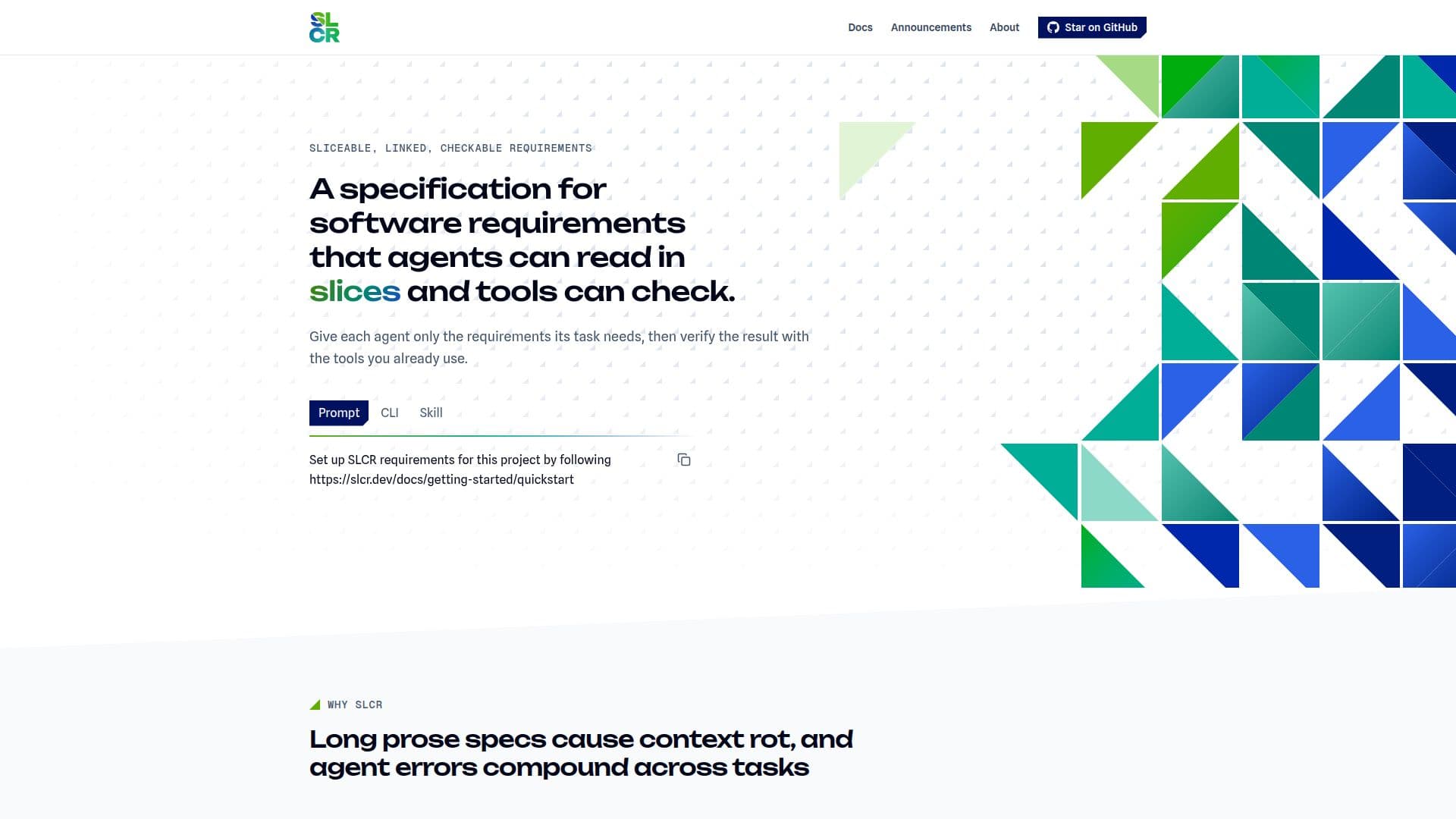
SLCR (Sliceable, Linked, Checkable Requirements) is an open standard designed to revolutionize spec-driven development, particularly for projects involving AI agents. It transforms traditional, long-form prose specifications into structured data that AI agents can efficiently process and development tools can rigorously check. The core problem SLCR addresses is 'context rot,' where large, unstructured specifications lead to agents mixing up or dropping instructions, causing errors to compound across tasks.
Read More
The standard defines software requirements that are 'Sliceable,' meaning an agent receives only the specific requirement and its linked context relevant to its current task, keeping the rest of the specification out of its context window. Requirements are also 'Linked,' allowing them to refine and depend on each other, combining with logical operators like AND, OR, and XOR. Crucially, SLCR requirements are 'Checkable,' with acceptance criteria mapping directly to validators such as tests, linters, browser tests, or agent checks. The `slcr check` command reports on which requirements are met, providing clear feedback.
SLCR makes the specification a first-class artifact in a standard format, serving as a single source of truth for both human developers and AI agents. It supports writing requirements in JSON, TOML, or YAML, complete with acceptance criteria. Developers can then attach validators using any declared tool, linking specific criteria to rules or tests. The `slcr init` and `slcr check` commands facilitate running these checks, allowing teams to verify code against requirements early in the development cycle, even in CI/CD pipelines.
The project includes an open specification with JSON Schemas, satisfaction semantics, and slice rules. A reference command-line interface (CLI) implementation, `slcr`, is built in Rust, and an agent skill teaches AI agents how to write SLCR and use the CLI. SLCR is maintained by Wack, Inc., with a governance model that encourages community contributions and public proposals for changes to the standard. It aims to reduce the need for human intervention in correcting agent-generated code by ensuring clarity and verifiability of requirements.
- CategoryCoding & Development
- Pricing ModelOpen Standard
- DeploymentCLI
- PlatformsCross-platform
SLCR's Core Features
Open Standard for Software Requirements
Sliceable Requirements for AI Agents
Linked Requirements with Dependencies
Checkable Acceptance Criteria
Support for JSON, TOML, YAML Formats
Reference Command-Line Interface (CLI)
Agent Skill for SLCR Integration
Validator Integration with Existing Tools
CI/CD Pipeline Compatibility
Structured Data for Specifications
Versioned Standard for Changes
Public Proposal System for Governance
Documentation for Installation and Concepts
Troubleshooting for Check Failures
Security Vulnerability Reporting
How to use SLCR?
Write Requirements: Define software requirements in JSON, TOML, or YAML, including acceptance criteria.
Attach Validators: Link acceptance criteria to specific tools like tests, linters, or agent checks.
Initialize Project: Use `slcr init` to set up SLCR in your project.
Run Checks: Execute `slcr check` to verify code against requirements and see what's met.
Integrate with CI: Run SLCR checks automatically in your continuous integration system.
Teach Agents: Use the SLCR agent skill to enable AI agents to write and use SLCR.
SLCR's Use Cases
- Spec-Driven Development
- AI Agent Code Generation
- Automated Code Verification
- Continuous Integration Checks
- Documentation for Developers
- Managing Complex Requirements
- Reducing Agent Errors
- Migrating Existing Specs