Description
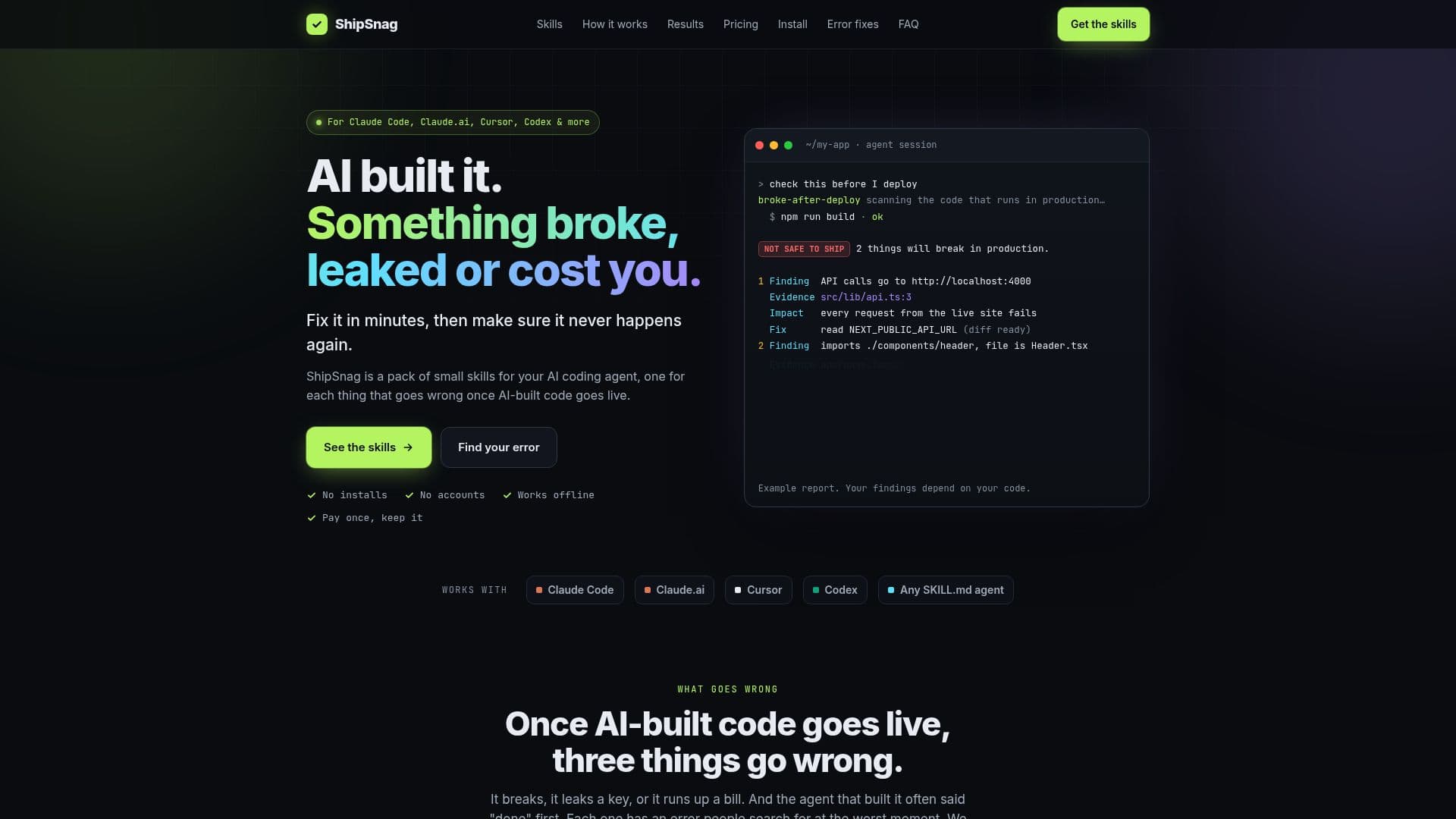
ShipSnag offers a suite of specialized skills designed to address common problems encountered with AI-built code. These skills integrate with various AI agents, including Claude Code, Claude.ai, Cursor, and Codex, by utilizing SKILL.md files and small Python scripts. The core purpose of ShipSnag is to help developers identify and rectify issues such as code breaking after deployment, exposed API keys, or unforeseen cost escalations in cloud services.
Read More
The platform operates by running read-only checks directly on the user's machine, ensuring that no code or secrets leave the local environment. The scripts are built using only the Python standard library and make no network calls, enhancing security and allowing for offline operation. When an issue is detected, ShipSnag provides a clear verdict, evidence (file and line), impact assessment, and a proposed fix. These fixes are presented as diffs and are applied only after explicit user approval, maintaining full control over code changes.
ShipSnag addresses three primary categories of problems: code breakage, key leaks, and bill spikes. For code breakage, it identifies issues like `Module not found` errors, `ECONNREFUSED`, or CORS errors that appear only in production. The Key Leaked skill scans code, Git history, and JavaScript bundles for exposed secrets, offering exact revocation and replacement steps for 19 providers. The Bill Spiked skill pinpoints uncapped calls, loops, and open endpoints that lead to unexpected charges, providing spending-cap checklists.
Additionally, the "Prove It Works" skill ensures that AI agents verify their work by running tests and builds, reporting any failures or rule breaches. The "Ship Check" bundle combines all four skills, offering a comprehensive pre-deployment verification with a single command. ShipSnag emphasizes transparency, providing detailed reports that prioritize the verdict and actionable steps. It also offers a 7-day full refund policy if a skill doesn't meet expectations, underscoring its commitment to user satisfaction.
- CategoryAI Code Review & Testing
- Pricing ModelOne-time purchase
- DeploymentLocal
- PlatformsClaude Code, Claude.ai, Cursor, OpenAI Codex
ShipSnag's Core Features
Integrates with Claude Code, Claude.ai, Cursor, and Codex
Fixes code breakage after deployment
Detects and helps revoke leaked API keys and secrets
Identifies causes of unexpected cloud bill spikes
Verifies AI agent work with tests and builds
Runs read-only checks on local machine
Scripts use Python standard library and make no network calls
Provides fixes as diffs for user approval
Offers exact revocation steps for 19 providers for leaked keys
Includes spending-cap checklists for cloud providers
Generates clear reports with verdict, evidence, impact, and fix
Supports JavaScript, TypeScript, and basic Python web apps
Offers a comprehensive "Ship Check" bundle for all skills
Provides a local saves ledger to track caught issues
7-day full refund policy
How to use ShipSnag?
Download Skill: Obtain the desired skill as a zip file from ShipSnag.
Unzip into Skills Folder: Unzip the skill file into your AI agent's designated skills folder (e.g., ~/.claude/skills/ for Claude Code, ~/.cursor/skills/ for Cursor, ~/.agents/skills/ for Codex). For Claude.ai, upload the zip directly via Settings > Capabilities > Skills.
Start Session: Begin a new session with your AI agent; it will automatically pick up the new skill.
Describe Problem: Describe your problem in plain words, paste an error or alert, or use the skill's specific command (e.g., /ship-check, /broke-after-deploy).
Review Verdict & Fixes: Receive a verdict and detailed report, then approve any proposed code changes presented as diffs.
ShipSnag's Use Cases
- Pre-Deployment Code Check
- Post-Deployment Error Diagnosis
- API Key Leak Detection
- Cloud Bill Spike Prevention
- AI Agent Work Verification
- Secure Secret Management
- CORS Error Resolution
- Environment Variable Configuration