Description
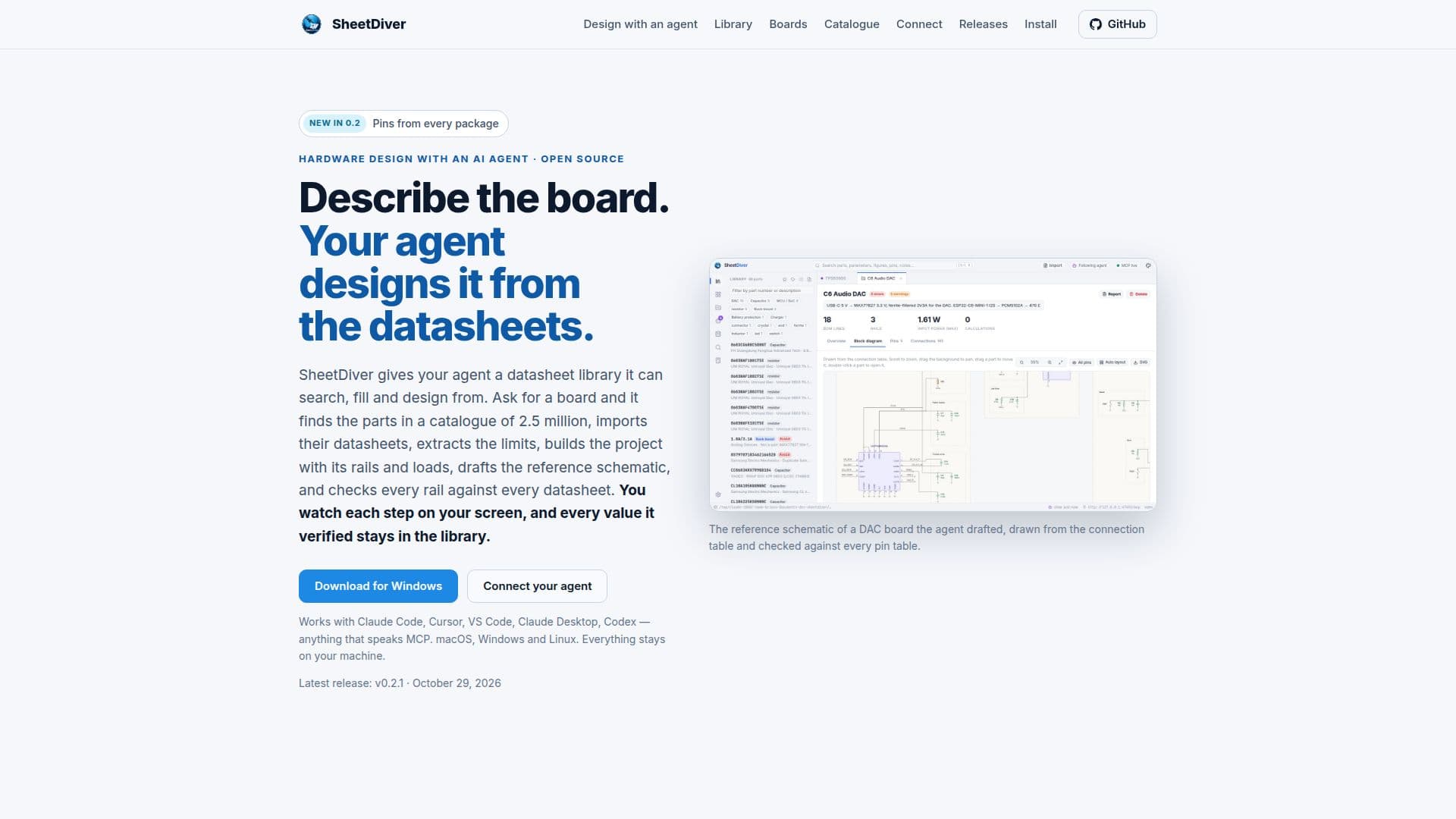
SheetDiver is an open-source desktop application designed to enhance the capabilities of AI agents in hardware design. It provides agents with a robust datasheet library, allowing them to search, fill, and design electronic boards directly from technical specifications. The application integrates a catalog of 2.5 million parts, enabling agents to find components, import their datasheets, and extract crucial parameters such as electrical characteristics and absolute maximum ratings.
Read More
The core functionality of SheetDiver involves a multi-step design process. From a simple textual description of a desired board, an AI agent can initiate a complete design chain. This includes identifying suitable parts, importing and extracting data from their datasheets, building the board project with its power rails and loads, drafting a reference schematic, and meticulously checking every rail against all relevant datasheet limits. Users can observe each step of this process on their screen, and all verified values are stored in the library for future use.
SheetDiver addresses common challenges in AI-driven hardware design by transforming raw PDF datasheets into a structured database. This approach prevents the loss of critical information, such as typical values or measurement conditions, which often occurs when agents process PDFs as plain text. By providing limits as structured data, SheetDiver ensures that every board design is checked consistently and automatically, improving reliability and accuracy. Furthermore, any corrections or learnings made by the agent, such as describing a graph or selecting an inductor, are recorded in the library, making them persistent across sessions and designs.
The application supports various AI agents and editors, including Claude Code, Cursor, VS Code, Claude Desktop, and Codex, through its MCP (Machine Comprehension Protocol) server. It runs locally on macOS, Windows, and Linux, ensuring that all datasheets and designs remain on the user's machine, enhancing privacy and security. Key features include a comprehensive library viewer that allows users to search, sort, compare, and correct datasheet parameters, as well as a comparison tool for finding alternative parts based on specifications. SheetDiver also generates schematics from connection tables, performs power arithmetic, and conducts design reviews, exporting findings as Markdown reports. It includes built-in calculators for common power supply topologies like buck, boost, and LDO converters, which can be filled with values directly from datasheets or project rails.
- CategoryRobotics & AI Hardware
- Pricing ModelFree
- DeploymentDesktop
- PlatformsmacOS, Windows, Linux
SheetDiver's Core Features
Open-source desktop application for hardware design
AI agent datasheet library for searching and design
Access to a 2.5 million part catalog (JLCPCB)
Automated datasheet import and parameter extraction
Builds board projects with rails and loads
Drafts reference schematics from connection tables
Verifies every rail against datasheet limits
Works with Claude Code, Cursor, VS Code, Claude Desktop, Codex
Supports macOS, Windows, and Linux platforms
Local-only operation for data privacy and security
Transforms PDF datasheets into a searchable database
Compares parts side-by-side based on specifications
Generates design review reports in Markdown
Includes calculators for buck, boost, LDO, and other designs
Allows agents to record verified values and learnings
How to use SheetDiver?
Import Datasheet: Drop a PDF or type a part number to extract its data into the local library.
Connect Agent: Add SheetDiver as an MCP server to your AI agent with a single command.
Describe Board: Ask your agent to design a board by describing its requirements in natural language.
Monitor Design: Watch the agent's design process step-by-step on your screen, from part finding to schematic drafting.
Review & Verify: Examine the generated project, schematic, and design checks, making any necessary corrections.
Export Project: Export the complete design review as a Markdown report or the project as a .sdproj file.
SheetDiver's Use Cases
- Automated Hardware Design
- Datasheet Information Extraction
- Component Selection and Comparison
- Schematic Generation
- Design Rule Checking
- Power Supply Design
- Design Documentation
- Local Data Management