Description
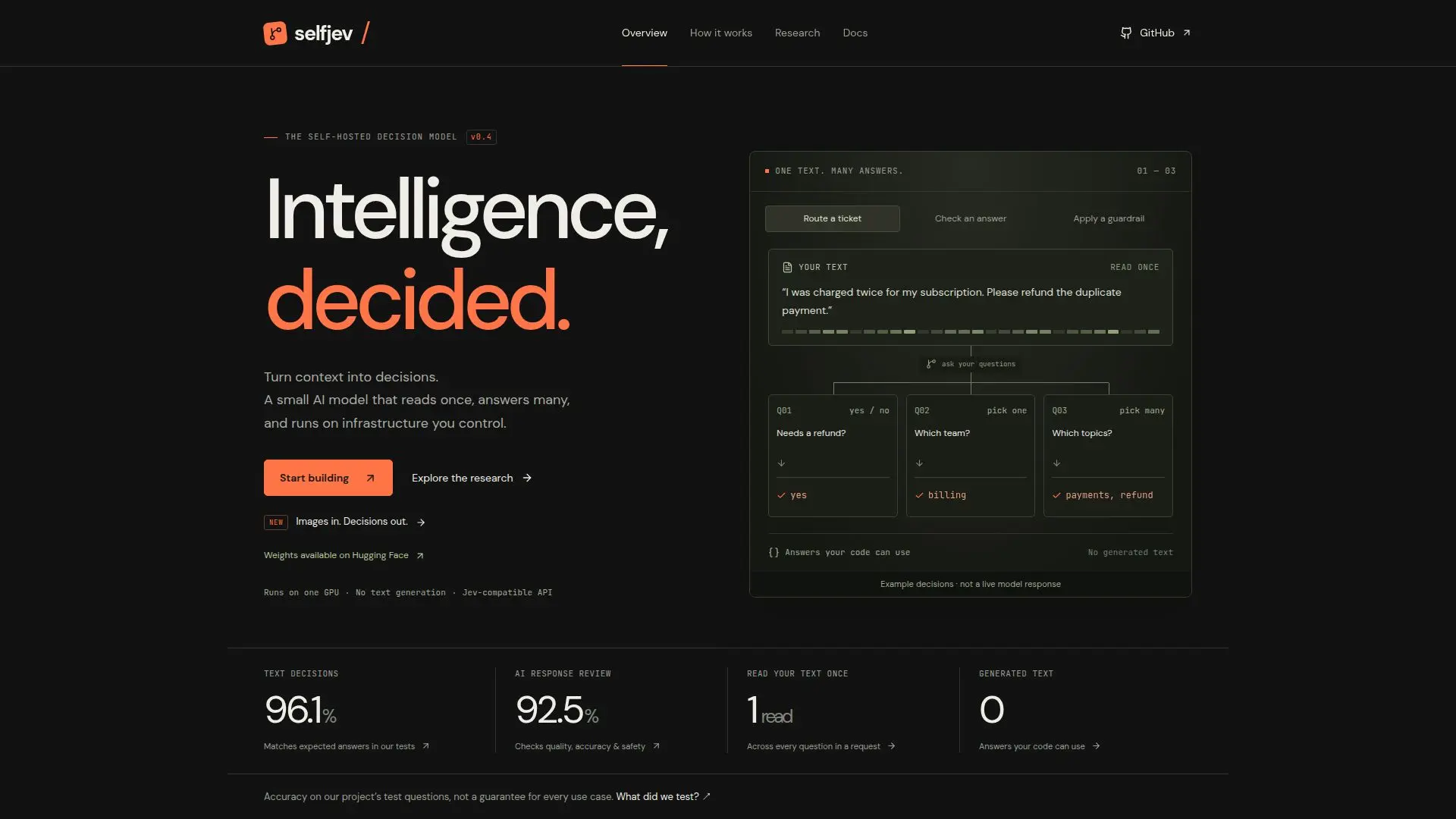
SelfJev is a self-hosted decision model designed to transform context into structured decisions. It operates on a 4B model that reads input once and provides multiple answers, making it efficient for applications requiring quick decision-making. The model supports text and image inputs, allowing users to ask questions about photos and receive structured answers with probabilities.
Read More
One of the key features of SelfJev is its ability to run on infrastructure controlled by the user, ensuring data privacy and security. This makes it suitable for processing sensitive inputs without relying on external model APIs. The model is designed to handle various types of questions, including yes/no, pick one, rate a result, or select all that apply, making it versatile for different applications.
SelfJev also offers fine-tuning capabilities, allowing users to adapt the model to their specific needs. This includes training the model on familiar image kinds and adapting it to unique vocabulary and edge cases. The model supports a large context window, with a default of 32,768 tokens, and can be configured for larger windows if needed.
The platform provides a lightweight Python SDK for easy deployment and integration into existing applications. It supports Docker and AWS deployment, with guides available for Runpod and Google Cloud. SelfJev's architecture is built on a shared-prefix decision tree, ensuring efficient processing of both text and image inputs.
Overall, SelfJev is a powerful tool for organizations looking to implement AI-driven decision-making processes while maintaining control over their data and infrastructure.
- CategoryMachine Learning & Data Science
- Pricing ModelOpen Source
- DeploymentSelf-hosted
- PlatformsLinux
SelfJev's Core Features
Self-hosted decision model
Supports text and image inputs
Typed answers with probabilities
Runs on user-controlled infrastructure
Fine-tuning capabilities
Large configurable context window
Lightweight Python SDK
Shared-prefix decision tree architecture
How to use SelfJev?
Configure: Set up your server with the required specifications
Deploy: Install the SelfJev model and SDK
Integrate: Connect your application to the SelfJev API
Use: Send text or image inputs and receive structured decisions
SelfJev's Use Cases
- Customer Support
- Policy Application
- Image Analysis
- Data Privacy
- Custom Workflows