
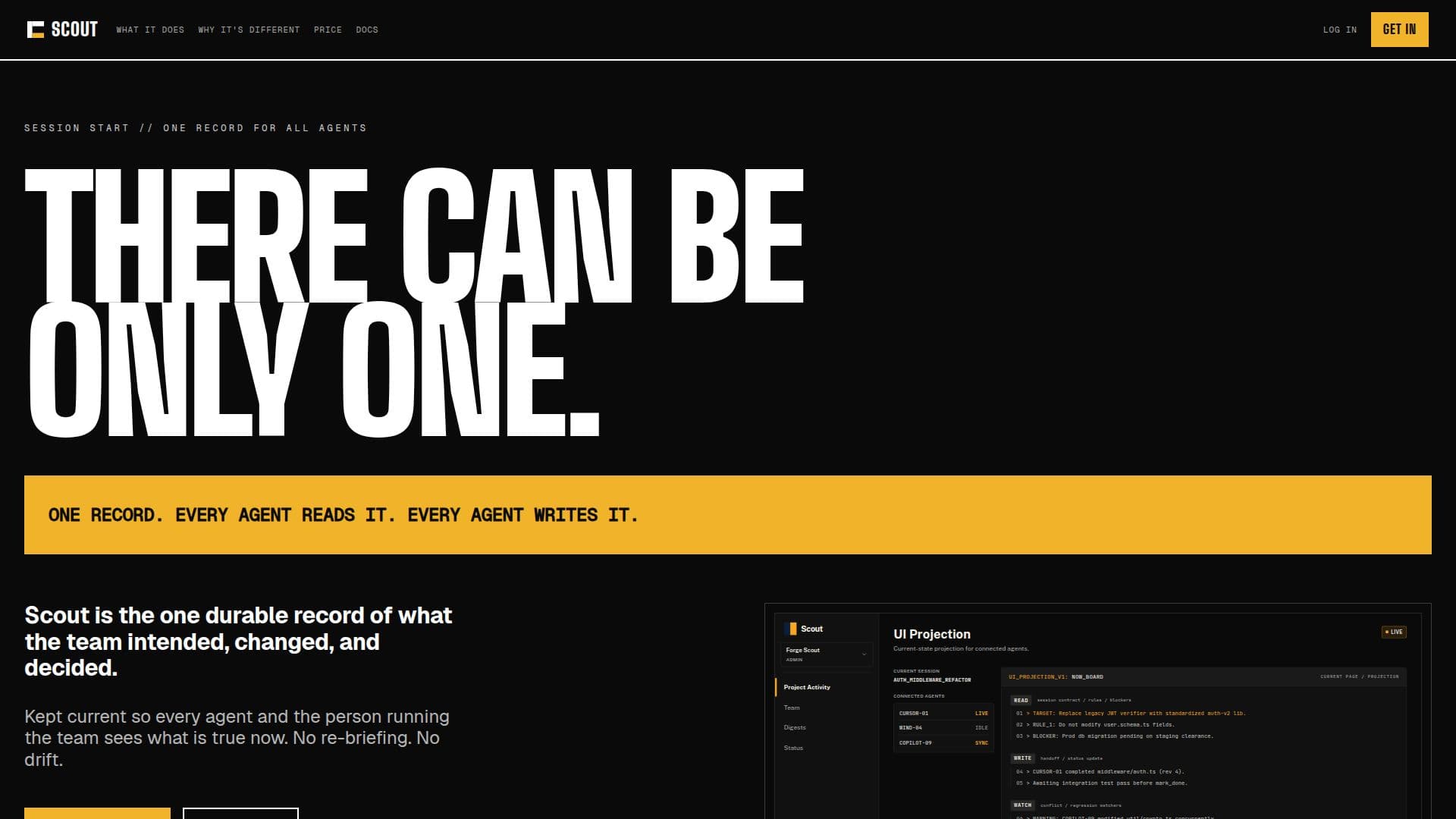
Description
Scout is designed to be the definitive, durable record for development teams utilizing AI agents, ensuring that all agents and human team members operate from a unified and current understanding of project status, intentions, and decisions. It addresses common problems in agentic workflows such as agent amnesia, context bloat, and the need for constant manual re-briefing.
Read More
At its core, Scout maintains one append-only log where agents write their intent as they work and read from it at the start of each session. This mechanism ensures full parity across all agents, preventing them from rewriting each other's work due to a lack of shared knowledge. Instead of dumping entire folders into prompts, Scout provides high-signal, low-noise context injection by feeding only what has changed and why, significantly reducing the risk of models ignoring relevant information or hallucinating non-existent files.
For team leaders, Scout offers the same current page view as the agents, providing transparent insight into active intent, blockers, and decisions as they are recorded. This includes features like the "Now Board" for active intent, "Needs Attention" for flagging stale facts and agent handoff contracts, and a "Morning Digest" delivered via Slack for continuity. This approach eliminates the need to re-explain the state of the repository to AI agents, allowing them to start new prompts with knowledge of previous session outcomes.
Scout is not a coding agent, a shared wiki, a chatbot for your repo, a commit dashboard, or vendor memory. It acts as a durable spine for an AI fleet, connecting to agents via MCP (Multi-Agent Communication Protocol). It keeps every entry but projects only what is currently true to the model, with newest entries winning, contested entries flagged, and unconfirmed entries expiring. This ensures the session bundle remains small and relevant, avoiding the issue of models guessing from outdated information.
Pricing for Scout is set at $14.99 per human developer per month, with unlimited seats per developer, covering multiple IDEs and agents. A 15-day free trial is available, with the first charge on day 15. An annual billing option offers two months free. A startup program is also available for early-stage startups (under $1M raised or $250K annual revenue), providing free access for 12 months for up to 5 developers and 5,000 entries a month. Scout is a managed service, with custom deployment on the roadmap, and export functionality is always available in an open-source tool's file layout, ensuring data is not trapped.
- CategoryAI DevOps & Cloud Tools
- Pricing ModelSubscription
- DeploymentCloud
- PlatformsWeb
Scout's Core Features
One durable, append-only record for all AI agents and team members
Agents read the current state at session start and write intent as they work
Current-state projection feeds only relevant changes to models, reducing context bloat
Eliminates manual re-briefing of AI agents
Provides a unified view of team intent, decisions, and blockers for human managers
Records eight types of entries: Now, Work in progress, Contract, Decision, Lesson, Handoff, Blocker, Rule
Watchers surface attention needs to human managers based on record updates
Connects to agents via MCP (Multi-Agent Communication Protocol)
Integrates with GitHub, Linear, and Slack for notifications and metadata
Export functionality for all workspace data is always available
Audit log of who wrote what, when, and from which tool
Configurable retention windows for entries
Deprecation scan and contract detection for code changes
Managed service with no setup required for session start
How to use Scout?
Sign Up: Create an account on runscout.dev.
Connect Agent: Tell Scout where your agent runs, e.g., add Scout as a connector in Claude Desktop or claude.ai, or create a key and paste a command in a terminal.
Start Session: Your agent automatically reads the team's rules and current state from the Scout record at the beginning of each session.
Work & Write: As agents execute tasks, they update the record with their intent, abandoned paths, new dependencies, and technical debt.
Monitor Progress: Team leaders and members can view the "Now Board," "Needs Attention," and "Morning Digest" to track active intent, blockers, and decisions.
Manage Rules: Update team conventions and rules once in Scout, and all connected agents will read the latest version in subsequent sessions.
Scout's Use Cases
- Unified Agent Context
- Eliminate Re-briefing
- Reduce Context Bloat
- Track Team Intent
- Manage Team Rules
- Facilitate Agent Handoffs
- Identify Stale Facts
- Improve Code Fidelity