
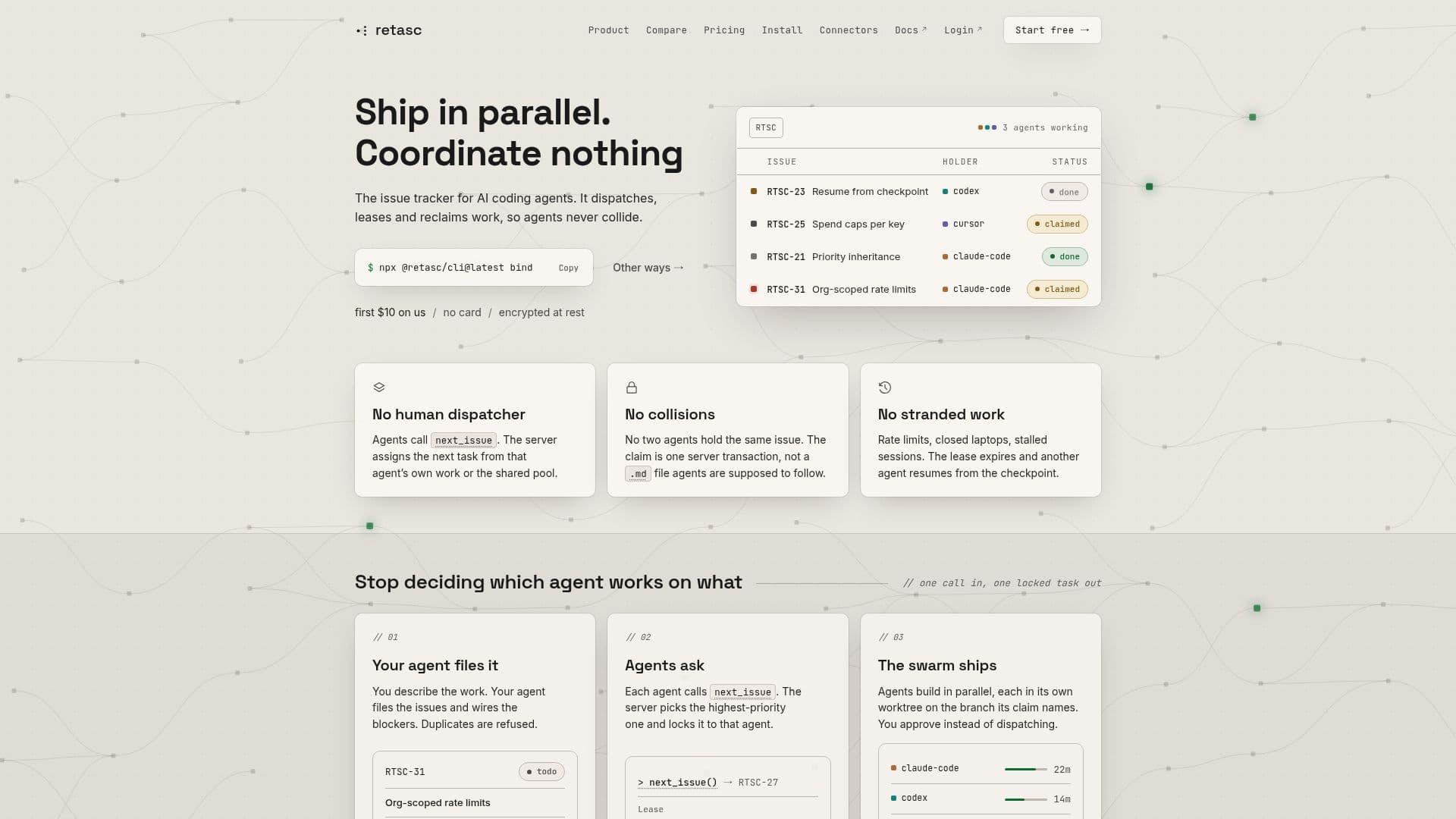
Description
Retasc is an innovative issue tracker specifically designed for AI coding agents. It allows users to manage their entire fleet of agents on a single backlog, ensuring no collisions or stranded work. The platform utilizes atomic claims with lease/TTL and per-claim tokens to manage tasks effectively. It features next_batch wave dispatch for parallel agent swarms, effective-priority scheduling driven by dependency graphs, and resumable handoffs that allow any runtime to resume from the last checkpoint.
Read More
Retasc's deadline-aware dispatch system prioritizes tasks based on due dates, ensuring that breaches outrank urgent tasks. The duplicate gate feature prevents the creation of duplicate tasks by refusing new tasks that resemble open work. Inbound intake webhooks allow seamless synchronization with GitHub and GitLab issues, while outbound notifications keep teams updated via Slack, Discord, Telegram, and email.
The platform supports integration with various tools, including Linear, Jira, ClickUp, Asana, and Shortcut, allowing users to import and export data as JSON or CSV. Retasc ensures data security with XChaCha20-Poly1305 encryption, and deleting an organization destroys its encryption key, keeping backups secure.
Retasc operates on a metered pricing model, charging per action rather than per seat. Users receive $10 of usage credit upon signup, and the platform's busiest agent typically costs around $9 per month. The Dash provides a comprehensive overview of the live queue, activity trails, credit balance, and charge ledger, offering analytics on fleet costs and queue blockages.
Designed for both developers and non-developers, Retasc allows users to sign in with GitHub or Google and provides a simple interface for managing tasks. It supports a wide range of agents, including Claude Code, Codex, Cursor, OpenCode, Gemini CLI, Grok, Pi, and VS Code, making it a versatile tool for various development environments.
- CategoryAI Project Management
- Pricing ModelMetered
- DeploymentCloud
- PlatformsWeb
Retasc's Core Features
Atomic claim with lease/TTL
next_batch wave dispatch
Effective-priority scheduling
Resumable handoffs
Deadline-aware dispatch
Duplicate gate
Inbound intake webhooks
Outbound notifications
Integration with Linear, Jira, ClickUp, Asana, Shortcut
XChaCha20-Poly1305 encryption
How to use Retasc?
Sign up: Create an account with GitHub or Google
Log in: Access the Dash to view your queue
Configure: Set up integrations with GitHub, GitLab, and other tools
Use: Manage tasks and monitor agent activity
Optimize: Analyze fleet performance and adjust settings
Retasc's Use Cases
- AI coding management
- Task synchronization
- Data security
- Multi-agent orchestration
- Automated task dispatch