
Description
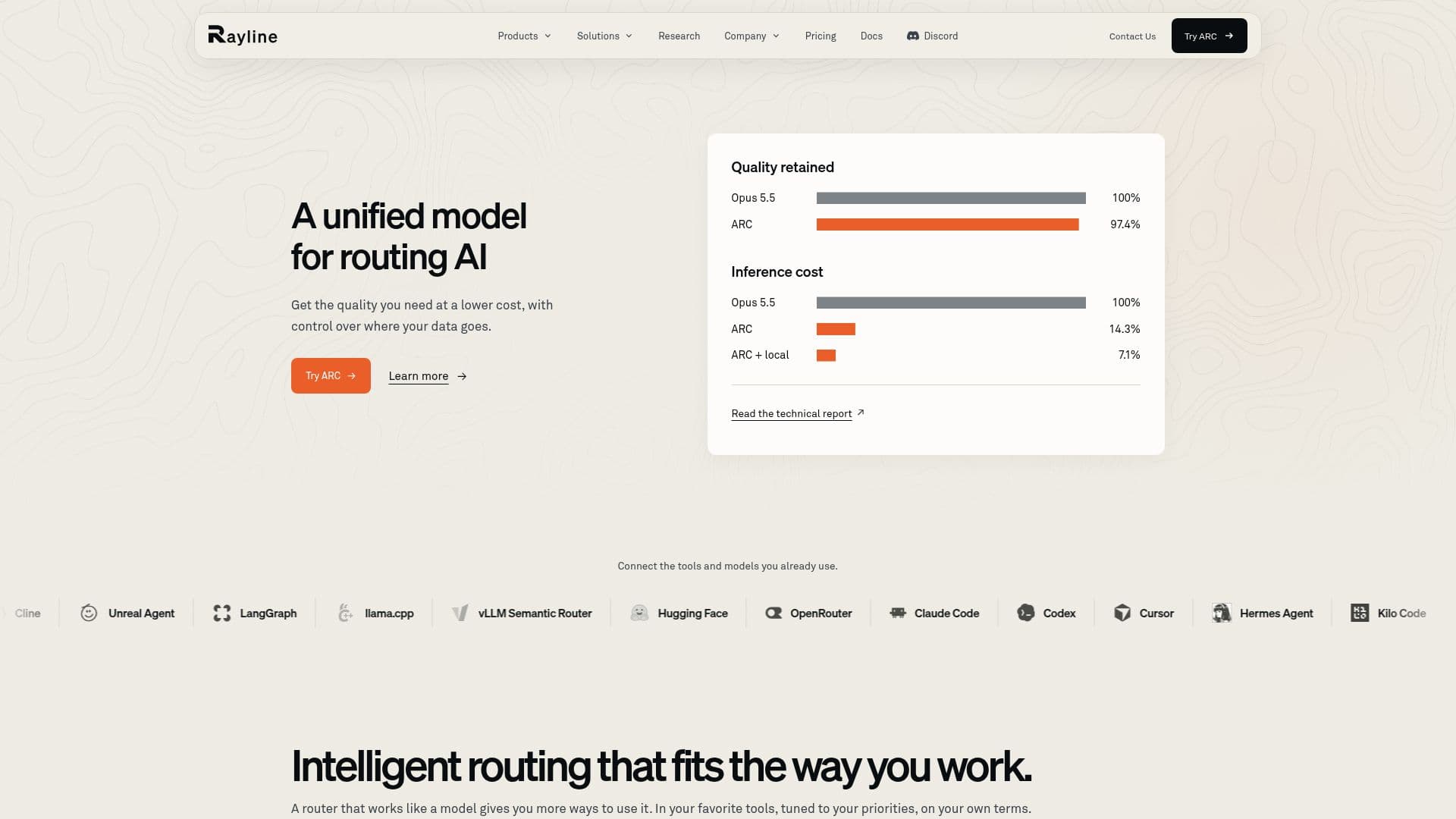
Rayline provides a unified model for routing AI, designed to deliver optimal quality at a lower cost while ensuring users maintain control over their data. At its core is ARC, Rayline’s adaptive routing system that intelligently chooses the most suitable AI model and reasoning level for each conversational turn, based on factors like conversation context, desired quality, and cost.
Read More
The platform seamlessly integrates with a wide array of existing tools and models, including llama.cpp, vLLM, Semantic Router, Hugging Face, OpenRouter, Claude, OpenAI, DeepSeek, GLM, Kimi, Qwen, Gemini, Gemma, and Mistral. This flexibility allows teams to continue working within their familiar environments while benefiting from Rayline’s intelligent routing capabilities. Users can shape ARC's decisions around their specific workload priorities and actual model costs, including any negotiated discounts.
Rayline offers deployment flexibility, allowing users to either let Rayline run inference or take the model recommendation to their own gateway, cloud provider, or local models. The Decisions API provides structured answers, choices, probabilities, and scores from any input, trained specifically for model routing but useful for broader applications. For hosted generation, users can start with ARC Swift or Sage, or utilize the Routes API for self-managed inference.
For developers, Rayline offers Workshop Cloud and Workshop Desktop, enabling the building of production-ready software with adaptive agents. The Rayline CLI connects local models and cloud services, bringing them into existing tools. The platform also boasts significant cost savings, with potential annual savings of up to $108,000 by achieving up to 90% lower inference costs. Rayline's approach is backed by extensive research, detailed in the ARC technical report, which explains the methodology and benchmark results behind its quality and cost balancing.
Rayline offers various pricing models, including fixed-rate presets like ARC Swift for efficient everyday API work and ARC Sage for quality-focused agent tasks. ARC Dynamic provides adaptive model selection with passthrough pricing based on the selected model, incurring 0% commission. The Routes API allows users to pay for model selection and reasoning level, managing their own inference costs. The Decisions API is priced based on input tokens for structured answers. Rayline CLI is open source with no software fee, with hardware and cloud inference billed separately. Contributor models offer lower token rates in exchange for allowing Rayline to use eligible request data for model training.
- CategoryMLOps & Model Deployment
- Pricing ModelFreemium
- DeploymentCloud, Local
- PlatformsWeb
Rayline's Core Features
Unified AI Model Routing (ARC)
Cost-Optimized Model Selection
Data Control and Privacy
Integration with Existing AI Tools and Models
Adaptive Routing based on Priorities
Flexible Inference Deployment (Hosted or Self-Managed)
Decisions API for Structured Answers
Routes API for Model Selection
Workshop Cloud and Desktop for Development
Rayline CLI for Local Model Integration
Significant Inference Cost Savings
Technical Report and Research Backing
Fixed-Rate and Dynamic Pricing Models
Contributor Model Pricing Options
Usage and Spend Tracking Platform
How to use Rayline?
Connect Tools: Integrate existing AI models and tools like Claude, OpenAI, and Hugging Face with Rayline.
Configure Routing: Define your priorities for quality and cost to shape ARC's model selection decisions.
Deploy Inference: Choose to run inference through Rayline's hosted services (Swift, Sage) or manage it on your own infrastructure using the Routes API.
Develop Applications: Utilize Workshop Cloud or Desktop to build production-ready software with adaptive agents.
Monitor and Optimize: Track usage and spend on the Rayline Platform and adjust routing policies for continuous improvement.
Rayline's Use Cases
- Optimizing AI Model Selection
- Reducing Inference Costs
- Integrating Diverse AI Tools
- Developing Adaptive AI Agents
- Ensuring Data Control
- Structured Decision Making
- Customizing Routing Economics
- Evaluating Routing Policies