
Description
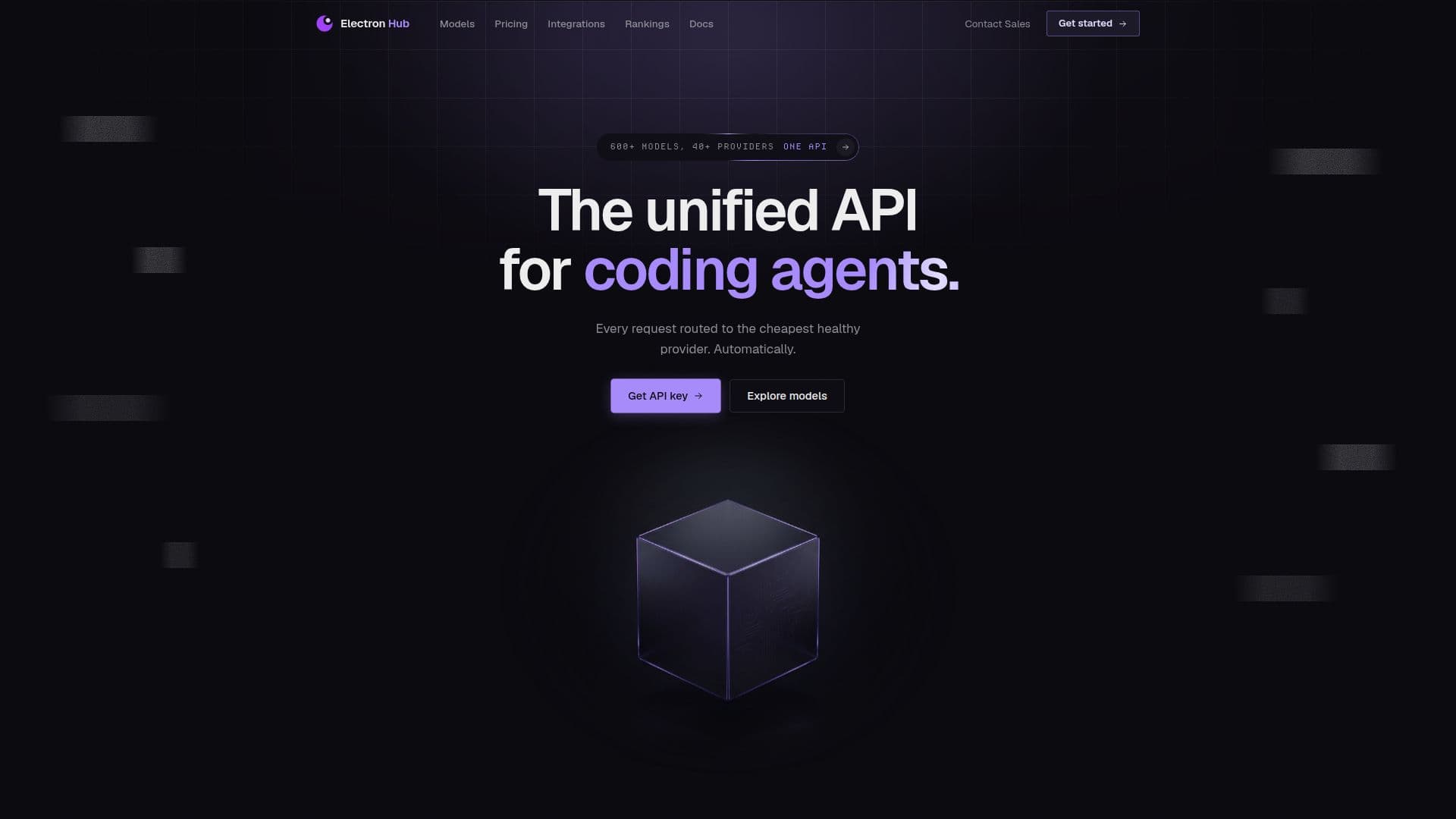
Electron Hub offers a comprehensive API gateway designed to streamline large language model (LLM) inference for developers and businesses. It consolidates access to over 600 models from more than 40 different providers through a single, OpenAI-compatible endpoint. This unified approach eliminates provider lock-in and simplifies the integration process, allowing users to switch models by changing just one string in their code.
Read More
The platform's core functionality revolves around its intelligent router, which automatically directs every request to the cheapest healthy provider based on real-time scoring of price, latency, and health. This ensures optimal performance and cost-efficiency without requiring users to manage complex failover logic or GPU infrastructure. Electron Hub manages the entire inference stack, including the API, runtime for batching and caching, and the underlying GPU fleet, freeing users from operational overhead.
Beyond basic routing, Electron Hub incorporates advanced production-grade features. It includes inline security guardrails such as PII redaction, injection scanning, and policy filters that process requests before they reach the model, ensuring data safety. The system also boasts high availability with multiple upstreams per model and automatic retry mechanisms, turning potential outages into minor blips. Users benefit from detailed cost per request tracking, showing tokens, latency, and spend by key, model, and day.
Electron Hub supports up to 100 scoped API keys, each with individual monthly spending limits, preventing unexpected charges. It ensures rapid access to new models, often within minutes of their release, without requiring any migration efforts. The platform is compatible with any agent or client that speaks OpenAI, allowing seamless integration by simply pointing to `api.electronhub.ai` and selecting a model from the catalog. A central console provides real-time usage, spend, key management, and provider health monitoring, with full export capabilities.
Security and privacy are paramount, with inference optionally running inside hardware-backed Trusted Execution Environments (TEEs). This ensures secrets remain in encrypted memory and every run ships a signed proof of execution. The service is globally distributed, with GPU capacity across the Americas, Europe, and Asia, automatically routing requests to the nearest healthy region for low latency. The system is designed for high throughput, continuously rebalancing millions of requests daily across providers. Users can get started quickly with free weekly credits and no credit card required.
- CategoryMLOps & Model Deployment
- Pricing ModelFreemium
- DeploymentCloud
- PlatformsWeb
Electron Hub's Core Features
Unified API Gateway for 600+ LLM models
Supports 40+ LLM providers
Single OpenAI-compatible endpoint
Automatic provider failover and load balancing
Real-time cost, latency, and health-based routing
Unified billing for all providers
Managed GPU pools and scaling
Inline PII redaction and injection scanning
Policy filters for content moderation
Automatic retry for outages
Detailed cost tracking by key, model, and day
Scoped API keys with monthly spending limits
Rapid integration of new models
Compatibility with OpenAI-speaking agents/clients
Real-time usage and spend console
Hardware-backed TEEs for secure inference
Global GPU capacity for low latency
How to use Electron Hub?
Start with Free Credits: Access weekly credits without a credit card to begin using the platform.
Configure API Endpoint: Point your OpenAI-compatible client or agent to `api.electronhub.ai` as the base URL.
Select Models: Choose from 600+ models across 40+ providers by changing a single string in your configuration.
Integrate with Tools: Drop Electron Hub into tools like Cursor, Cline, Zed, or Aider by editing the OpenCode config.
Monitor Usage: Use the central console to track usage, spend, manage keys, and view provider health in real time.
Electron Hub's Use Cases
- LLM Inference Routing
- Unified API Access
- Cost Optimization
- Enhanced Security
- High Availability
- Developer Productivity
- Agent Runtime
- Model Experimentation
- Usage Monitoring
- API Key Management