
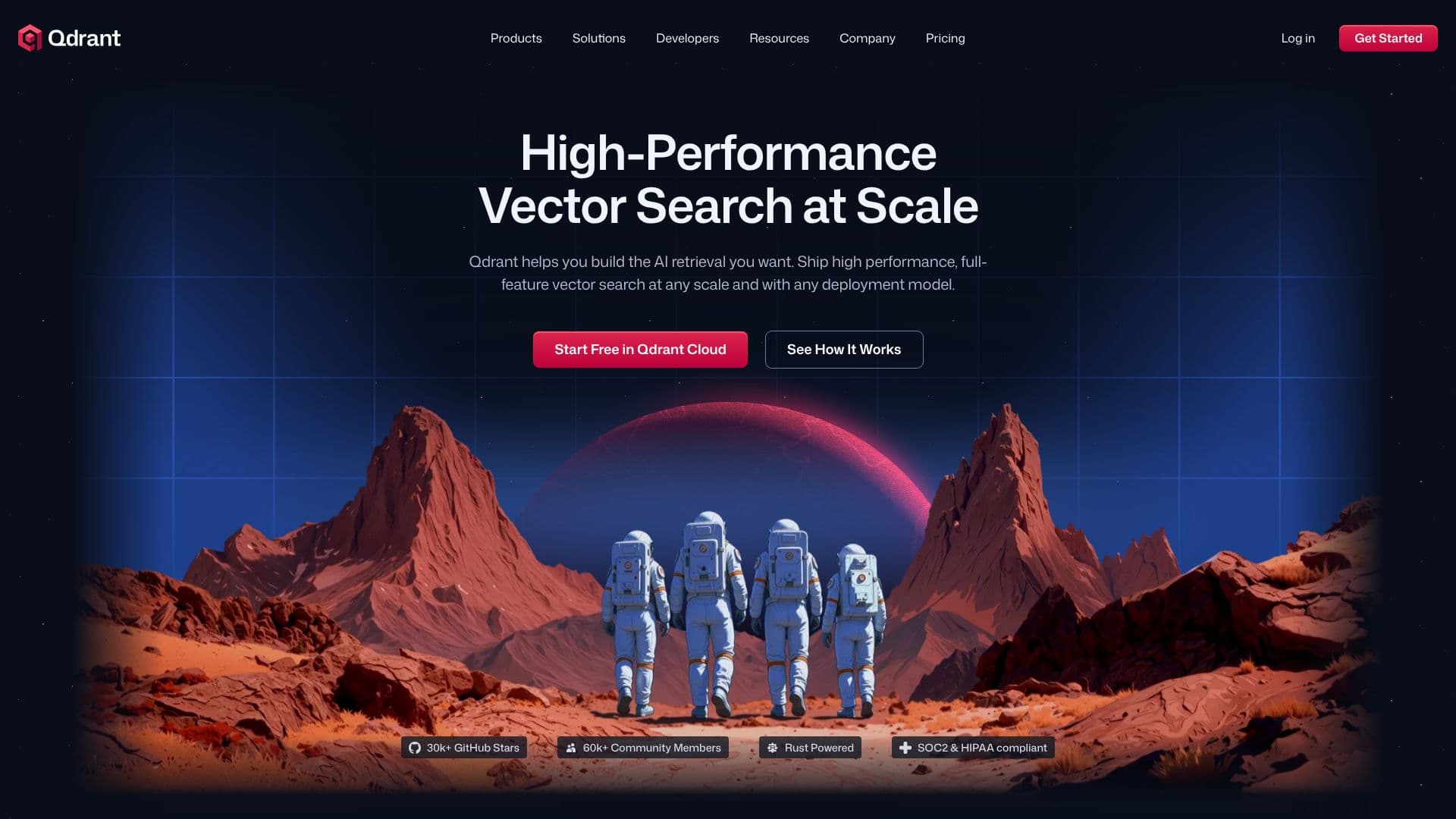
Description
Qdrant is a powerful, open-source vector search engine engineered in Rust to provide high-performance and scalable vector similarity search. It is designed to empower developers in building sophisticated AI retrieval systems that demand speed, accuracy, and flexibility at any scale. Qdrant offers a production-grade solution for AI search, supporting diverse deployment models from cloud to edge.
Read More
At its core, Qdrant excels in real-time retrieval, leveraging an efficient architecture for low latency and high recall. It features expansive metadata filtering, allowing users to store metadata in JSON and apply advanced filters, including nested, text, and geo queries. The engine also supports native hybrid search, seamlessly blending keyword and vector search using dense or sparse vectors, with compatibility for algorithms like BM25 and SPLADE++.
Qdrant introduces multivector capabilities, enabling more expressive and multimodal retrieval by supporting multiple vectors per object. Its efficient, one-stage filtering is applied during HNSW traversal, avoiding pre- or post-filtering bottlenecks. Furthermore, Qdrant provides full-spectrum reranking options, allowing for score boosting, late interaction models for token-level precision, and result diversification through Maximum Marginal Relevance (MMR).
The platform is built for enterprise-grade deployment, offering flexibility to run on-premise, in hybrid setups, at the edge, or via Qdrant Cloud. Qdrant Cloud is a fully managed service available on AWS, GCP, or Azure, featuring high availability and auto-sharding. Hybrid Cloud and Private Cloud options provide greater control over infrastructure and data, while Qdrant Edge (Beta) offers lightweight, low-latency search close to data sources.
Engineered for builders, Qdrant provides intuitive APIs and built-in tools, including a web UI for exploration and visualization. It integrates with leading AI tools and frameworks, supporting use cases such as RAG & GenAI, AI Agents, Semantic Search, Recommendation Systems, and Data Analysis. The engine's performance is a result of its Rust-based architecture, SIMD optimizations, and a custom storage engine, ensuring efficient memory usage and real-time indexing.
- CategoryVector Databases & Retrieval
- Pricing ModelOpen Source
- DeploymentCloud, Hybrid, Private, Edge
- PlatformsWeb
Qdrant Vector Search Engine's Core Features
High-performance vector search at scale
Open-source, written in Rust
Expansive metadata filtering with JSON support
Native hybrid search (dense + sparse vectors)
Built-in multivector support
Efficient, one-stage filtering during HNSW traversal
Full-spectrum reranking capabilities (score boosting, MMR)
Multiple deployment options: Cloud, Hybrid, Private, Edge
Real-time indexing without full index rebuilds
Memory-efficient storage for billions of vectors
Asymmetric, Scalar, and Binary Quantization for memory reduction
Developer-friendly APIs (REST, gRPC, official clients)
Built-in Web UI and visualizations
Native cloud inference for embeddings
How to use Qdrant Vector Search Engine?
Explore Documentation: Understand Qdrant's architecture and capabilities.
Choose Deployment: Select Qdrant Cloud, Hybrid Cloud, Private Cloud, or Edge.
Integrate API: Connect your application using REST, gRPC, or official clients.
Index Vectors: Add your data vectors and associated metadata.
Configure Filters: Implement advanced metadata filtering for precise retrieval.
Perform Searches: Execute vector similarity searches with hybrid and reranking options.
Optimize Performance: Fine-tune settings for speed, accuracy, and scale.
Qdrant Vector Search Engine's Use Cases
- RAG & GenAI
- AI Agents
- Semantic Search
- Recommendation Systems
- Data Analysis
- Image Search
- Natural Language Processing