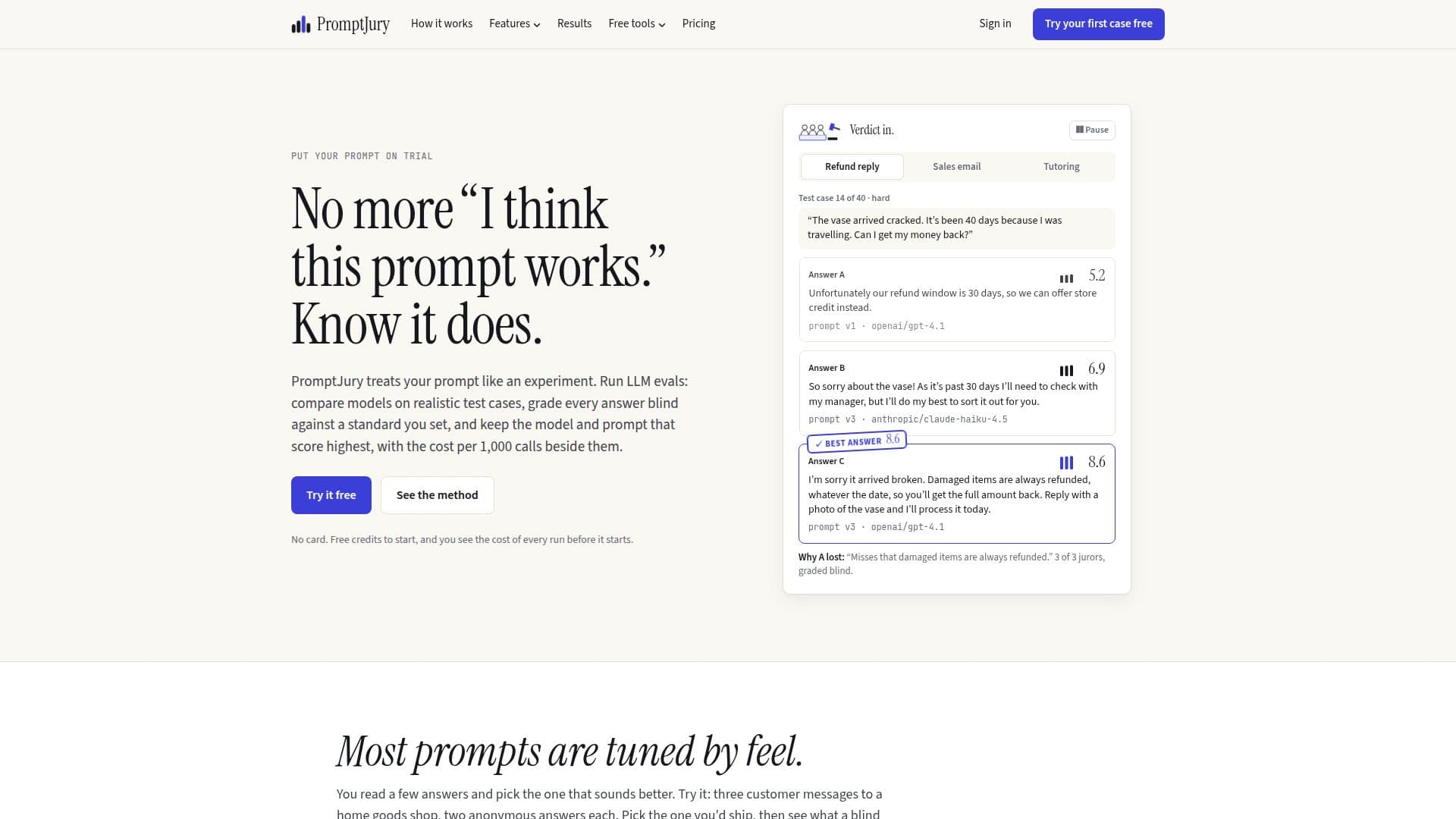
Description
PromptJury offers a comprehensive platform for evaluating Large Language Models (LLMs) and prompts, designed to help users make data-driven decisions about their AI applications. The service allows individuals and teams to run LLM evaluations on their custom prompts, comparing models like GPT, Claude, and Gemini on blind-graded test cases. This process reveals which model and prompt combinations achieve the highest scores and what each option costs, providing a scientific approach to prompt engineering.
Read More
Unlike developer-centric evaluation platforms that require SDKs, custom configurations, and user-provided test sets, PromptJury streamlines the entire evaluation workflow. It automatically generates grading guides and test cases, drafts rival prompts, and conducts blind grading using a diverse jury of models from various makers. The platform then delivers a clear recommendation, including the winning prompt, model, and its associated cost, all without requiring any coding expertise.
PromptJury ensures the scientific rigor of its evaluations by establishing a clear definition of a "good answer" before any scoring begins. Every prompt and model is subjected to the same set of test cases, and grading is performed blindly. Each score is presented with a range, allowing users to accurately assess the impact of any changes made to their prompts or models. The system addresses concerns about AI grading AI by ensuring that the grading standard is user-approved, multiple models from different makers grade answers without knowing the source, and no model grades its own output. The median score from three or more graders prevents bias from a single harsh or generous juror.
Users can compare any chat model available on OpenRouter's live list, including offerings from OpenAI, Anthropic, Google, xAI, DeepSeek, and Mistral. The platform also helps identify cheaper models that perform comparably to top contenders, providing a "value pick" alongside the winner. This includes cost-per-1,000-calls data and potential monthly savings based on user-defined call volumes. New accounts receive 200 free credits to run an initial evaluation without requiring a credit card, with paid plans starting at $25 per month. The service does not require API keys, SDKs, or an OpenRouter account, as all model calls are managed through PromptJury's own OpenRouter account and paid with user credits. The platform supports subjective outputs by allowing users to define quality dimensions with written examples for scoring. Users can also upload their own test cases via CSV or JSONL files or edit the system-generated ones. PromptJury explicitly states that it does not train on user prompts or data, ensuring privacy and control over user content.
- CategoryPrompt Engineering Tools
- Pricing ModelFreemium
- DeploymentCloud
- PlatformsWeb
PromptJury's Core Features
LLM Evaluation Platform
Compare GPT, Claude, Gemini, and other models
Blind-graded test cases
Automated test case generation
Automated grading guide creation
Drafts rival prompts
No-code evaluation process
Cost per 1,000 calls displayed
Identifies value pick (cheapest good model)
Supports subjective output grading
Upload custom test cases (CSV, JSONL)
No API key or SDK required
Does not train on user data
Scheduled regression tests (retrials)
Private verdict reports
How to use PromptJury?
Describe Task: Define the goal of your AI and its audience in two sentences.
Create Grading Guide: Approve what a great answer looks like, dimension by dimension, with a scale for each.
Generate Competing Prompts: Allow models to draft rival prompts and critique each other against your grading guide.
Gather Test Cases: Use system-generated realistic inputs or upload your own CSV/JSONL file.
Run Blind Trial: Every prompt and model answers every test case, with a separate panel grading answers blindly.
Review Verdict & Improve: Get the best prompt and model, with proof and suggestions for further improvement.
PromptJury's Use Cases
- Prompt Optimization
- Model Comparison
- Quality Assurance
- Cost Efficiency
- Subjective Output Grading
- Regression Testing
- Client Reporting
- AI Feature Development