Description
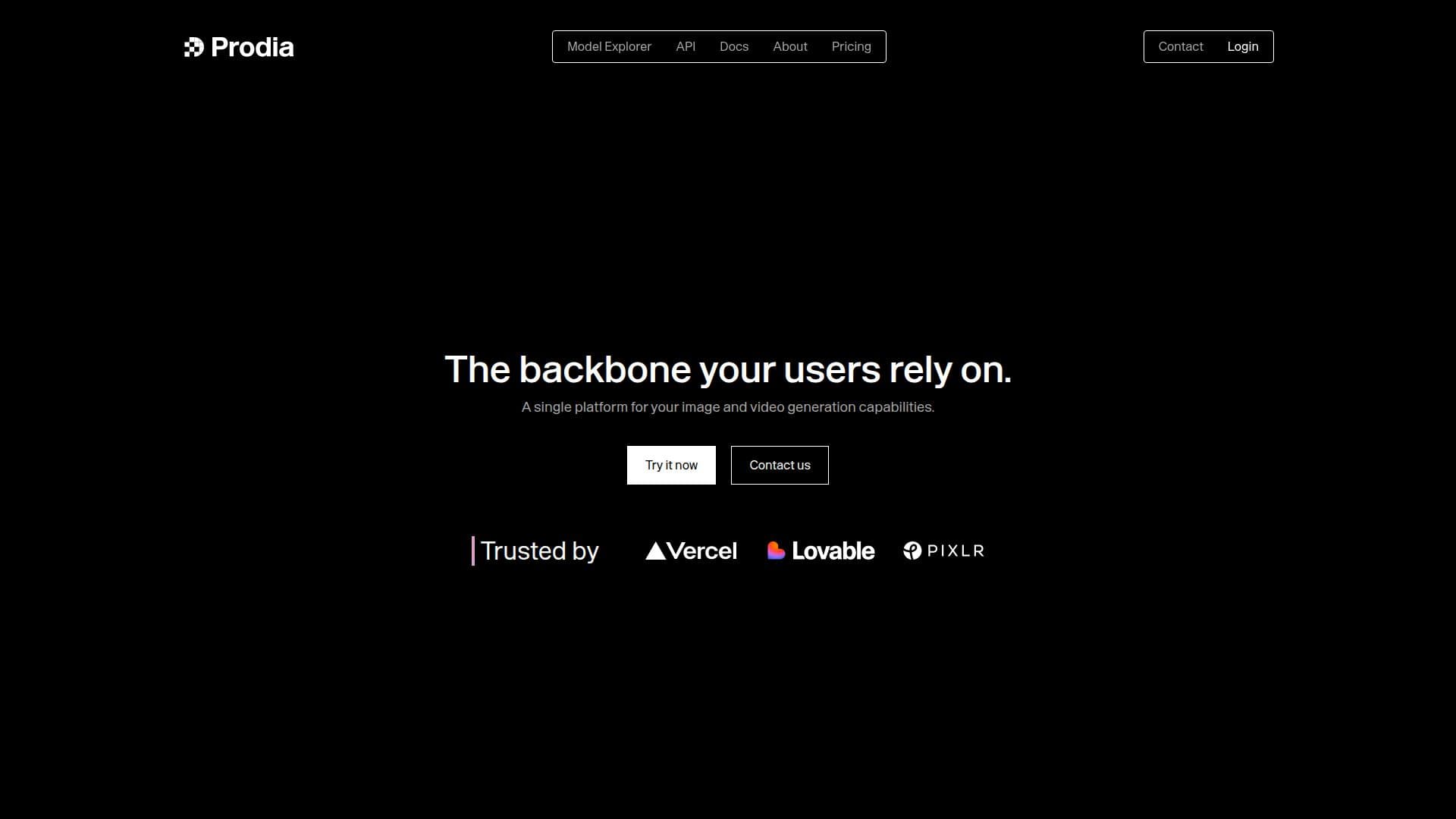
Prodia is an inference platform that gives developers a single API for generating and transforming images and video across a wide range of AI models. Rather than building a consumer-facing generation app, Prodia positions itself as infrastructure: other products call its API to add image or video generation to their own interfaces, and its current homepage describes the company's focus as optimizing implementations of AI models across different hardware for the best balance of cost, quality, and performance.
Read More
A request is submitted as a job, for example a JSON body naming a job type such as "inference.flux-fast.schnell.txt2img.v2" with a prompt in its config, sent to the inference API with a bearer token; the response can come back directly or be polled asynchronously for longer video jobs. Prodia's documentation lists dozens of specific job types across image models (the FLUX family including FLUX.2 and FLUX Kontext, Recraft V4, SDXL, Nano Banana, and Gemini image models) and video models (Kling, Seedance, Seedream, Minimax H3, LTX 2.5, Wan, and others), covering text-to-image, image-to-image, inpainting, background removal, face restoration, upscaling, vectorizing, and text-to-video or image-to-video generation.
Beyond single-model calls, Prodia documents multi-step workflows, such as generating an image with moderation applied, producing a product shot with a transparent background, or generating a still hero frame and then animating it into video. It also integrates with Cloudflare Workers for edge deployment. The company lists Lovable, Vercel, Pixlr, and Kapwing as users of its API, and recent updates on its site focus specifically on new video models, including Wan 2.2, Minimax H3, and a pareto-optimal LTX 2.5 release.
Prodia is built for developers and product teams embedding generation into their own applications, not for people looking for a standalone image or video generator to use directly. Its public site does not list specific per-generation prices, so anyone evaluating cost needs to check the account console directly. The company is small, with a handful of named engineering and infrastructure leads and backing from investors including Dragonfly Capital and individuals such as Guillermo Rauch and Thomas Wolf.
- CategoryAI Video Generators
- Pricing ModelPay-per-generation
- DeploymentCloud
- PlatformsCloud
Prodia's Core Features
Single job-based API for both image and video generation
Access to dozens of models including the FLUX family, Recraft V4, SDXL, Kling, Seedance, Seedream, and Wan
Text-to-image, image-to-image, and inpainting endpoints
Text-to-video and image-to-video endpoints across multiple video models
Background removal, face restoration, upscaling, and vectorizing jobs
Image and video segmentation and classification jobs
Multi-step workflows such as moderation, transparent product shots, and image-then-animate
Async job polling and per-job cost tracking
Cloudflare Workers integration for edge use
How to use Prodia?
Get an API token: Create an account and generate a Prodia bearer token.
Pick a job type: Choose a model and task from the docs, such as flux-fast.schnell.txt2img.
Submit a job: POST the job type and config, like a text prompt, to the inference API.
Handle the response: Read the returned image or video directly, or poll the async endpoint for longer video jobs.
Chain workflows if needed: Combine jobs, such as generating an image then animating it, using Prodia's documented workflow patterns.
Prodia's Use Cases
- In-app image generation
- In-app video generation
- Ecommerce product visuals
- Edge-deployed generation