
Description
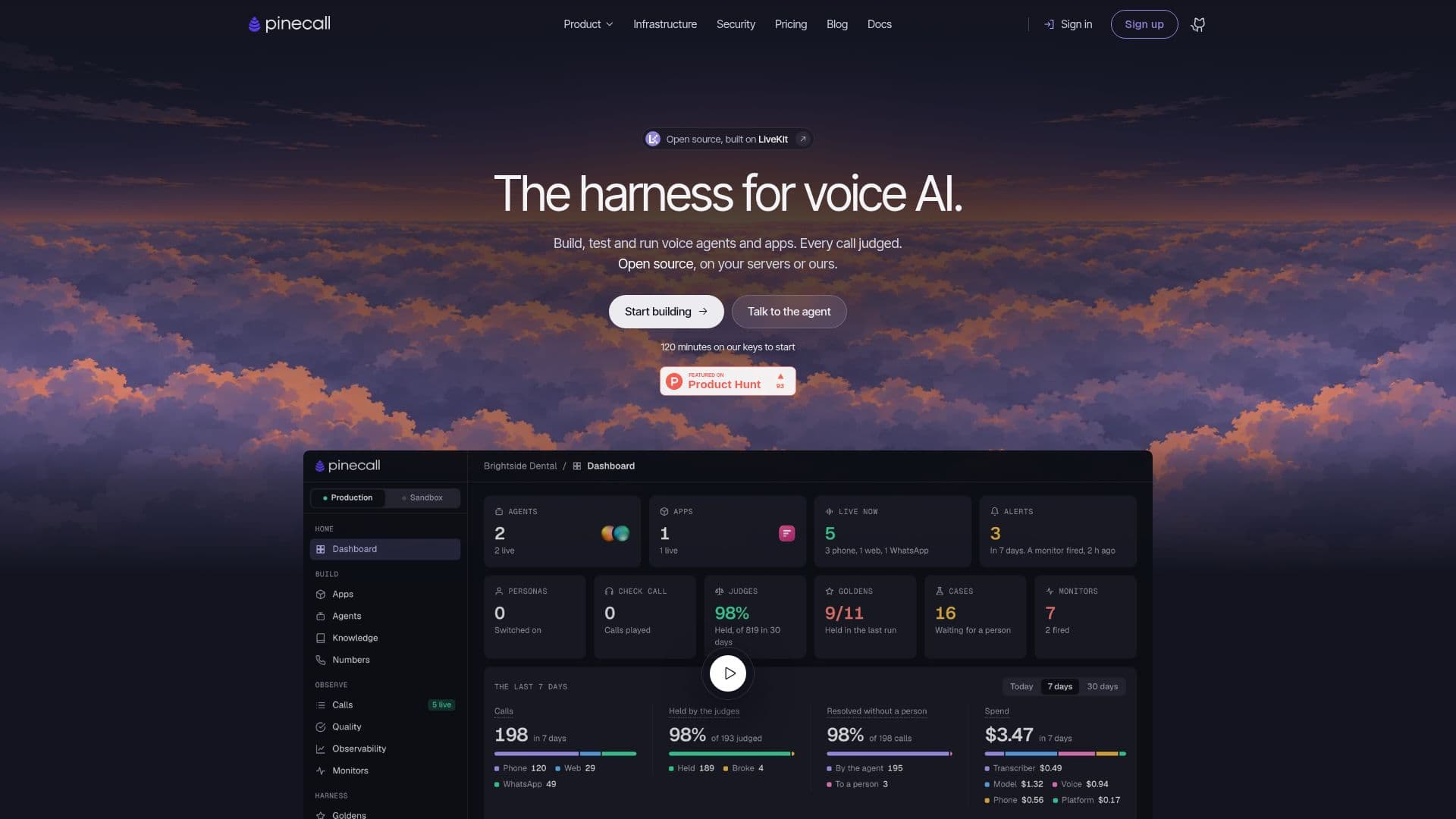
Pinecall serves as an open-source harness for voice AI, enabling developers and teams to build sophisticated voice agents and applications. The platform supports two primary methods for agent creation: writing voice apps in code using TypeScript, Python, or Ruby, or building agents in a no-code studio form. This flexibility allows both technical and non-technical users to design interactive voice experiences.
Read More
A core strength of Pinecall lies in its robust testing capabilities. Users can thoroughly test their voice agents before deployment, with every code change triggering automated tests. The platform employs AI test callers that simulate various caller personas, such as hurried, upset, or confused individuals, to rigorously evaluate agent performance. If a test fails, the change is not shipped, and problematic calls can be converted into new test cases, ensuring continuous improvement and reliability.
Pinecall integrates with existing voice stacks, supporting popular services like LiveKit, Twilio, Deepgram, ElevenLabs, Cartesia, OpenAI, Anthropic, and Gemini. This allows users to leverage their preferred providers for speech, models, and voice. The platform offers comprehensive call logging and scoring, automatically documenting what was said, agent actions, call duration, cost, and a score immediately after each call ends. Supervisors can review calls against defined rules, identifying issues and suggesting fixes.
For live calls, Pinecall provides a console for supervisors to listen in, whisper guidance to the agent, or take over the conversation seamlessly, ensuring callers never have to restart. The system can be fed business documents to answer questions contextually and remembers individual callers to avoid repetition. It also offers real-time alerts when key metrics deviate, allowing teams to address issues proactively. Pinecall can be self-hosted for free or run on its cloud infrastructure, offering various plans with included minutes and features.
- CategoryAI Agent Builders
- Pricing ModelFreemium
- DeploymentSelf-hosted, Cloud
- PlatformsWeb
Pinecall's Core Features
Open-source voice AI platform
Build voice agents in code (TypeScript, Python, Ruby)
Build voice agents in no-code studio form
Test agents with AI test callers
Automated testing for every change
Deploy agents on phone, WhatsApp, and web
Every call logged and scored automatically
Supervisor console for listening, whispering, and taking over calls
Integrates with LiveKit, Twilio, Deepgram, ElevenLabs, Cartesia
Supports OpenAI, Anthropic, Gemini models
Knowledge base integration for contextual answers
Caller memory to avoid repetition
Real-time alerts for performance metrics
Self-hosting option available
Cloud hosting with various plans
How to use Pinecall?
Build Agent: Create a voice agent using code (TypeScript, Python, Ruby) or the no-code Studio form by defining instructions, greetings, requests, and data collection points.
Integrate Stack: Connect Pinecall with your existing voice stack and AI providers like Twilio, Deepgram, ElevenLabs, and OpenAI.
Test Agent: Run automated tests with AI test callers that simulate various caller personas to ensure the agent performs as expected under different scenarios.
Deploy Agent: Deploy your voice agent to handle calls across phone, WhatsApp, and web channels.
Supervise Calls: Use the supervisor console to monitor live calls, whisper guidance to the agent, or take over the conversation when human intervention is needed.
Review Performance: Analyze logged and scored call data to identify areas for improvement and ensure agents meet performance criteria.
Pinecall's Use Cases
- Customer Support Automation
- Sales Outreach
- Interactive Voice Response (IVR)
- Internal Communication
- Voice Application Development
- Call Center Augmentation
- Market Research & Surveys
- Appointment Scheduling