Description
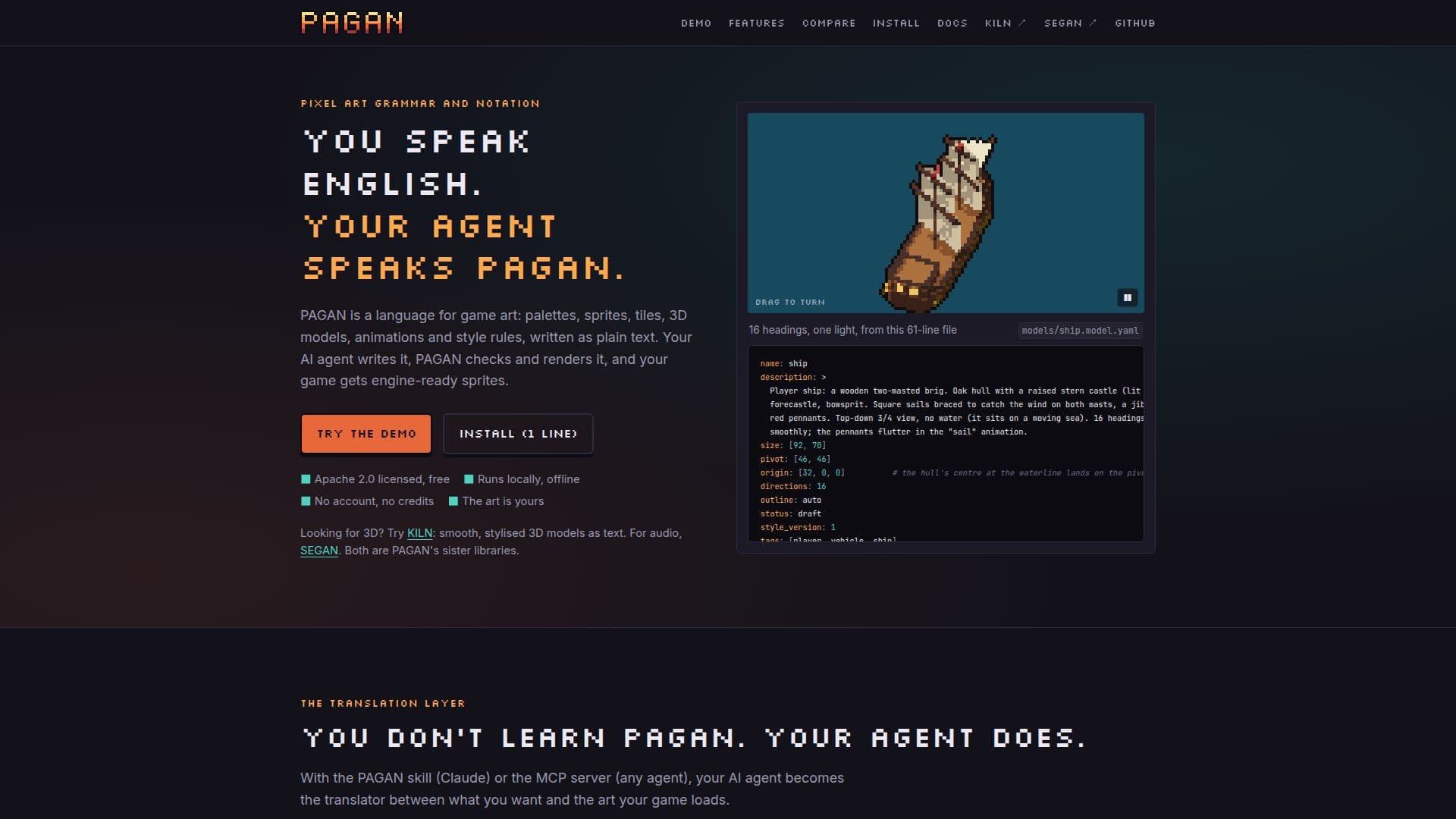
PAGAN is a free and open-source language specifically developed for generating game art, particularly pixel art. It functions as a compiler for art assets, where an AI agent writes source files defining palettes, grids, voxel models, and animations. PAGAN then processes these files, performing linting to ensure quality and consistency, and renders them into various game-ready assets.
Read More
The tool is designed to produce consistent sprites, 3D-rendered headings, glTF meshes for 3D games, animations, and tilesets. A core benefit is its ability to maintain a single art style across an entire game, ensuring that all assets, from characters to environments, adhere to a unified visual aesthetic. This is achieved through project-wide palettes, ramps, camera settings, and style versions, allowing a single change to propagate across all assets.
PAGAN operates locally on your machine, requiring no account, credits, API keys, or cloud services. It is Apache 2.0 licensed, ensuring it remains free to use, modify, and distribute for commercial or non-commercial purposes. The builds are deterministic, meaning the same source files will always produce byte-identical output files.
Unlike traditional image-model generators that paint from prompts, PAGAN compiles text-based source files. This approach results in exact, repeatable, and editable assets, with quality derived from the agent's modeling and PAGAN's renderer rather than a diffusion model. It excels in scenarios requiring a large volume of matching assets, consistent animations, and a unified palette.
PAGAN supports both 2D and 3D game development. For 2D games, it generates sprites, animations, and tilesets. For 3D games, it can build real glTF meshes with one node per part, including animations, hit zones, joints, and detachable flags. It also provides Godot-specific resources like SpriteFrames and TileSets out of the box, and manifest.json for compatibility with any game engine. The tool includes a linter that agents can read and fix, identifying issues like orphan pixels, jitter, and outline clipping.
- CategoryAI Game Development Tools
- Pricing ModelFree
- DeploymentLocal
- PlatformsWindows, macOS, Linux
PAGAN's Core Features
Free and open-source game art language
AI agent writes art source files
Lints and renders consistent sprites and animations
Generates 3D-rendered headings and glTF meshes
Produces Godot-ready assets (SpriteFrames, TileSets)
Supports project-wide palettes and style versions
Deterministic builds for byte-identical output
Runs locally and offline, no account or credits needed
Provides a linter for quality checks and issue fixing
Exports manifest.json for engine compatibility
Supports 2D and 3D game asset creation
Offers tools for palette adjustment and style evolution
Includes API for generator scripts and procedural art
Allows for variant creation (e.g., team colors, arctic versions)
Provides detailed documentation and notation reference
How to use PAGAN?
Initialize Project: Use `pagan init` to create a new project, specifying perspective and style.
Create Assets: Generate new palettes, sprites, tilesets, or 3D models using `pagan new` commands.
Author Content: Write source files for grids, parts, and animations in PAGAN's text notation.
Lint and Review: Run `pagan lint` to check for errors and warnings, then `pagan preview` to visualize assets.
Adjust and Iterate: Use `pagan config set` to adjust project settings like camera angle or lighting, and `pagan palette adjust` to modify colors.
Mark Approval: Once satisfied, use `pagan mark --status approved` to record reviews and `pagan style bump` for style version changes.
Build Assets: Execute `pagan build` to generate final game assets and the manifest.json file.
Integrate into Engine: Use the manifest.json and generated files (PNGs, GLBs, Godot .tres) in your game engine.
PAGAN's Use Cases
- Consistent Game Art Generation
- AI-Driven Asset Creation
- 2D Pixel Art Production
- 3D Game Asset Export
- Procedural Art Generation
- Game Asset Localization
- Version Control for Art
- Offline Game Development
- Godot Engine Integration
- Long-Term Project Management