
Description
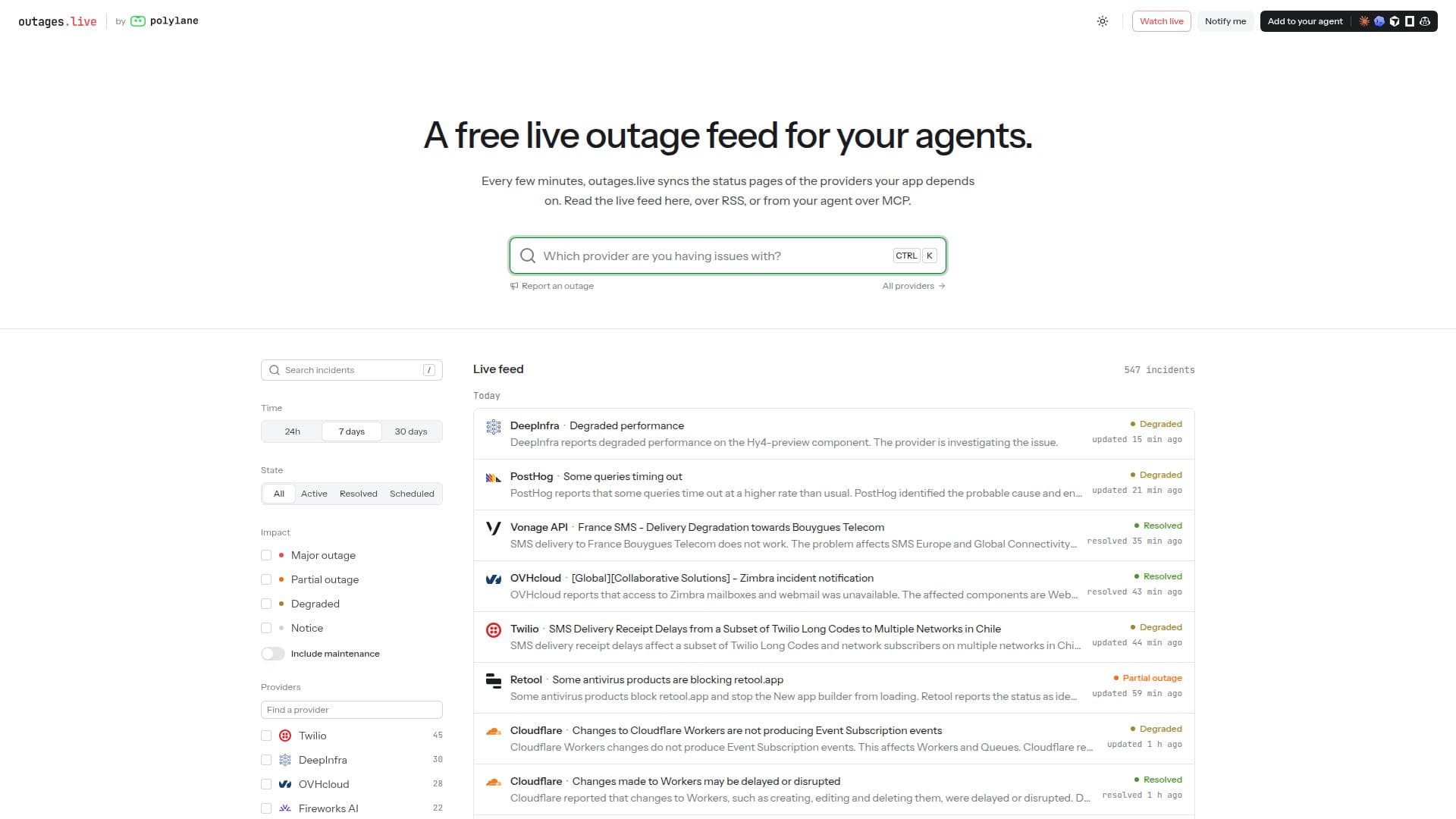
outages.live offers a comprehensive and free live outage feed, designed to keep agents informed about incidents and maintenance across various cloud, AI, and developer providers. The platform aggregates data directly from the official status pages of these providers, which often run on diverse systems like Atlassian Statuspage, incident.io, Better Stack, status.io, UptimeRobot, AWS Health, and Google Cloud.
Read More
Every few minutes, outages.live reads and processes these status pages, merging the information into a standardized format. Each entry details an incident, its impact, affected components, and all relevant updates. This ensures that users receive timely and consistent information, regardless of the original source's format. A language model is employed to write concise summaries of each incident, based solely on the updates posted by the provider, without adding any new facts. Users can always access the original updates and links to the official status page for full transparency.
The service is entirely free, requiring no login or API key, making it easily accessible for any user or system. The data is updated frequently, typically every few minutes, making one request every few minutes sufficient for staying current. This real-time monitoring helps users understand when a service failure is on the provider's side rather than their own, preventing misdiagnosis and wasted troubleshooting efforts.
outages.live supports multiple methods for accessing its live feed, including direct viewing on the website, RSS feeds for integration into news readers, and a JSON API for programmatic access. Additionally, it provides an MCP (Message Control Protocol) server, allowing coding agents to directly consume outage information. This integration enables automated systems to react to provider incidents, such as GitHub, Vercel, or OpenAI outages, and differentiate between internal application failures and external service disruptions.
The platform lists recent and ongoing incidents from a wide array of providers, including DeepInfra, PostHog, Vonage API, OVHcloud, Twilio, Retool, Cloudflare, Vapi, Sinch, Zoom, Jina AI, GitHub, Augment Code, Webflow, OpenAI, Cursor, xAI, Moonshot AI, Crusoe, Akamai Cloud (Linode), Inngest, Hetzner, monday.com, Backblaze, bunny.net, and Temporal Cloud. Each incident entry provides details such as the start time, duration, affected components, and the current status, offering a clear overview of service health.
- CategoryAI DevOps & Cloud Tools
- Pricing ModelFree
- DeploymentCloud
- PlatformsWeb
outages.live's Core Features
Live Outage Feed: Consolidates incidents and maintenance from official status pages.
Multi-Provider Aggregation: Gathers data from cloud, AI, and developer providers.
Real-time Updates: Information is updated every few minutes for current status.
Standardized Format: Merges diverse status page data into one consistent format.
AI-Generated Summaries: Language model writes concise summaries from provider updates.
Original Source Links: Provides links to official status pages for verification.
Free Access: No login or API key required for usage.
RSS Feed: Subscribe to live outage updates via RSS.
JSON API: Access outage data programmatically.
MCP Server: Integrate with coding agents for automated incident awareness.
Incident Details: Shows impact, affected components, and update timelines.
Historical Data: Displays past incidents and their durations.
Provider-Reported Status: Reflects what each provider officially reports.
Component-Level Tracking: Identifies specific affected service components.
Multi-Platform Support: Integrates with various status page systems like Atlassian Statuspage, incident.io, Better Stack, AWS Health, and Google Cloud.
How to use outages.live?
Access Live Feed: Visit the outages.live website to view the current incident feed.
Subscribe via RSS: Use the provided RSS feed to receive updates in your preferred feed reader.
Integrate with Coding Agent: Add the outages.live MCP server to your coding agent for automated incident notifications.
Monitor Specific Providers: Follow individual provider feeds to get alerts for services like Retool, OVHcloud, or Moonshot AI.
Review Incident Details: Click on any incident to see its timeline, affected components, and original provider updates.
Check Provider Status: Verify the operational status of cloud, AI, and developer providers your applications depend on.
outages.live's Use Cases
- Developer Incident Monitoring
- IT Operations Alerting
- Customer Support Awareness
- Automated System Response
- Service Level Agreement (SLA) Tracking
- Dependency Health Checks
- RSS Feed Integration
- API-Driven Monitoring