
Description
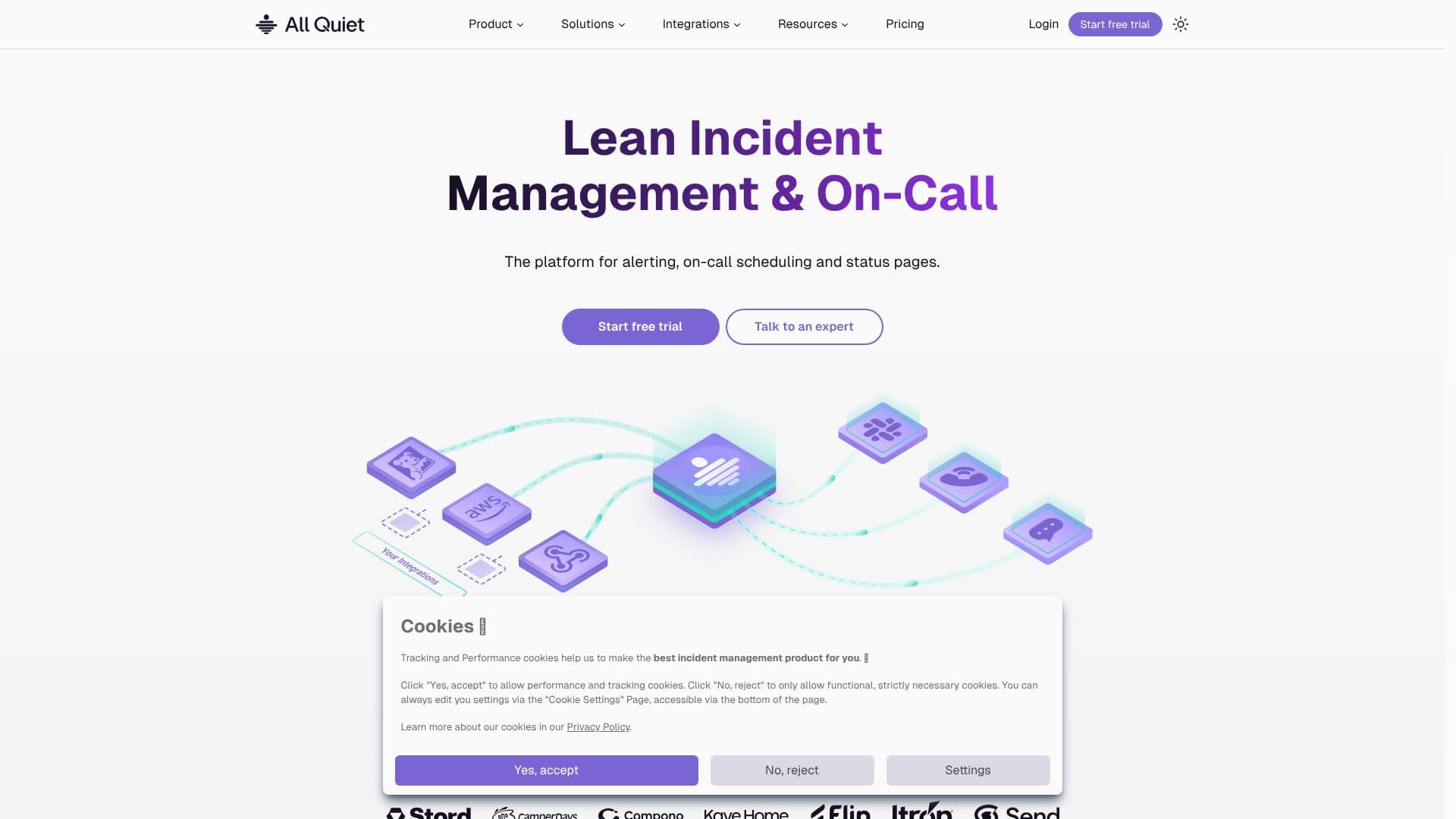
All Quiet provides a lean incident management and on-call platform designed specifically for engineering teams. It centralizes alerting, on-call scheduling, and status pages, aiming to reduce noise and resolution times during outages and emergencies. The platform supports the entire incident response lifecycle, from initial alert to post-mortem analysis.
Read More
Connecting your existing observability stack is straightforward, with over 50 built-in integrations available, including popular tools like Datadog, Grafana, Slack, and ServiceNow. For any missing integrations, users can leverage webhooks to create custom inbound integrations, allowing alerts from any system to be sent to a unique webhook endpoint. All Quiet's mapping engine then allows for the customization of incident creation based on the payload data, enabling teams to define attributes like 'Environment' based on host domains or other criteria.
The platform offers flexible on-call scheduling, supporting everything from simple weekday-weekend rotations to complex day-and-night shifts with automatic escalations. Multi-channel alerting ensures that critical notifications reach the right people through SMS, phone calls, emails, and push notifications to native apps. Collaboration is enhanced through integrations with tools like Slack, Microsoft Teams, and Jira, facilitating communication and investigation.
All Quiet also enables teams to keep stakeholders informed with customizable status pages, providing instant updates on incident resolution. The platform is designed with developers in mind, offering configuration options via Terraform, a Public API, or a user-friendly Web UI. This developer-first approach, combined with simple and transparent pricing plans that avoid artificial user limits, makes All Quiet a cost-effective solution for teams of all sizes.
Key benefits include reduced alert fatigue, faster issue resolution, and improved team alignment, especially for remote or hybrid teams. All Quiet is built for DevOps, SRE, and IT operations teams seeking a reliable and efficient incident management solution. Its focus on simplicity, automation, and developer-friendly integrations differentiates it from legacy platforms.
- CategoryAI DevOps & Cloud Tools
- Pricing ModelPer user
- DeploymentCloud
- PlatformsWeb
All Quiet's Core Features
Automated alerting and incident creation
Flexible on-call scheduling and rotation management
Multi-channel notification delivery (SMS, phone, email, push)
Over 50 built-in integrations with observability tools
Custom integration support via webhooks
Incident mapping engine for custom attribute creation
Configurable status pages for stakeholder communication
Collaboration tool integrations (Slack, Teams, Jira)
Infrastructure as Code support (Terraform)
Public API for programmatic access
Transparent pricing with no user limits
ISO 27001 certified
How to use All Quiet?
Connect Integrations: Link your observability stack or set up custom webhook integrations.
Configure On-Call Schedules: Define rotations, shifts, and escalation policies for your teams.
Set Up Alert Routing: Map incoming alerts to the appropriate teams and notification channels.
Manage Incidents: Respond to alerts, collaborate with team members, and update stakeholders.
Publish Status Updates: Use status pages to inform users about ongoing incidents and resolutions.
Review Post-Mortems: Analyze incidents to learn and improve future response processes.
All Quiet's Use Cases
- Incident Response
- On-Call Management
- Automated Alerting
- Stakeholder Communication
- DevOps & SRE Operations
- Reducing Alert Fatigue
- Team Collaboration