
Description
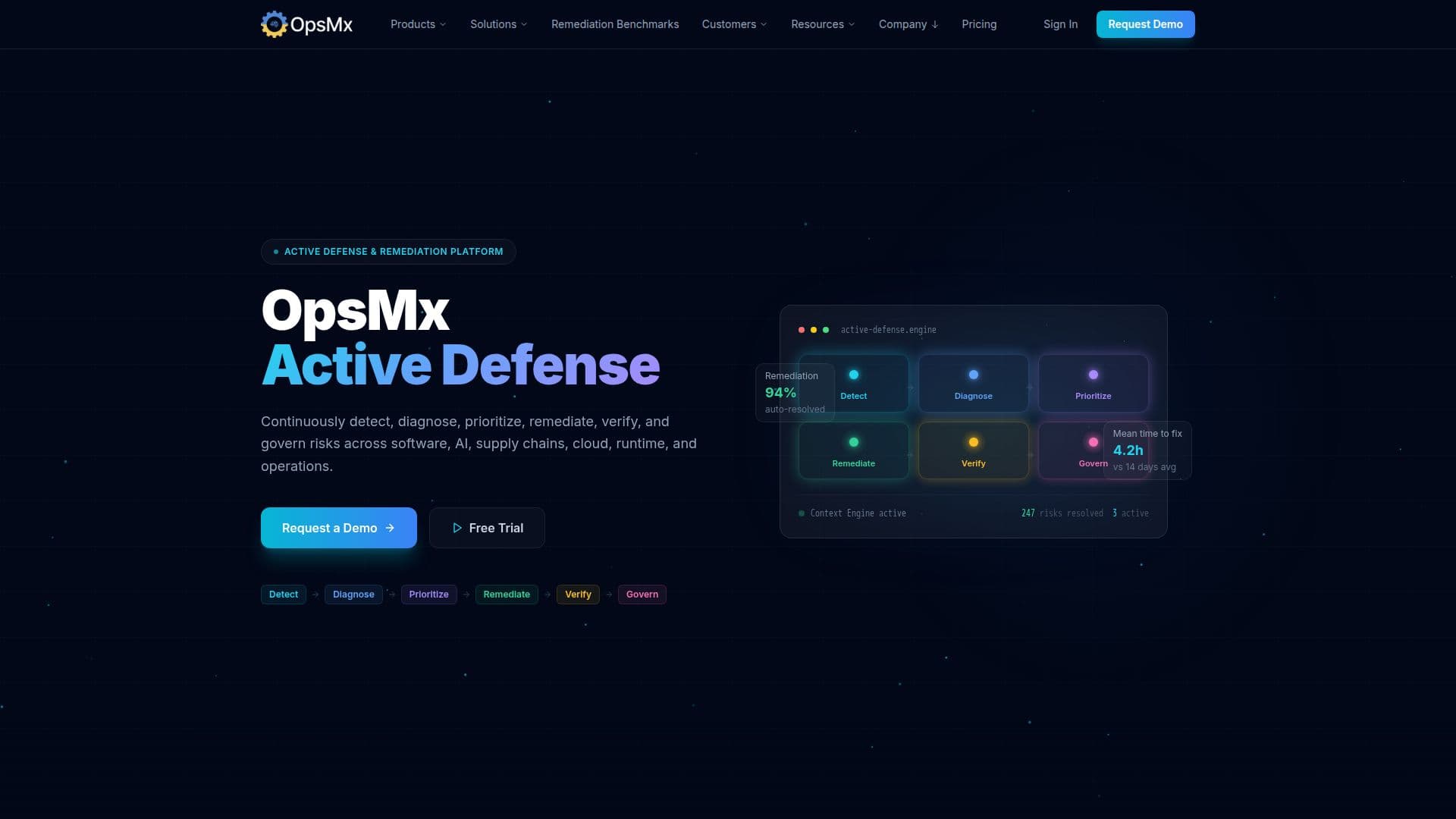
OpsMx Active Defense positions itself as one platform across four "active defense pillars": code and AI, supply chain, cloud and runtime, and operations. Its stated problem to solve is that most security tools generate alerts, findings and dashboards without a clear path forward; OpsMx instead aims to give teams one prioritized action with an automated path to a verified fix.
Read More
The platform is powered by the OpsMx Context Engine, described as the intelligence layer behind every active defense decision. It continuously discovers, correlates, serves and optimizes context across applications, code, APIs, dependencies, pipelines, cloud resources, Kubernetes, runtime systems and business ownership, feeding a diagnostics engine, a remediation factory, a verification engine and a governance framework.
Its capabilities span vulnerability correlation with exploitability and reachability analysis to reduce false positives, root cause diagnosis, and supply chain risk assessment covering SBOM generation, license risk and provenance. On the remediation side it covers code, dependency, cloud, infrastructure-as-code and Kubernetes fixes, alongside SAST, DAST, API security, secrets scanning, cloud security posture management and deployment policy enforcement, plus root cause and incident diagnostics for operational issues.
OpsMx states it is trusted by security and engineering teams at enterprises including Western Union, Cisco, Salesforce and Google, among others, and reports program-benchmark outcomes of 94% of issues auto-resolved and a 4.2-hour mean time to fix versus a 14-day average. It lists SOC 2 Type II and ISO 27001 certification, GDPR readiness, an enterprise SLA and human-in-the-loop governance over automated actions.
OpsMx Active Defense is built for security and engineering teams managing risk across large or regulated software organizations rather than individual developers. It offers both a bookable demo and a free trial sandbox for evaluating the platform directly.
The framing throughout is deliberately outcome-focused: rather than adding another dashboard of findings, OpsMx presents itself as closing the loop from detection to a verified, governed fix, with a human still in control of the actions the platform recommends or automates.
- CategoryAI DevOps & Cloud Tools
- Pricing ModelFreemium
- DeploymentCloud
- PlatformsWeb
OpsMx Active Defense's Core Features
Detects, diagnoses, prioritizes, remediates, verifies and governs risk in one workflow
OpsMx Context Engine correlates context across code, APIs, dependencies, pipelines, cloud and runtime
Vulnerability correlation with exploitability and reachability analysis to cut false positives
Automated code, dependency, cloud, IaC and Kubernetes remediation
Supply chain risk assessment including SBOM generation, license risk and provenance
Static and dynamic application security testing (SAST/DAST) plus API and secrets scanning
Cloud security posture management (CSPM) and deployment policy enforcement
Root cause and incident diagnostics for operational issues
SOC 2 Type II and ISO 27001 certified, with human-in-the-loop governance
How to use OpsMx Active Defense?
Connect your environment: link code repositories, pipelines, cloud accounts and runtime systems.
Let the Context Engine assess risk: OpsMx correlates and scores findings across every layer.
Review prioritized issues: focus on what the platform ranks as the highest-impact risk.
Apply remediation: use automated fixes for code, dependency, cloud, IaC or Kubernetes issues.
Verify and govern: confirm a fix resolved the risk and track outcomes under human-in-the-loop governance.
OpsMx Active Defense's Use Cases
- Vulnerability triage
- Kubernetes and cloud remediation
- Supply chain risk management
- Release governance