
Description
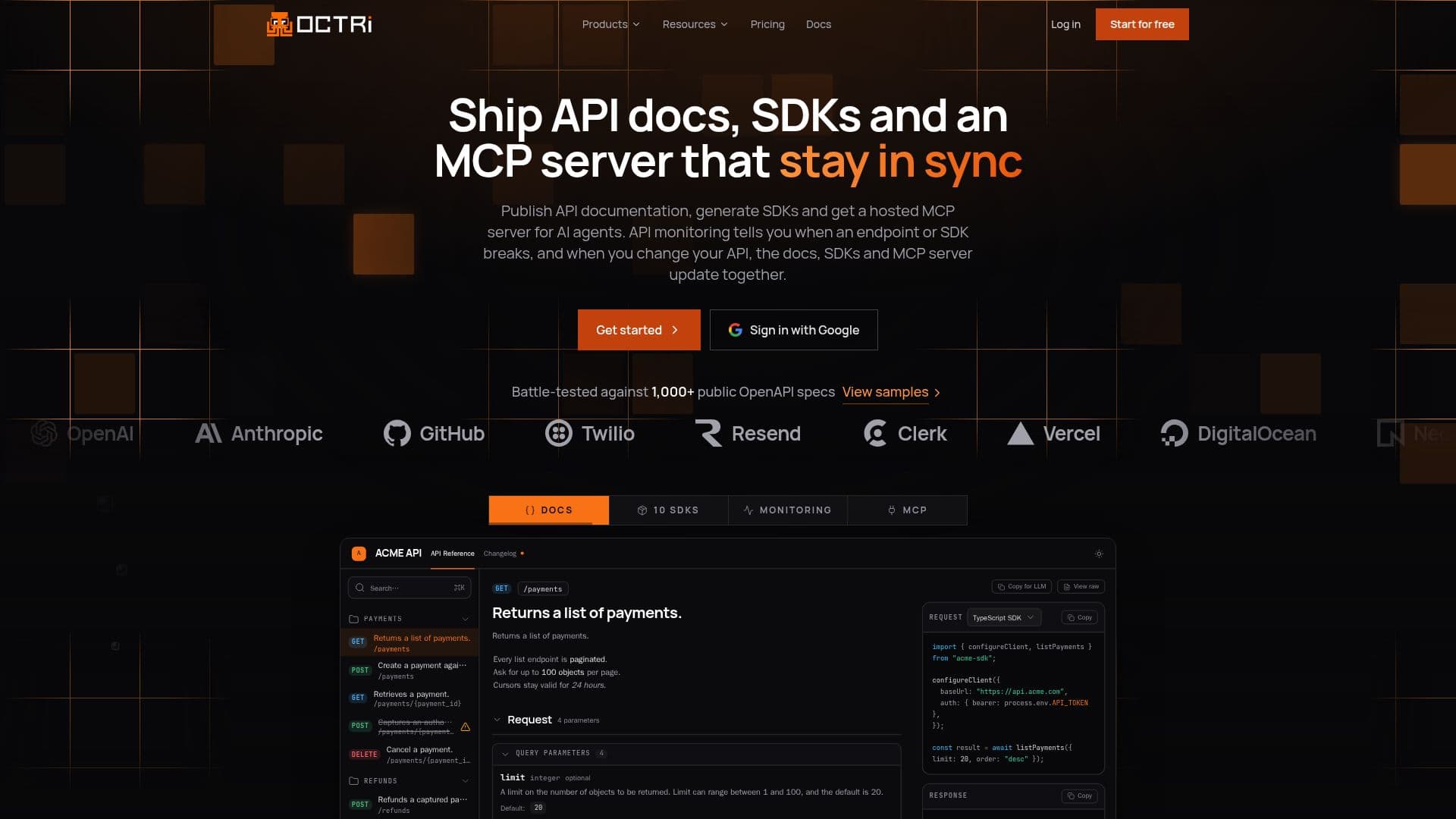
Octri provides a unified platform for managing the entire API lifecycle, from documentation to SDK generation, AI agent integration, and production monitoring. It starts by taking a single OpenAPI specification (or building one from scratch if you add endpoints in the editor) and uses it to generate four core products: hosted API documentation, client libraries (SDKs) in ten different programming languages, an MCP (Multi-Agent Communication Protocol) server for AI agents, and robust production monitoring for both the API and the generated clients.
Read More
The API documentation generated by Octri is polished and interactive, featuring guides, an API reference with search functionality, and a live "try-it" playground that allows users to call the live API with their own keys. It supports custom domains and includes AI search capabilities, along with `llms.txt` for coding agents. The platform also offers a visual editor for documentation, allowing edits that persist even after regeneration, and GitHub sync for managing changes as drafts with diffs before publishing.
For SDKs, Octri generates production-ready client libraries in languages like TypeScript, Python, Go, Java, Kotlin, Ruby, PHP, Swift, Dart, and Rust. These SDKs include features like retries, pagination, and typed errors, and can be auto-published to various package registries such as npm, PyPI, and Maven. Custom hooks can be written and compiled into the client, and SDKs are regenerated automatically with every API change, maintaining a build history.
The MCP server exposes the API documentation and endpoints as tools for AI agents, supporting platforms like Claude, Cursor, and VS Code. It includes seven documentation tools and a callable tool for every endpoint, with secure OAuth sign-in for agents. Features like approval before writes, safety limits, and an audit log ensure secure agent interaction. The MCP server is available on all plans, including Free, with options for self-hosting.
Production monitoring and observability features track logs, errors, distributed traces, and service maps for the API and the SDKs installed by users. It includes error reporting built into the SDKs (opt-in for users), uptime checks, and a public status page. Alerts can be configured for various thresholds and issues, integrating with platforms like Slack and PagerDuty. Octri offers a Free plan with limited allowances, and paid plans (Starter, Growth, Business, Enterprise) scale up features like SDK languages, API endpoints, AI credits, and monitoring ingest. Pricing is per organization, not per seat, with annual billing discounts available.
- CategoryAI DevOps & Cloud Tools
- Pricing ModelFreemium
- DeploymentCloud
- PlatformsWeb
Octri's Core Features
Generate hosted API documentation from OpenAPI specifications
Create idiomatic SDKs in ten programming languages
Provide a hosted MCP server for AI agents
Offer production monitoring for APIs and generated clients
Support custom domains for documentation sites
Enable AI-written API documentation and changelog summaries
Include interactive "try-it" API playground
Integrate with GitHub for spec synchronization and draft management
Auto-publish SDKs to package registries (npm, PyPI, Maven, etc.)
Implement opt-in error reporting within generated SDKs
Offer structured logs, error tracking, and distributed traces
Provide tools for AI agents to search, read, and call API endpoints
Support OAuth sign-in for AI agents with audit logs
Allow visual editing of documentation pages with persistent changes
Offer various pricing tiers including a Free plan
How to use Octri?
Add Your API: Import OpenAPI, Swagger, Postman, or AsyncAPI specifications, or add endpoints directly in the editor.
Review Drafts: Changes from GitHub sync arrive as drafts with diffs for review before publishing.
Configure Documentation: Arrange docs in API Studio, add guides, and customize the site's appearance.
Select SDK Languages: Choose from ten supported languages and configure client shape, method naming, and file layout.
Publish Products: Publish API documentation, SDKs to registries, and enable the MCP server and monitoring.
Monitor Performance: Track logs, errors, and traces for your API and user-installed SDKs.
Integrate AI Agents: Activate the MCP server to expose your API and documentation as tools for AI agents.
Manage Changes: Push new API specifications; docs, SDKs, and MCP tools automatically update and regenerate.
Octri's Use Cases
- API Documentation Publishing
- SDK Generation
- AI Agent Integration
- API and SDK Monitoring
- Developer Experience Enhancement
- API Lifecycle Management
- Internal API Management
- OpenAPI Specification Management