
Description
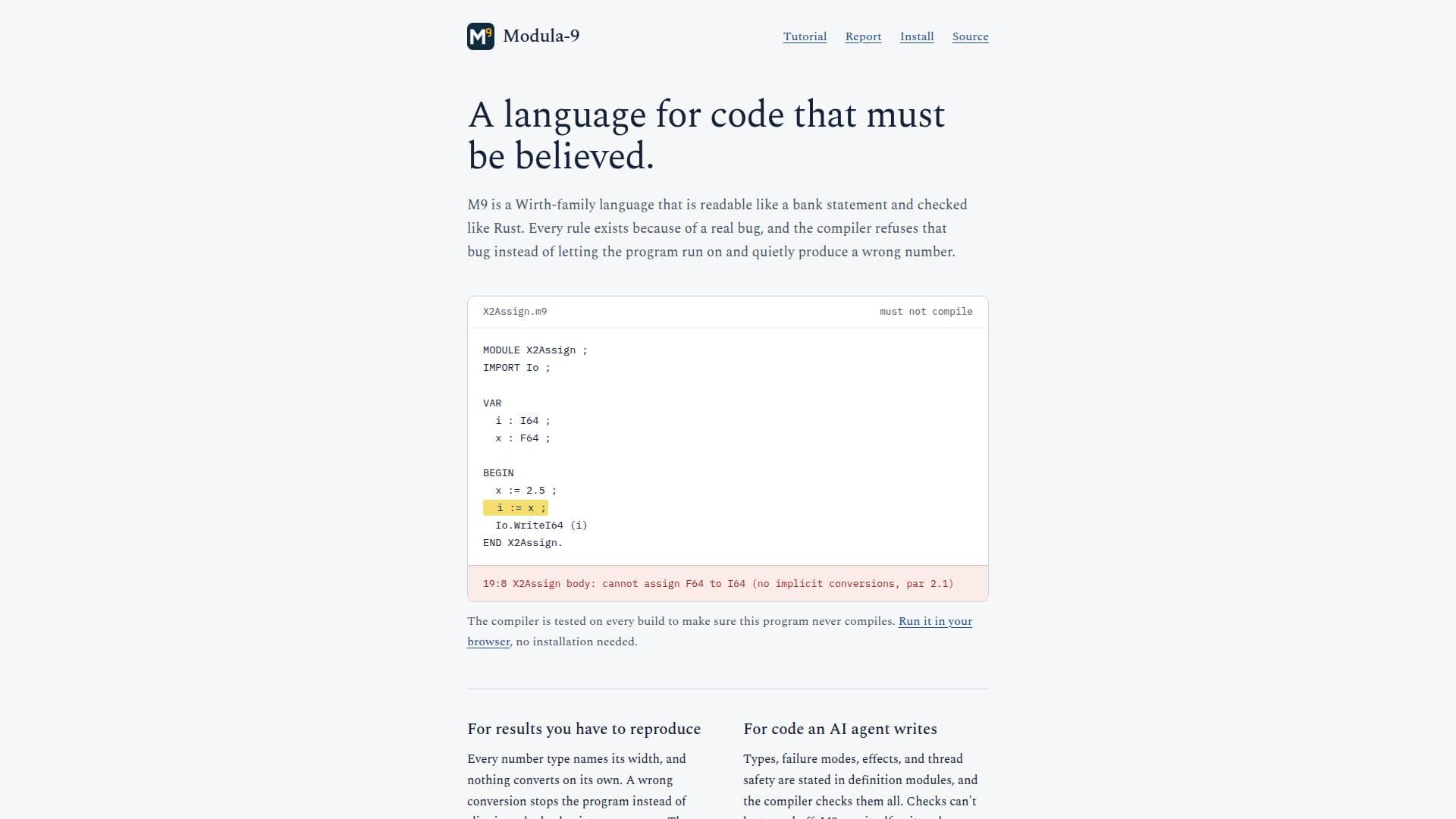
Modula-9 is a programming language that belongs to the Wirth-family, known for its emphasis on readability and reliability. It is particularly suited for scientific computing and auditing code written by AI agents. The language is designed to be as readable as a bank statement and as rigorously checked as Rust, with every rule in place to prevent real bugs. The compiler is strict in refusing code that could potentially lead to bugs, ensuring that the code is both reliable and reproducible.
Read More
The language is open-source, with the compiler and tools available under the GNU General Public License (GPL) version 3. However, the runtime and standard library come with a runtime exception, allowing developers to release programs built with Modula-9 under any license they choose, whether open or proprietary. This flexibility makes it an attractive option for developers who need to maintain control over their software's licensing.
Modula-9 supports various platforms, including Ubuntu, Debian, Fedora, Rocky, and Arch, with experimental support for Windows and macOS. The language is distributed as packages that can be easily installed using standard package managers like apt, dnf, and pacman.
The language's core features include a robust compiler that ensures code correctness, a standard library for scientific computing, and tools for code formatting and linting. It also includes an editor extension and a Jupyter kernel for interactive development. These tools are designed to enhance the developer's productivity and ensure that the code is both efficient and error-free.
Modula-9 is ideal for developers in scientific fields, AI researchers, and anyone who requires a high level of code reliability and auditability. Its focus on preventing bugs and ensuring code correctness makes it a valuable tool for projects where accuracy and reproducibility are critical.
- CategoryAI Code Review & Testing
- Pricing ModelOpen Source
- DeploymentOn-Premise
- PlatformsLinux, Windows, macOS
Modula-9's Core Features
Wirth-family language
Readable syntax
Strict bug-checking compiler
Open-source under GNU GPL
Runtime exception for flexible licensing
Supports multiple Linux distributions
Experimental Windows and macOS support
Includes Jupyter kernel and editor extension
How to use Modula-9?
Install: Use package manager for your OS
Configure: Set up environment variables
Develop: Write and compile code using M9 tools
Deploy: Release under chosen license
Modula-9's Use Cases
- Scientific Computing
- AI Code Auditing
- Open Source Projects
- Proprietary Software
- Educational Use