
Description
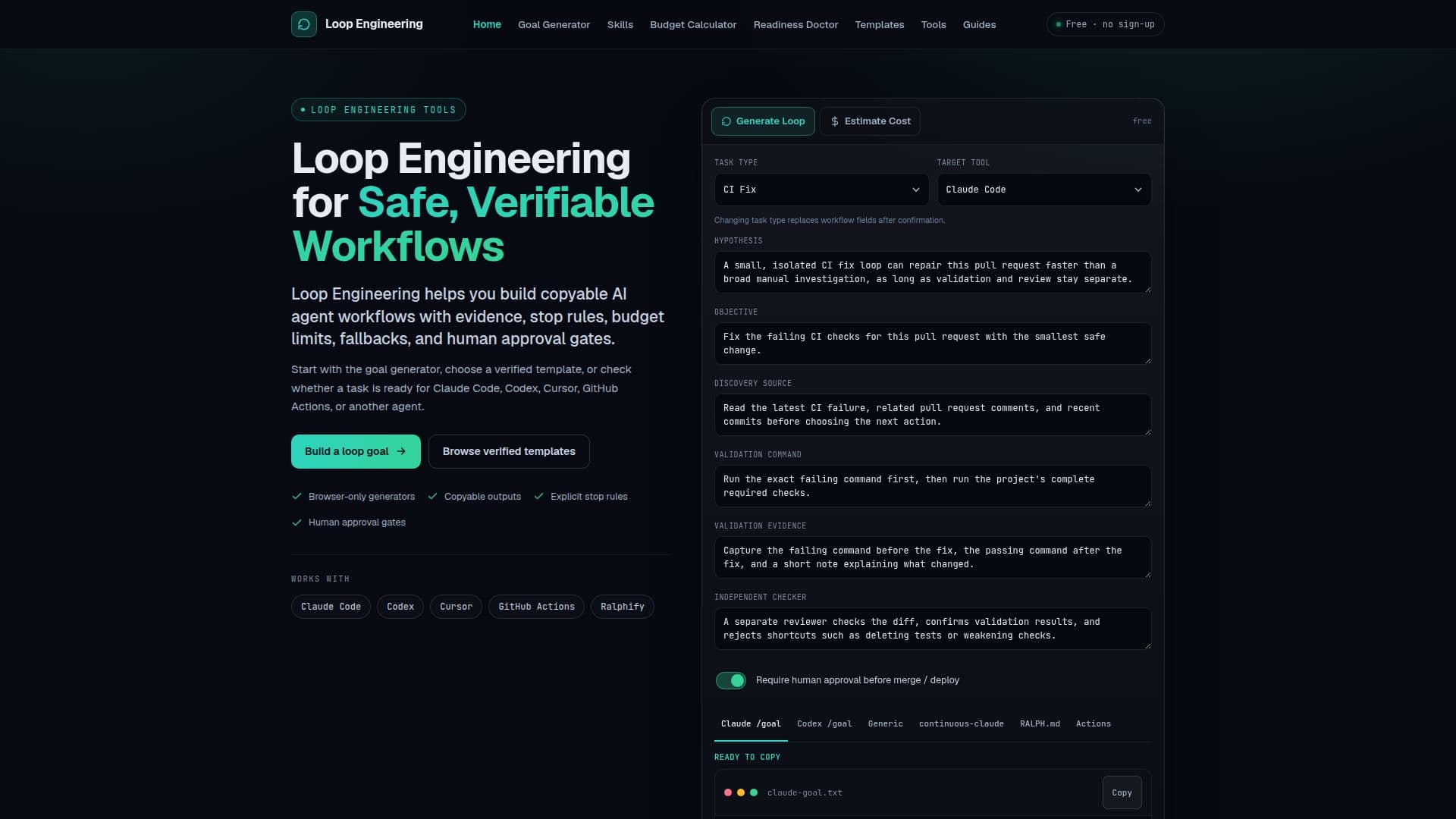
Loop Engineering offers a suite of free, browser-based tools designed to help users build safe and verifiable AI agent workflows. Instead of turn-by-turn prompting, the platform focuses on designing the entire system around an AI agent, encompassing goals, context, validation, boundaries, budget, stop rules, and feedback. This approach ensures that AI agent tasks are controlled, reviewable, and operate within defined parameters.
Read More
The platform provides several key tools to facilitate this process. The goal generator helps users define clear, machine-verifiable objectives for their AI agents. Verified templates offer practical patterns for common tasks like CI repair, code review, research, and data work, ensuring a structured starting point. A budget calculator allows users to estimate per-run, daily, and monthly token costs, helping to set maximum iterations and budget caps before execution. Additionally, a readiness doctor checks whether a task is prepared for an AI agent by identifying missing evidence, boundaries, budgets, rollback steps, or human decision points.
Loop Engineering supports various AI agents and platforms, generating copyable prompts, files, and configurations for Claude Code, Codex, generic agents, GitHub Actions skeletons, and experimental RALPH.md exports for Ralphify-style loops. It is not a runtime itself; all outputs are generated in the user's browser without executing code, connecting to repositories, or calling external APIs. This ensures privacy and control over the generated workflows.
The methodology emphasizes building small, useful loops first, focusing on a testable hypothesis, a minimal viable run, clear validation signals, and feedback. A core principle is the use of an independent checker—which can be a test suite, review rules, another agent, or a human—to verify results and prevent the agent from missing its own shortcuts. This separation of maker and checker enhances safety and reliability.
Key concepts integrated into Loop Engineering include AGENTS.md for durable project instructions, SKILL.md for reusable workflow packages, and RALPH.md for experimental loop definitions. The platform also addresses critical safety concerns by providing a checklist for verifying goal verifiability, independent checkers, forbidden actions, iteration limits, budget limits, fallback plans, and human approval gates for high-risk actions. It also highlights common pitfalls like verification debt, comprehension rot, cognitive surrender, and token blowout, offering strategies to mitigate them through thoughtful loop design.
- CategoryAI Agent Builders
- Pricing ModelFree
- DeploymentBrowser-based
- PlatformsWeb
Loop Engineering's Core Features
Goal Generator for AI Agent Workflows
Verified Templates for Common AI Tasks
Budget Calculator for Token Cost Estimation
Readiness Doctor for Task Assessment
Copyable Outputs for Claude Code and Codex
Support for GitHub Actions Skeletons
Experimental RALPH.md Exports
AGENTS.md for Durable Project Instructions
SKILL.md for Reusable Workflow Packages
Independent Checker Integration for Validation
Safe Stop Conditions and Budget Limits
Fallback Planning and Human Approval Gates
Browser-Based Tool, No Sign-up Required
No Code Execution or API Calls
Guides on Loop Engineering Best Practices
How to use Loop Engineering?
Define Goal: Use the goal generator to create a clear, machine-verifiable objective for your AI agent.
Select Template: Choose a verified template for your specific task, such as CI repair or code review.
Estimate Budget: Utilize the budget calculator to estimate token costs and set limits for your agent's operation.
Check Readiness: Employ the readiness doctor to identify any missing elements before deploying your agent.
Generate Workflow: Create copyable prompts, files, and configurations for your chosen AI agent.
Implement Safety: Integrate independent checkers, stop rules, and human approval gates into your workflow.
Iterate and Refine: Start with a small, testable loop, gather feedback, and refine your workflow based on evidence.
Loop Engineering's Use Cases
- CI Repair Automation
- Code Review with Agents
- Research Task Management
- Data Work Automation
- Pull Request Monitoring
- Methodology Skill Packaging
- Experimental Loop Definitions