Description
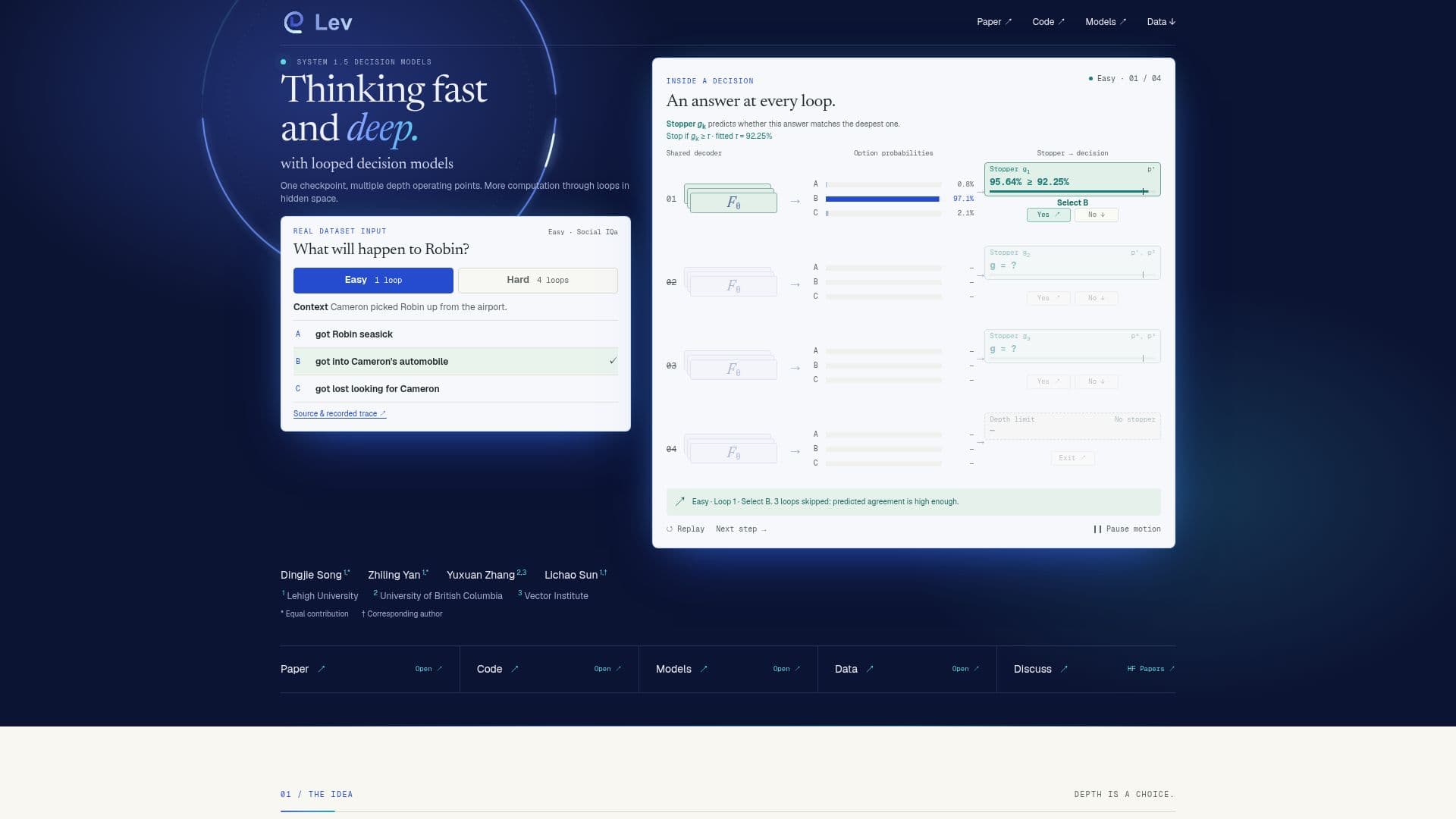
Lev is a novel System 1.5 decision model engineered to facilitate both rapid and in-depth analytical thinking. Unlike traditional models that might require extensive reasoning token generation, Lev scores options at each loop step, providing immediate answers while also allowing for deeper, more considered responses as needed. This unique architecture enables the model to operate across multiple depth points from a single checkpoint, making it highly versatile and efficient.
Read More
The core principle behind Lev is its looped decision-making process. By thinking in loops, the model can incrementally increase its depth of analysis, leading to improved decision quality from the same underlying checkpoint. This on-demand depth capability is a significant advantage, as it allows users to save on computational resources by only engaging deeper analysis when the task truly requires it. The model's ability to provide a fast answer and a deeper answer from the same 2.6B weights, across four distinct operating points, highlights its flexibility.
Lev is particularly effective for scenarios where a balance between speed and accuracy is crucial. Its design ensures that even small models can cover a useful latency range, making it adaptable to various computational environments and application requirements. The research behind Lev explores the conditions under which these gains in efficiency and depth hold true, providing a clear understanding of its strengths and limitations.
The model's performance data, available through datasets like `songdj/Lev-results` on Hugging Face, showcases its capabilities across different tiers and confidence levels. This data includes metrics such as predicted index, confidence scores, and probabilities for various options, demonstrating its ability to make informed decisions with varying degrees of certainty. The dataset also categorizes results by 'tier' (e.g., 'easy', 'standard'), indicating its robustness across different problem complexities.
Lev represents a significant step forward in decision model design, offering a practical solution for applications requiring adaptive analytical depth and efficient resource utilization. Its looped thinking mechanism and flexible operating points make it a valuable tool for researchers and developers looking to implement more nuanced and responsive AI systems.
- CategoryAI Models & LLMs
- DeploymentCloud
- PlatformsWeb
Lev's Core Features
System 1.5 decision model
Looped decision models for thinking
Multiple depth operating points from one checkpoint
Scores options at every loop step
Does not generate reasoning tokens
Provides fast answers
Provides deeper answers
Utilizes same 2.6B weights across operating points
Four distinct operating points
On-demand depth saves compute
Small models cover useful latency range
Research-backed methodology
How to use Lev?
Understand Model: Review the core principles of Lev's looped decision models and System 1.5 architecture.
Explore Operating Points: Learn how to utilize the multiple depth operating points available from a single checkpoint.
Analyze Performance Data: Access and interpret the performance data and metrics provided in the `songdj/Lev-results` dataset.
Apply to Scenarios: Identify use cases where adaptive analytical depth and efficient resource utilization are beneficial.
Follow Research: Stay updated with ongoing research and findings related to Lev's performance and applications.
Lev's Use Cases
- Adaptive Decision Making
- Efficient Resource Utilization
- Rapid Option Scoring
- Performance Evaluation
- Research & Development