
Description
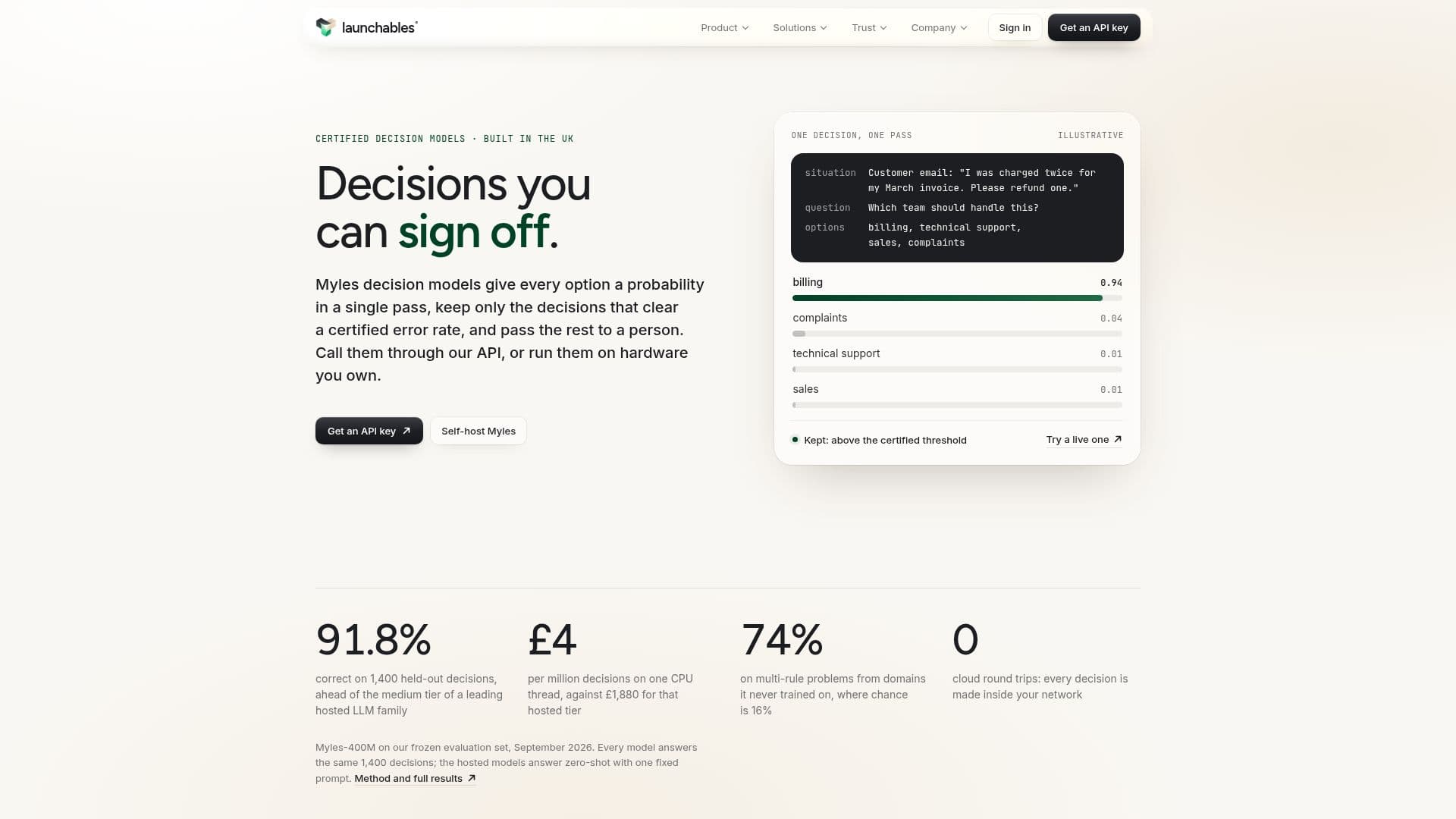
Launchables offers Myles, a suite of certified decision models engineered to provide precise, calibrated probabilities for various question types, including yes/no, choice, and score. These models are built in the UK and are designed to run either on your own servers, laptops, and devices, or through the Launchables Decision API. A core principle of Myles is its ability to maintain decisions within a measured error rate, passing any uncertain or low-confidence decisions to a human for review, ensuring reliability and accountability.
Read More
The Myles models process situations presented as text, JSON, or images, delivering a probability for every option in a single forward pass. This eliminates the need for text generation or complex parsing, making the decision-making process fast and efficient. The calibration of Myles means that if a model assigns a 0.9 probability to an option, that option is correct approximately 90% of the time, allowing users to set a trusted error rate before deployment.
Launchables provides several Myles models, each optimized for different deployment environments and performance needs. These range from Myles-22M, capable of running in a browser or on a phone in milliseconds, to Myles-G 31B, designed for data-centre GPUs, offering high accuracy and speed. This flexibility allows organizations to deploy decision-making capabilities where their data already resides, including disconnected or air-gapped networks, ensuring data sovereignty and security.
The Decision API supports three primary question types: 'noul' for yes/no classifications, 'choice' for selecting one from several labels, and 'score' for rating on a scale. It also handles image inputs, allowing models like Myles-G 12B and Myles-G 31B to make decisions based on receipts, screenshots, or product photos. This capability is crucial for use cases such as expense claim approval, agent tap-safety checks, and visual product inspection.
Myles models are particularly suited for small, frequent, and consequential decisions within various sectors. These include public sector applications like triage and eligibility checks, financial services for fraud detection and complaint routing, health and care for referral triage and data checks, and AI product teams for implementing guardrails and grounding checks within their agents. The licensing model is flexible, offering per-deployment licenses for self-hosted solutions or a pay-per-million-input-tokens model for the hosted API, with no per-decision fees for self-hosted deployments.
- CategoryMachine Learning & Data Science
- Pricing ModelFreemium
- DeploymentCloud, Self-hosted
- PlatformsWeb, Windows, macOS
Launchables Myles's Core Features
Certified Decision Models: Built in the UK with measured error rates.
Calibrated Probabilities: Provides a probability for every option, ensuring trustworthiness.
Flexible Deployment: Runs on your own servers, laptops, phones, or via a hosted API.
Text and Image Input: Processes situations from text, JSON, and PNG/JPEG images.
Three Question Types: Supports yes/no (noul), choice, and score questions.
Single Pass Decision Making: Delivers probabilities in one forward pass, no text generation.
Human Handoff: Passes decisions below a set confidence threshold to a person.
Offline Capability: Operates on disconnected and air-gapped networks.
Multiple Model Sizes: Offers models from 22M (browser/phone) to 31B (data-centre GPU).
Data Sovereignty: Data remains on hardware you operate, nothing sent to Launchables.
LLM Guardrails: Checks for prompt injection, toxicity, and personal data for AI agents.
Tap-Safety Checks: Assesses risk of agent actions from screenshots before execution.
Receipt and Image Approval: Automates checks for expense claims and visual inspections.
Transparent Lineage: Published record of base model, data, and licenses for every model.
How to use Launchables Myles?
Evaluate Decisions: Send a sample of your decisions to Launchables for measurement and error rate assessment.
Get API Key: Obtain an API key to start calling the hosted Decision API.
Integrate API: Send situations (text, JSON, or images) and typed questions to the API to receive calibrated probabilities.
Set Thresholds: Define error rate thresholds for decisions to automate what clears and hand over the rest.
Deploy On-Premise: License Myles for deployment on your own servers, GPUs, laptops, or phones.
Monitor and Upgrade: Track model performance and upgrade to new versions with measured results.
Launchables Myles's Use Cases
- Customer Service Triage
- Fraud and Scam Detection
- LLM Agent Guardrails
- Receipt and Expense Approval
- Visual Product Inspection
- Healthcare Referral Triage
- Computer-Use Agent Safety
- Content Grounding Checks
- Eligibility Checks