
Description
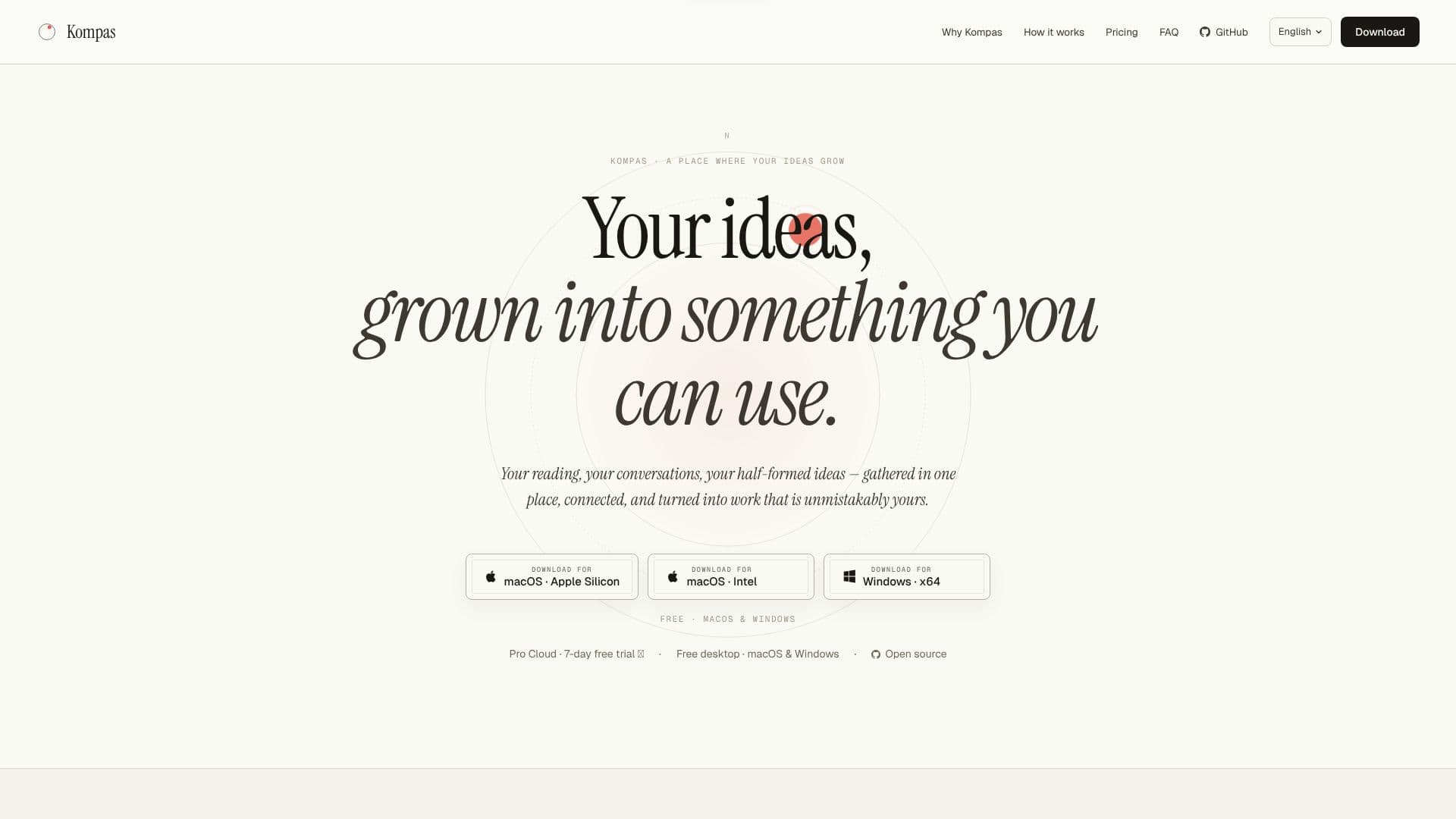
Kompas is designed to be a "compass for thought," a digital space where your ideas can flourish and evolve into tangible outputs. In an era of information overload, where reading, conversations, and AI interactions generate vast amounts of data, Kompas addresses the challenge of retaining and compounding these insights. It provides a structured environment to gather your thoughts, documents, highlights, voice notes, and web pages, marking them as yours from the outset.
Read More
The core functionality revolves around "sessions," where users can delve into a specific topic and think it through with Kompas. The AI assists by recalling past notes, decisions, and reading materials, prompting deeper reflection with relevant questions. Each session leaves a trace, connecting decisions, memories, and retrieved passages to previous work, fostering a continuous flow of thought where today's ideas interact with yesterday's.
Kompas emphasizes that it "writes with you, not for you." It doesn't generate content autonomously but rather surfaces your past work when it's most relevant, ensuring that your writing originates from your own thoughts. This approach is crucial for originality, which Kompas defines as "recollection with intent." The tool transforms your sessions into a connected graph, which then informs your writing process.
Data ownership and privacy are paramount. Kompas offers a free desktop version where all data stays local. The Pro version introduces cross-device sync and optional cloud hosting for your graph, with a commitment that your content is never used for training models. Users can export their data to JSON at any time. The desktop application is open-source under the MIT license, promoting transparency.
Kompas caters to individuals who seek to build upon their ideas rather than merely save them. This includes essayists aiming for drafts that reflect their arguments, researchers engaged in continuous thinking and concept connection, and founders needing to recall past decisions and their rationales. It's also positioned as a step beyond note-taking apps like Obsidian and Logseq, enabling users to actively build on their collected material.
The pricing model is straightforward, offering a free desktop tier with unlimited local use and the ability to bring your own AI keys. Paid tiers, Pro Sync and Pro Full, add cross-device sync and managed AI features, respectively, with clear usage limits and optional top-ups for AI services. A 7-day free trial is available for Pro Full.
- CategoryAI Knowledge Management
- Pricing ModelFreemium
- DeploymentDesktop, Cloud
- PlatformsmacOS, Windows
Kompas's Core Features
Capture documents, highlights, voice notes, and web pages.
AI-assisted sessions to explore topics and recall past notes.
Connects sessions and notes into a personal knowledge graph.
Facilitates writing by surfacing relevant past work.
Data remains local on the free desktop version.
Cross-device sync available with Pro Sync and Pro Full tiers.
Option to use your own OpenAI, Anthropic, or local LLM keys.
Frontier AI built-in with managed usage in Pro Full.
Open-source desktop application under MIT license.
Data is never used for training AI models.
JSON export available for all data.
Real-time voice and audio transcription capabilities.
How to use Kompas?
Capture: Gather your documents, highlights, voice notes, and web pages.
Session: Start a new session with a topic and engage with Kompas.
Connect: Allow Kompas to link your current thoughts to past notes and decisions.
Write: Move your session content into a draft, with your past work surfacing as needed.
Organize: Manage your growing knowledge graph and written drafts.
Kompas's Use Cases
- Idea Capture
- Knowledge Synthesis
- Writing Assistance
- Research Management
- Decision Making
- Personal Knowledge Graph
- AI-Powered Reflection