Description
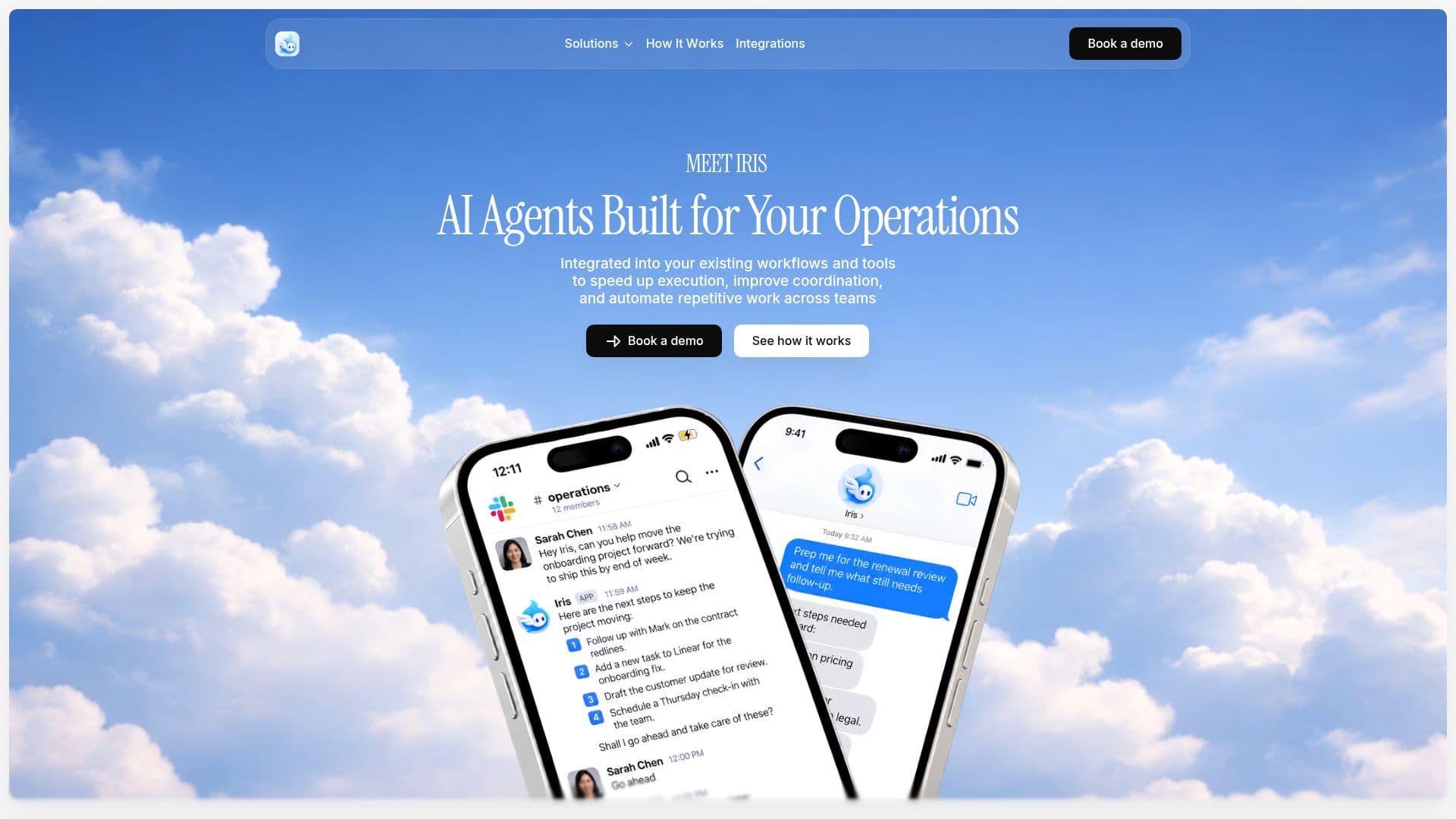
Iris is an AI agent designed to streamline business operations by integrating seamlessly with existing workflows and tools. It automates repetitive tasks, improves coordination, and enhances execution across teams. Iris connects with your CRM, email, documents, and project management tools, allowing work to progress without manual handoffs or copy-pasting between applications.
Read More
The platform is built to handle various operational tasks, such as research, reporting, and routine actions, reducing the need for manual work and coordination across departments. Iris maintains a company memory, ensuring that key decisions, customer context, and operating knowledge are accessible across teams and workflows. This shared memory allows for more efficient operations and reduces the need for repeated briefings.
Iris offers department-specific agents tailored to the unique processes, tools, and approval rules of each team. For example, a sales agent might manage account reviews and CRM updates, while an operations agent might track project commitments and prepare follow-ups. Customization options include workflow steps, connected systems, information access, output formats, approval requirements, and permitted actions.
Iris is model-agnostic, allowing companies to choose supported models based on task requirements, cost, speed, and data policies. For enterprises, Iris can be deployed in various ways, including private cloud or on-premises setups, with features like SSO, role-based access, and audit records.
Overall, Iris provides a comprehensive solution for automating and optimizing business operations, enabling companies to achieve measurable returns by comparing completion times, review efforts, and execution costs against manual processes.
- CategoryAI Personal Assistants
- Pricing ModelCustom
- DeploymentCloud, On-Premises
- PlatformsWeb
Iris's Core Features
Automates repetitive tasks
Integrates with existing tools
Customizable department-specific agents
Maintains company memory
Model-agnostic support
Enterprise deployment options
Supports CRM, email, and project tools
Reduces manual work and coordination
How to use Iris?
Configure: Set up integrations with existing tools
Use: Deploy agents to automate workflows
Optimize: Customize agents for specific departments
Monitor: Track performance and adjust as needed
Iris's Use Cases
- Sales Automation
- Project Management
- Customer Success
- Research Assistance
- Executive Assistance