
Description
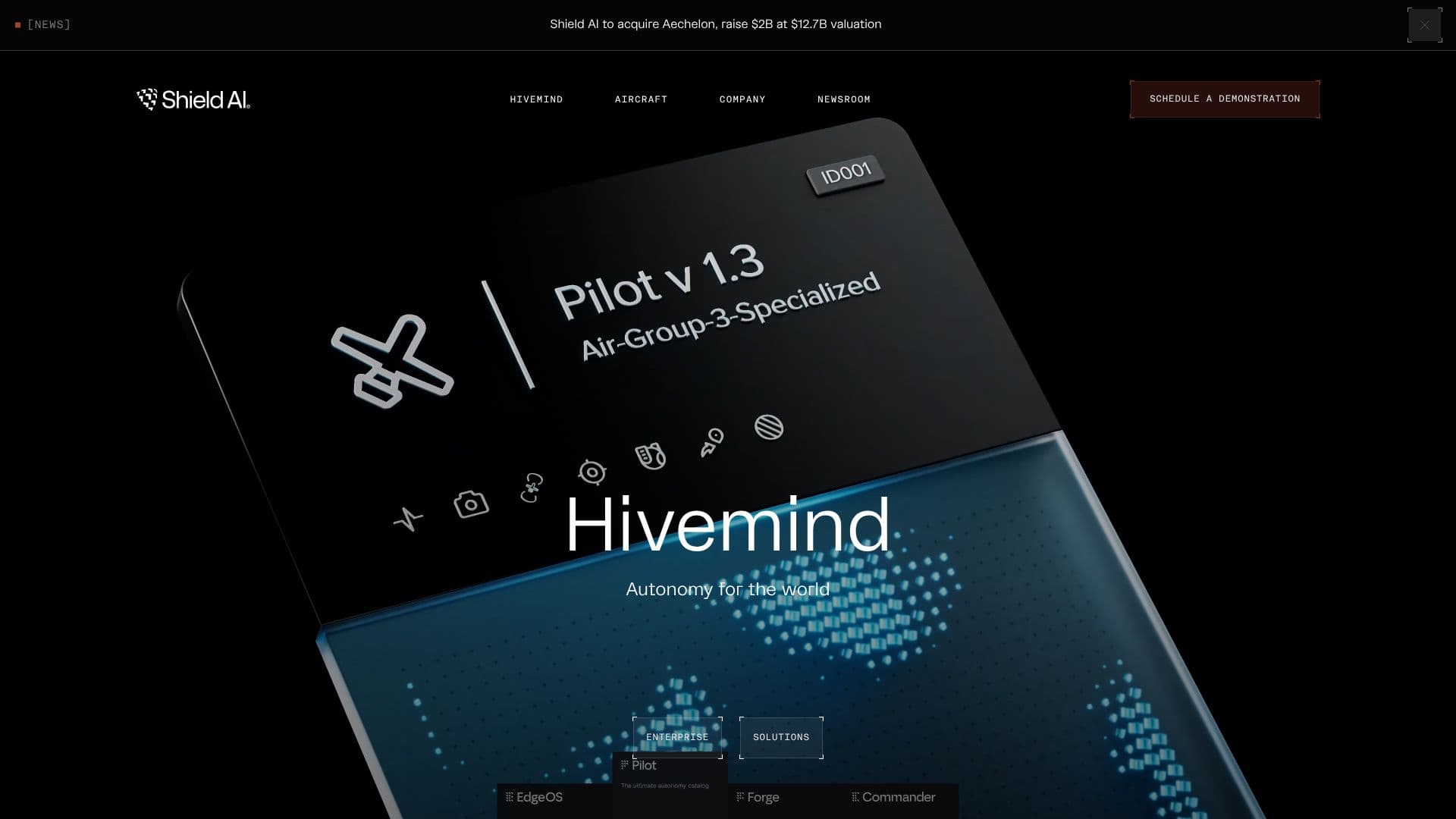
Hivemind is Shield AI's autonomy software for uncrewed aircraft and other unmanned systems, letting them fly and complete missions without relying on GPS or a continuous communications link.
Read More
It operates in GPS- and comms-jammed environments, executes missions autonomously, and coordinates multiple aircraft as a team through multi-agent teaming and swarming. It is platform-agnostic, so it can be integrated across different aircraft rather than tied to one airframe, and is offered for both military and commercial use. Shield AI sells it two ways: Hivemind Solutions, where its own engineers build a turnkey AI pilot for a customer's aircraft and mission, and Hivemind Enterprise, software for a customer's own team to develop, test, and deploy AI pilots while retaining the intellectual property they build.
Since what Shield AI describes as the first fully autonomous combat mission in 2018, Hivemind has flown on platforms including the Lockheed X-62 VISTA testbed, Anduril's YFQ-44A, General Atomics' MQ-20, the Airbus H145, HII's ROMULUS, Kratos' BQM-177, Northrop Grumman's Talon IQ, and Shield AI's own V-BAT and Nova aircraft, among others. In 2026 the company says it was selected as a mission autonomy provider for the U.S. Air Force. Shield AI also reports earlier milestones including the first AI-piloted F-16 flight in 2022, the first AI dogfight in 2023, and the first AI-piloted VTOL fighter jet, the X-BAT, in 2025.
Hivemind is built for militaries and defense OEMs rather than consumer or general commercial users, and Shield AI does not publish pricing; engagement happens through direct contact with the company. A related capability on the same platform, Hivemind Benchmark, applies AI to score and visualize flight maneuvers for post-flight debriefs on U.S. Air Force training aircraft such as the T-6, T-38, F-15E, and F-16.
Shield AI cites operator feedback from multiple countries: an Israeli Yamam unit says Hivemind "saved many lives in combat," and a Ukrainian V-BAT operator describes flying deep into contested territory in GPS- and GNSS-denied conditions with it. Mitsubishi Heavy Industries has also said Hivemind will help accelerate its own mission autonomy development in Japan, and the company lists the Republic of Singapore Air Force among its customers as well. For Hivemind Enterprise customers specifically, Shield AI emphasizes that they retain full intellectual property rights over the autonomy they build for their own unmanned system.
- CategoryRobotics & AI Hardware
- Pricing ModelContact sales
- DeploymentAirborne
Hivemind's Core Features
Autonomous flight and mission execution without GPS or continuous comms
Multi-agent teaming and swarming across multiple aircraft
Platform-agnostic integration across different unmanned aircraft
Hivemind Solutions: turnkey AI pilots built by Shield AI engineers
Hivemind Enterprise: software for customers to build and own their own AI pilots
Deployed across single-arm aircraft types from ISR drones to fighter-class platforms
Post-flight debrief scoring and visualization of flight maneuvers
Dual-use design for both military and commercial operators
How to use Hivemind?
Contact Shield AI: Reach out to discuss your unmanned aircraft or mission requirements.
Choose an engagement model: Pick Hivemind Solutions for a turnkey build or Hivemind Enterprise to build your own.
Integrate with your platform: Work with Shield AI to fit Hivemind to your aircraft or system.
Test in your environment: Validate autonomous performance in GPS- and comms-denied conditions.
Deploy and debrief: Fly missions and use Hivemind Benchmark to review flight performance afterward.
Hivemind's Use Cases
- GPS-denied missions
- Multi-aircraft teaming
- OEM autonomy integration
- Post-flight debrief