Description
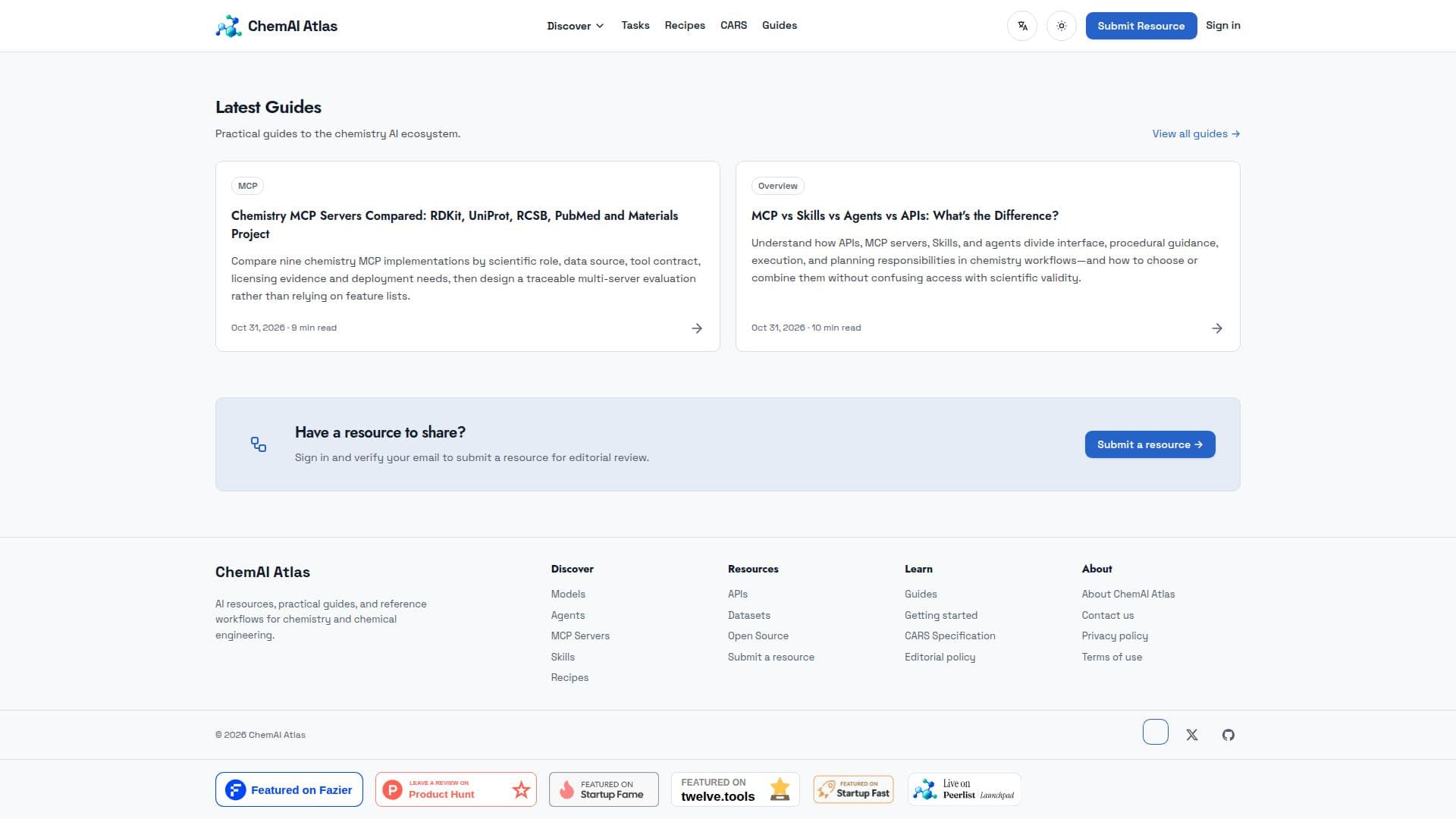
ChemAI Atlas serves as a central hub for exploring and applying artificial intelligence within chemistry and chemical engineering. This platform is designed to assist researchers, students, developers, and industry professionals in discovering relevant AI tools, understanding underlying technologies, and navigating complex research workflows. It addresses the challenge of finding and integrating diverse AI resources, which are often scattered across various websites, code repositories, and academic projects.
Read More
The platform categorizes AI resources into several key areas, including molecular and materials AI models, research and scientific workflow agents, MCP servers for connecting AI clients to chemistry tools, reusable skills for AI workflows, chemical data APIs, datasets for scientific machine learning, open-source libraries, and commercial/academic platforms. Users can browse these categories to review the purpose, sources, and requirements of each tool.
Beyond discovery, ChemAI Atlas provides practical learning resources. Its 'Guides' section offers insights into key concepts, tool selection, deployment strategies, evaluation methods, and limitations of chemistry AI. The 'Recipes' section allows users to start with a specific research goal and explore suggested tool combinations, setup approaches, step-by-step instructions, and verification checks. These recipes serve as adaptable technical references, aiding in the practical application of AI in chemistry.
ChemAI Atlas also fosters open initiatives, such as CARS (Chemistry AI Recipe Specification), a community draft for describing and sharing chemistry AI workflows. The platform's content is meticulously curated, drawing from official websites, public repositories, technical documentation, and academic sources. While AI may assist in drafting and organizing information, all claims are grounded in verifiable sources, and users are encouraged to cross-reference original documentation for features, licensing, and performance details. The platform is operated by the ChemAI Atlas team, based in Japan, and offers content in English, Simplified Chinese, and Japanese.
- CategoryScientific Discovery & Lab Tools
- Pricing ModelFree
- DeploymentWeb-based
- PlatformsWeb
ChemAI Atlas's Core Features
Explore AI models for molecular and materials science
Discover research and scientific workflow agents
Access MCP servers for connecting AI clients to chemistry tools
Browse reusable skills for AI workflows
Find chemical data and developer interfaces (APIs)
Locate datasets for scientific machine learning
Identify open-source libraries and tools
Explore commercial and academic platforms for chemistry AI
Access practical guides on chemistry AI concepts and tools
Utilize research workflow Recipes for practical application
Support for CARS (Chemistry AI Recipe Specification)
Editorial review of resources and recipes
Content available in English, Simplified Chinese, and Japanese
Provides examples of computational workflow validation
Features tools for molecular property prediction and generation
How to use ChemAI Atlas?
Discover Resources: Browse models, agents, MCP servers, skills, APIs, datasets, open-source tools, and platforms by category or task.
Learn Technologies: Read guides on key concepts, tool selection, deployment, evaluation, and limitations of chemistry AI.
Explore Recipes: Start with a research goal and examine suggested tool combinations, setup approaches, steps, and checks.
Understand the Stack: Learn how MCP, skills, agents, and APIs fit together in chemistry workflows.
Connect Your Tools: Integrate scientific data into AI applications using APIs like PubChem and RCSB PDB.
Build a Workflow: Turn theoretical concepts into practical research processes, such as building a cheminformatics workflow with RDKit.
ChemAI Atlas's Use Cases
- Molecular Property Prediction
- Molecular Generation
- Chemical Structure Recognition
- Cheminformatics Analysis
- Reaction Prediction
- Retrosynthesis Planning
- Spectroscopy Interpretation
- Literature & Research Connection
- Protein-Ligand Docking
- Crystal Relaxation