Description
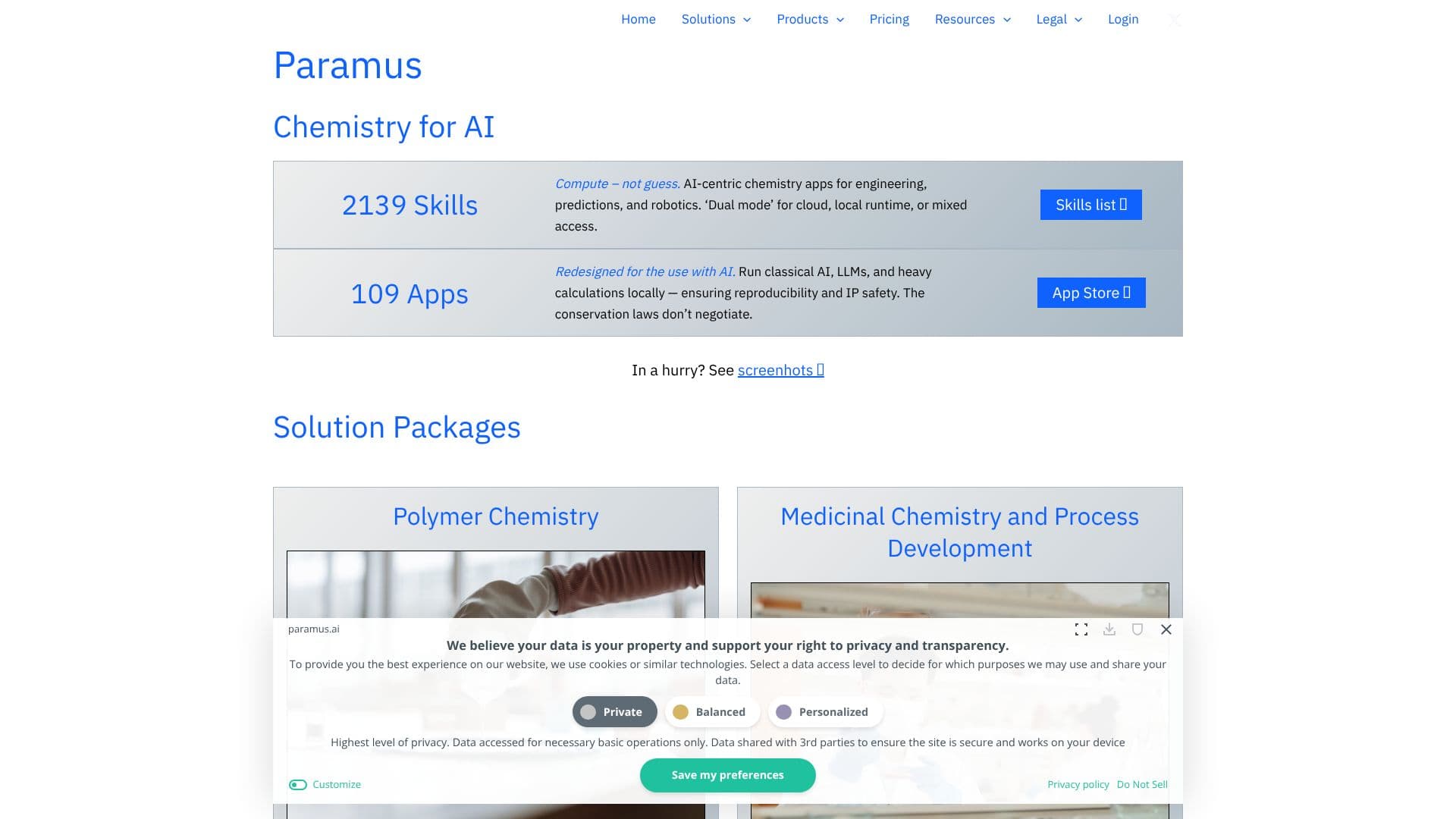
Paramus.ai is a computational chemistry platform designed to bridge the gap between artificial intelligence and scientific computation. It offers AI-centric applications specifically for engineering, predictions, and robotics, enabling users to run classical AI, LLMs, and heavy calculations locally. This local execution ensures reproducibility and protects intellectual property, a critical aspect in scientific research and development.
Read More
The platform's 'dual mode' capability allows for flexible access, supporting cloud, local runtime, or a mixed approach, catering to diverse user needs and environments. Paramus.ai transforms the fragmented landscape of simulations, models, and data into a unified, usable, and evolving ecosystem engineered for AI. It emphasizes that conservation laws do not negotiate, highlighting the platform's commitment to accurate and verified computations.
Key solution packages include Polymer Chemistry for AI-powered design of polymers and processes, accelerating discovery with AI models and agent-driven optimization. Medicinal Chemistry and Process Development focuses on predicting properties, optimizing reactions, and accelerating drug discovery through multi-agent workflows and secure local inference, used by researchers from Ivy League universities. Material Science offers inverse design of new materials using AI combined with simulation tools like ORCA, LAMMPS, AIMNet2, and MatterGen. Chemical Engineering provides AI-powered design of processes and plants, leveraging generative LLMs for complex calculations.
Paramus.ai distinguishes itself by combining generative AI with exact chemistry models, ensuring verified atoms, validated reactions, and trustworthy computations from kinetics to DFT, explicitly avoiding hallucinations. The platform serves a heterogeneous ecosystem with different client roles collaborating to deploy, extend, and evolve the chemistry platform. These roles include Single Users (individual scientists/engineers), Contributors (experts/teams providing models, agents, data, or domain knowledge, receiving free access), and Partners (resellers and system integrators). Data Scientists can utilize the Paramus Python API to accelerate tool availability and integrate Paramus into Jupyter notebooks, eliminating the need to repeatedly set up computational software or datasets.
The platform exposes over 1,200 chemistry tools via the Model Context Protocol (MCP), enabling AI assistants like Claude, GitHub Copilot, and Cursor to execute computations through natural language. Paramus Chemistry OS runs locally on Windows 10 and 11, with no cloud dependency required for computation. A cloud edition is available for browser-based access and team collaboration.
- CategoryScientific Discovery & Lab Tools
- Pricing ModelFree for Academic, Commercial
- DeploymentCloud, Local, Mixed
- PlatformsWindows
Paramus.ai's Core Features
AI-centric chemistry applications
Local and cloud runtime options ('dual mode')
Reproducibility and IP safety through local execution
Integration of generative AI with exact chemistry models
Verified atoms, validated reactions, and trustworthy computations
Multi-agent workflows for drug discovery and process optimization
Inverse design of new materials with AI + simulation tools
AI-powered design of processes and plants
Exposes 1,200+ chemistry tools via Model Context Protocol (MCP)
Python API for Data Scientists
Runs locally on Windows 10 and 11
Free access for academic use
Commercial licenses available
How to use Paramus.ai?
Download: Obtain the installer from paramus.ai.
Install: Run the setup wizard on your Windows machine.
Configure: No initial configuration needed for local use.
Compute: Use INTENT to ask questions or run computations in natural language.
Integrate: Utilize the Python API in Jupyter notebooks for advanced workflows.
Collaborate: Access cloud edition for team-based projects and browser-based use.
Paramus.ai's Use Cases
- Polymer Design
- Drug Discovery
- Material Science
- Process Engineering
- Robotics
- Local Inference
- Agentic Workflows
- Data Integration