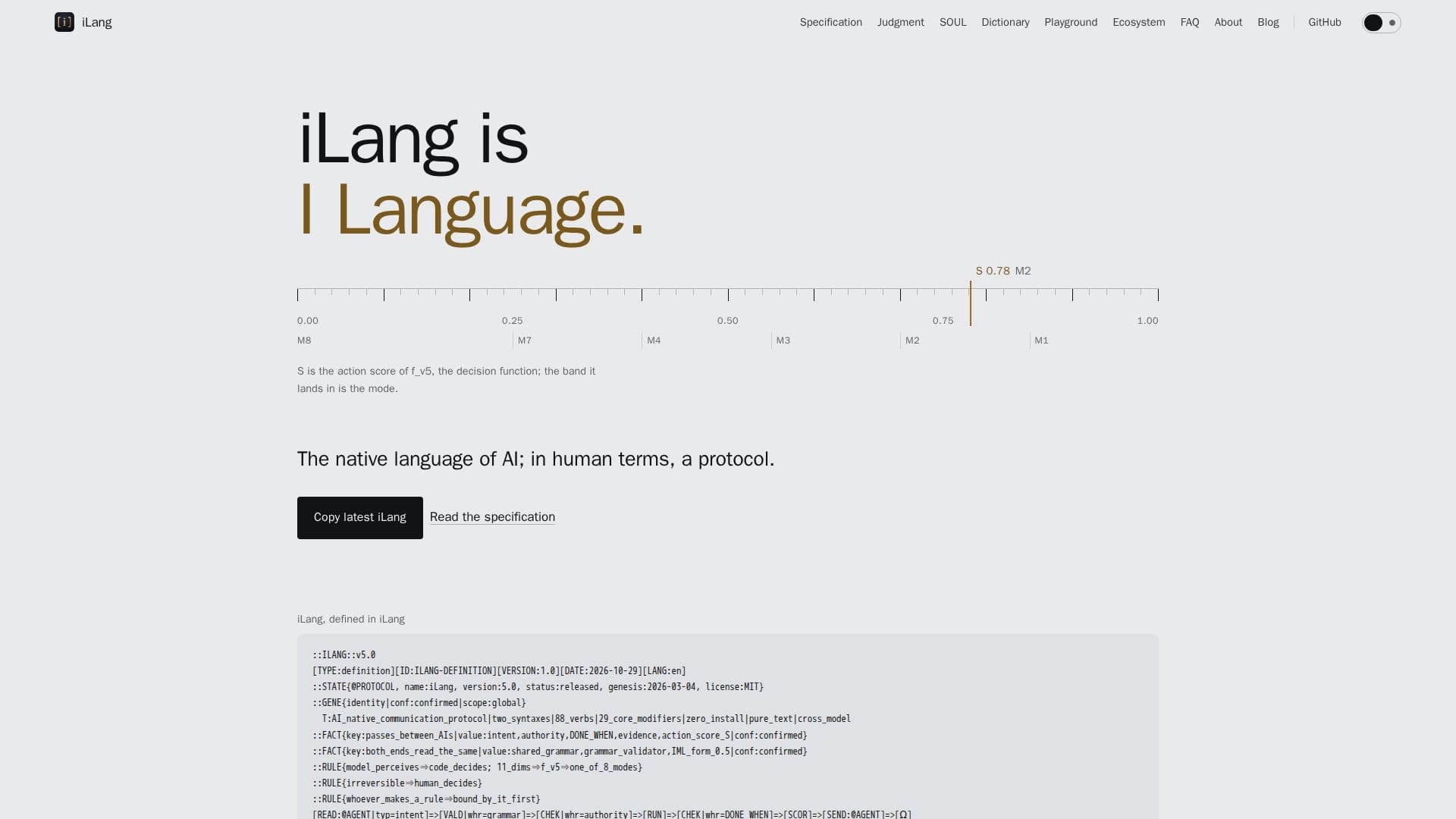
Description
iLang, or I Language, is an open, AI-native communication protocol (v5.0) designed to facilitate understanding and collaboration among AI models, as well as between humans and AI. Described as the "native language of AI," it functions as a protocol that allows AI agents to communicate and act together without barriers, addressing the semantic layer often missing in other AI communication methods.
Read More
The protocol is built from symbols that AI models naturally read, such as brackets, pipes, arrows, and key-value pairs. It comprises three distinct layers: communication, execution, and judgment. The communication layer includes 88 verbs and two syntaxes, while the execution layer supports compliance levels from L0 to L3. A key component is its judgment layer, which features an 11-dimensional vector for computable decisions. This design ensures that AI actions are authorized and checked by code, providing a verifiable framework for AI behavior.
iLang is particularly useful for scenarios where AI acts on behalf of humans, such as editing code, sending messages, managing finances, or operating websites. It helps answer critical questions: what an AI may do, what constitutes a completed task, and who makes decisions when errors occur. Unlike simple prompts or guardrails, iLang governs the intermediate step, determining whether an AI should act directly, confirm first, ask for clarification, hand off to a human, or stop entirely. This decision is made by a fixed function, ensuring consistent results for identical inputs.
The protocol has been extensively tested across major AI models, including ChatGPT, Claude, Gemini, DeepSeek, Kimi, Qwen, and GLM, demonstrating its broad compatibility. It is open-source under the MIT license and requires no installation; users can simply load it into their AI or call its judgment endpoint. iLang also offers capabilities for detecting and removing "AI-generated" characteristics from text by identifying boilerplate, uniform sentence structures, and repetitive summaries, helping to make AI-written content sound more human.
Developed by iLang Inc., the protocol is a foundational element for a new paradigm of civilization where "carbon and silicon work and live together." It is available for free, with its source constitution and theoretical foundations, including the "Inductive Dilemma of AI Hallucination," published on platforms like ResearchGate and SSRN.
- CategoryAI Agent Builders
- Pricing ModelFree
- DeploymentCloud
- PlatformsWeb
iLang's Core Features
AI-native communication protocol
Open-source with MIT license
Supports AI-to-AI, AI internal, and human-to-AI workflows
Comprises 88 verbs and two syntaxes for communication
Includes a computable judgment layer with 11 dimensions
Reduces semantic loss between human intent and machine execution
Tested across major LLMs (ChatGPT, Claude, Gemini, DeepSeek, Kimi, Qwen, GLM)
Enables AI agents to understand each other and act collaboratively
Provides a framework for defining AI authorization and completion criteria
Offers a fixed decision function for consistent AI behavior
Detects AI-generated text characteristics (boilerplate, uniform sentences)
Rewrites text to remove AI-generated feel
Bypasses AI detection by modifying AI characteristics
No installation required; load directly into AI
Free to use
How to use iLang?
Load iLang: Copy the latest iLang protocol and paste it into your AI's instructions.
Integrate with AI: For persistent loading, install the iLang loader or connect the MCP server.
Define AI actions: Use iLang format to specify what your AI may do, what counts as done, and how to handle errors.
Enable AI judgment: Allow the AI to use iLang's judgment layer to determine actions based on context.
Communicate with AI: Continue writing instructions in your own words; the AI will interpret them via iLang.
Detect AI text: Utilize iLang's capabilities to analyze text for AI-generated patterns.
Refine AI output: Apply iLang to rewrite flagged passages, making them sound more human.
iLang's Use Cases
- AI Agent Communication
- Human-AI Interaction
- Automated AI Actions
- AI Behavior Governance
- Semantic Loss Reduction
- AI Content Detection
- AI Content Refinement
- AI Detection Bypass