
Description
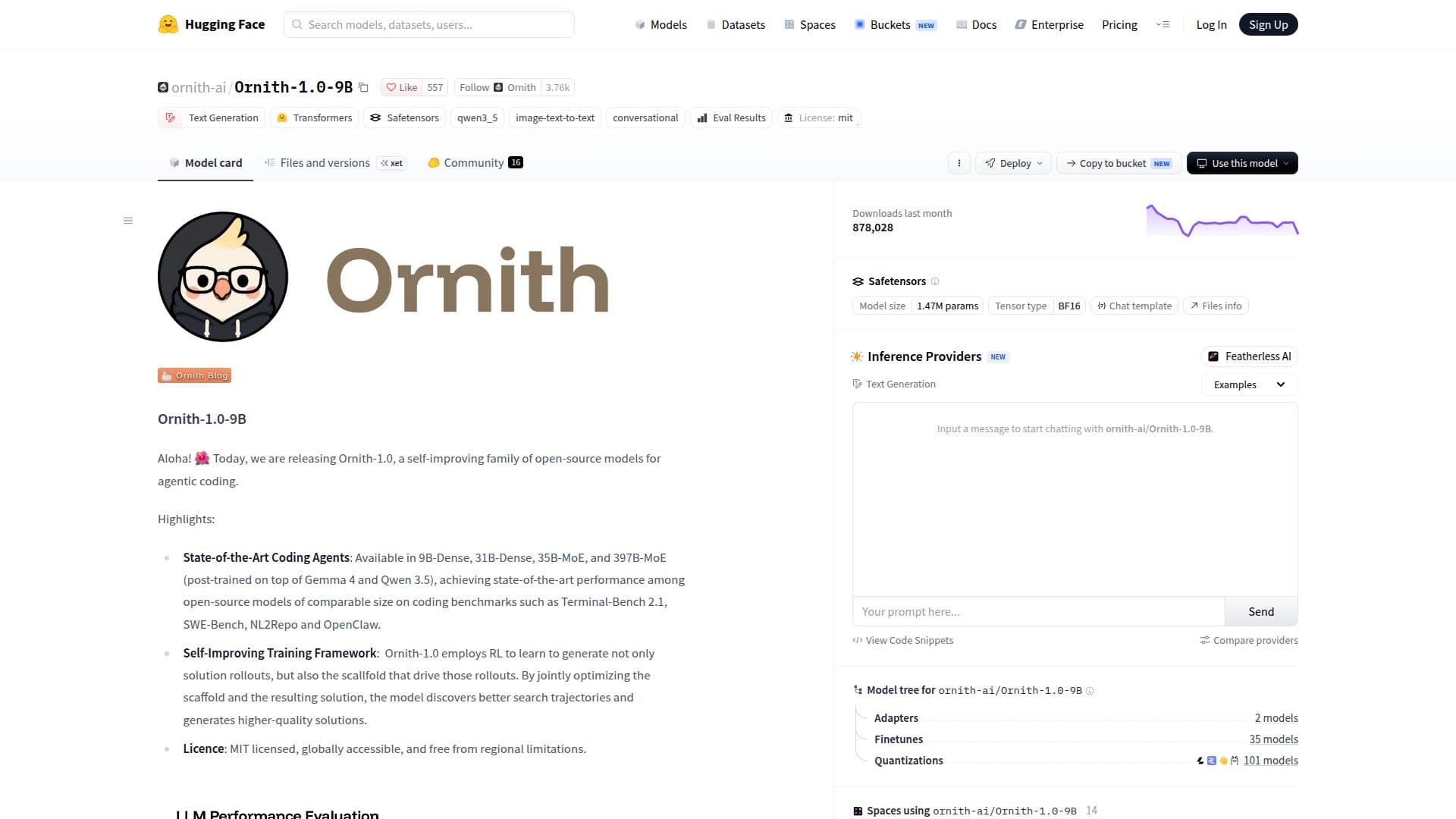
Ornith-1.0-9B is part of the Ornith family, a collection of open-source models aimed at advancing agentic coding. This model is the most lightweight member, optimized for efficient deployment on a single GPU. It is designed to perform exceptionally well on coding benchmarks such as Terminal-Bench 2.1, SWE-Bench, NL2Repo, and OpenClaw, achieving state-of-the-art results among models of comparable size.
Read More
The model employs a self-improving training framework that uses reinforcement learning to generate solution rollouts and the scaffolds that drive them. By optimizing both the scaffold and the resulting solution, Ornith-1.0-9B discovers better search trajectories and generates higher-quality solutions.
Ornith-1.0-9B is MIT licensed, making it globally accessible and free from regional limitations. It supports a variety of agent frameworks and can be integrated with OpenAI-compatible clients, offering flexibility for developers.
The model's benchmarks demonstrate its superior performance. For instance, it scores 43.1 on Terminal-Bench 2.1 (Terminus-2) and 69.4 on SWE-Bench Verified. These results highlight its capability to handle complex coding tasks efficiently.
Ornith-1.0-9B is compatible with recent runtimes like Transformers ≥ 5.8.1, vLLM ≥ 0.19.1, and SGLang ≥ 0.5.9. It is optimized for terminal-based coding agents, allowing developers to automate tedious work and ship faster.
- CategoryAI Models & LLMs
- Pricing ModelFree
- DeploymentCloud
- PlatformsWeb
Ornith-1.0-9B Highlights
State-of-the-Art Coding Agents
Self-Improving Training Framework
MIT Licensed
Efficient Single-GPU Deployment
OpenAI-Compatible Endpoint
Supports Agent Frameworks
Optimized for Terminal-Based Coding
High Performance on Coding Benchmarks
Getting Started with Ornith-1.0-9B
Access model page: visit Hugging Face
Authenticate: log in or create an account
Configure: set up the model with required parameters
Send prompts: interact with the model via API
Fine-tune: adjust model settings for specific tasks
Ornith-1.0-9B's Use Cases
- Agentic Coding
- Single-GPU Deployment
- OpenAI-Compatible Integration
- Terminal-Based Coding
- Reinforcement Learning