
Description
CBLL Research Lab's energy-based models page is a research resource from NYU's Computational and Biological Learning Lab (CBLL), covering an area of study active since September 2003 with participants including Yann LeCun, Sumit Chopra, Raia Hadsell and Fu-Jie Huang. Rather than a structured course with a syllabus, it organizes tutorial slide decks, streaming video talks and publications that teach the theory and practice of energy-based models (EBMs).
Read More
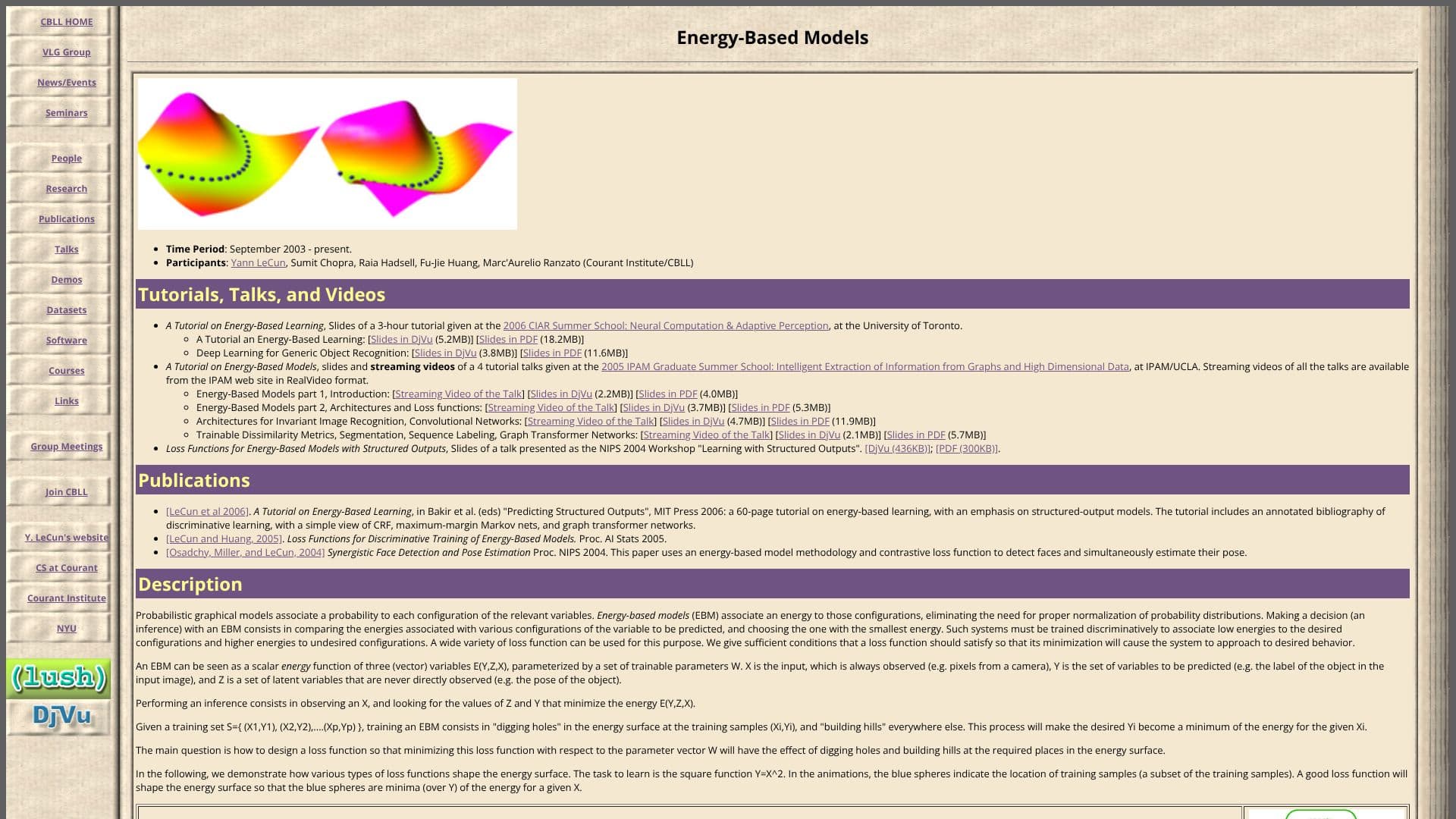
An EBM associates an energy value with each configuration of a set of variables, instead of a normalized probability as in a standard probabilistic graphical model. Making a prediction (an inference) means finding the configuration with the lowest energy, and training an EBM means shaping the energy surface so that desired configurations sit at low energy and undesired ones sit higher, guided by a loss function designed for that purpose.
The page's tutorials include "A Tutorial on Energy-Based Learning," given at the 2006 CIAR Summer School at the University of Toronto, with slides in DjVu and PDF; a 4-part tutorial from the 2005 IPAM Graduate Summer School at UCLA, with streaming video and slides covering an introduction to EBMs, architectures and loss functions, convolutional networks for invariant image recognition, and trainable dissimilarity metrics, segmentation, sequence labeling and graph transformer networks; and a talk on loss functions for EBMs with structured outputs from a NIPS 2004 workshop. Linked publications include the 60-page tutorial "A Tutorial on Energy-Based Learning" (Bakir et al., 2006), "Loss Functions for Discriminative Training of Energy-Based Models" (LeCun and Huang, 2005), and "Synergistic Face Detection and Pose Estimation" (Osadchy, Miller and LeCun, NIPS 2004), which applies EBM methodology and a contrastive loss function to detecting faces and estimating their pose at the same time. The page also includes animated demonstrations that visualize how different loss functions shape an EBM's energy surface on a simple example task.
This resource is aimed at graduate students and researchers studying machine learning theory, particularly energy-based and structured-output models, rather than at developers looking for a downloadable tool. All the slides, videos and linked papers are freely accessible on the page.
- CategoryOther AI Tools
CBLL Research Lab's Core Features
Tutorial slide decks on energy-based model theory, in DjVu and PDF formats
Streaming video recordings of a 4-part IPAM Graduate Summer School tutorial
Published papers on energy-based and structured-output learning
Animated demonstrations showing how different loss functions shape an energy surface
A NIPS workshop talk on loss functions for structured outputs
Research on convolutional networks for invariant image recognition
A paper on synergistic face detection and pose estimation using EBM methodology
How to use CBLL Research Lab?
Start with the overview: Read the Energy-Based Models description on the page for the core concept.
Watch the IPAM tutorial: Follow the 4-part streaming video series for the fullest walkthrough.
Read the tutorial paper: Work through "A Tutorial on Energy-Based Learning" for the theory in depth.
Review the demonstrations: Study the animated examples showing how loss functions shape the energy surface.
Check the publications: Read the linked papers for specific applications such as face detection and pose estimation.
CBLL Research Lab's Use Cases
- Learning EBM theory
- Structured-output learning
- Academic reference