
Description
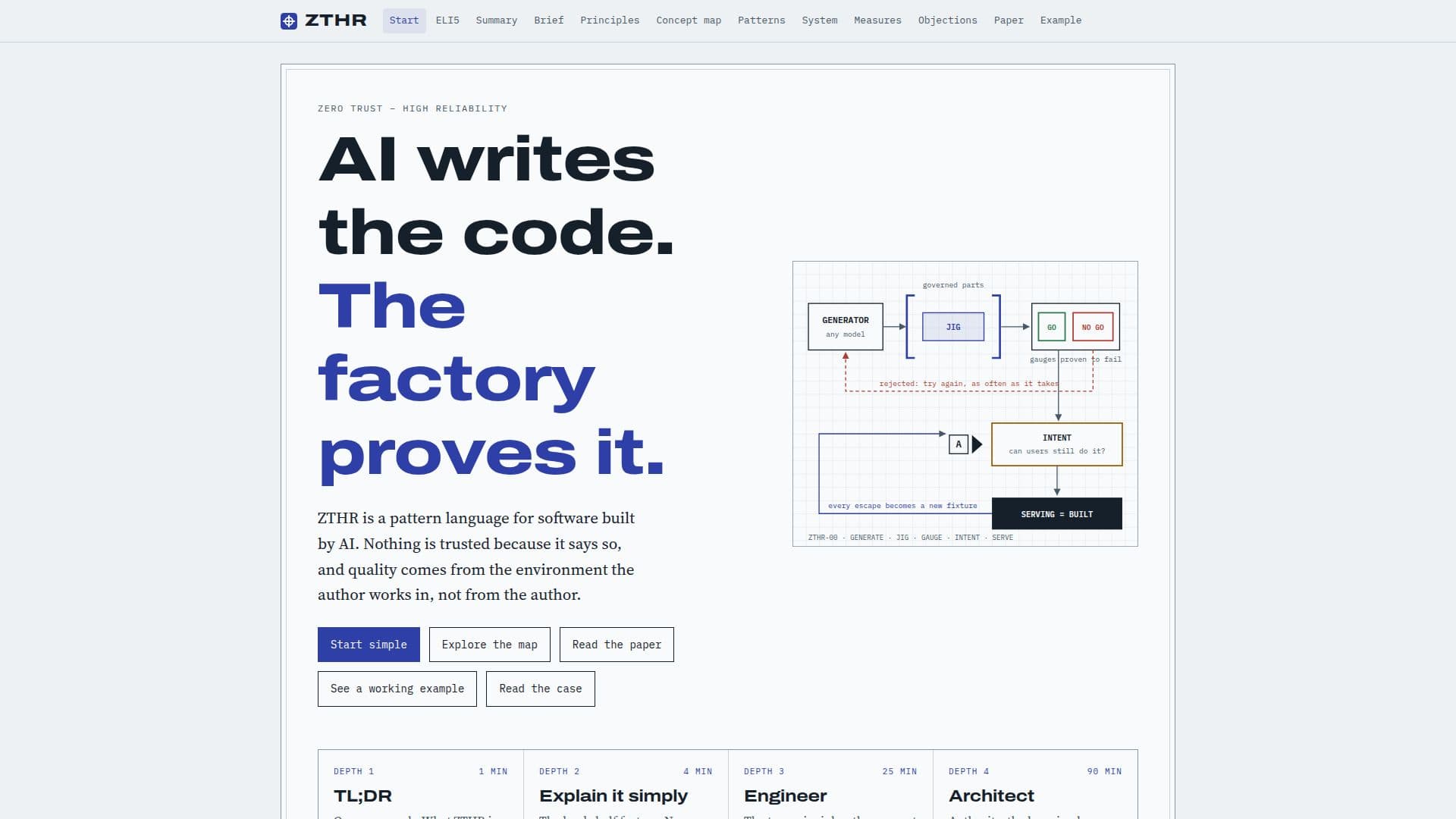
ZTHR, which stands for Zero Trust – High Reliability, is a comprehensive framework designed for developing software where AI writes the code. It addresses the challenge that while code generation is becoming nearly free, deciding whether the generated code is correct remains a significant hurdle. ZTHR proposes a "factory" approach that cannot be fooled, relying on governed parts, proven checks, and user intent statements that authors cannot rewrite. This allows AI models to iterate as many times as needed, shipping only what passes rigorous verification, and turning every miss into a new check.
Read More
The core of ZTHR is built on two principles: Symmetric Zero Trust and the Fixture Inversion. Symmetric Zero Trust means no participant gains authority by merely asserting success; all claims must be backed by evidence the claimant does not control. This applies to authors (human or AI models), models inside products, verification checks, and operators. The Fixture Inversion shifts the focus of quality from the author's skill to the quality of the "fixtures"—governed mechanisms that constrain capabilities, evaluate properties, or control progression. In this model, authors become generators of candidates, and expertise is spent defining intent and building robust fixtures rather than writing and reviewing every line of code.
The framework is structured around 33 patterns organized into six families: Construction (jigs), Verification (gauges), Intent, Independence, Operational, and Runtime and Environment. Construction patterns dictate what can be built, such as Governed Foundation and Parts Catalog with Purpose Notes. Verification patterns ensure code meets stated properties and that checks themselves are effective, including Zero-Bypass Admission and Prove the Gate Can Fail. Intent patterns focus on ensuring the product fulfills user goals, with Intent as the Primary Datum and Locked Intent.
Independence patterns ensure that the system is understandable and verifiable by a reader without the author's context, utilizing concepts like Multi-Family Review and Roles Defined by What They Are Denied. Operational patterns cover aspects like deployment and continuous operation, ensuring that what ships is what passed, exemplified by Done Means Serving and The Persistent Operator. Finally, Runtime and Environment patterns ensure model behavior adheres to policy during use and that integrations hold under various conditions, including The Deterministic Sandwich and Authorization by Absence.
ZTHR also incorporates learning loops, such as the bounded generation loop and the improvement loop, where every failure is converted into a new fixture, continuously enhancing the system's fidelity. The framework defines clear roles and authorities within a control plane, ensuring separation of concerns and tamper-evident records for all consequential actions. It provides a systematic way to measure success, including intent completion rate, generation convergence, problem detection speed, and system learning, making it a comprehensive solution for building and assuring AI-generated software.
- CategoryAI DevOps & Cloud Tools
- Pricing ModelNot specified
- DeploymentCloud
ZTHR's Core Features
Symmetric Zero Trust principle for all participants
Fixture Inversion model for quality assurance
33 patterns across six families: Construction, Verification, Intent, Independence, Operational, Runtime
Governed Foundation for application identity, audit, deploy, and checks
Parts Catalog with Purpose Notes for assembling qualified components
Zero-Bypass Admission for all required checks
Prove the Gate Can Fail to ensure check effectiveness
Intent as the Primary Datum for user goal-oriented verification
Locked Intent to prevent goal modification by code changes
Multi-Family Review for diverse model-based code assessment
Roles Defined by What They Are Denied for structural limits
Done Means Serving for deployment by identity and verification of running code
The Persistent Operator for continuous, bounded actions
The Deterministic Sandwich for model behavior within policy
Improvement loop for converting failures into new fixtures
How to use ZTHR?
Understand the Principles: Begin by studying the Symmetric Zero Trust and Fixture Inversion principles to grasp the core philosophy.
Explore the Patterns: Review the 33 patterns across the six families to understand how ZTHR structures software development and assurance.
Implement Construction Jigs: Apply patterns like Governed Foundation and Parts Catalog to constrain what can be built by AI models.
Integrate Verification Gauges: Implement patterns such as Zero-Bypass Admission and Prove the Gate Can Fail to rigorously check AI-generated code.
Define User Intent: Establish clear user intent as the primary datum using patterns like Intent as the Primary Datum and Locked Intent.
Set Up Learning Loops: Configure the bounded generation loop and improvement loop to ensure continuous learning and system enhancement.
Deploy with Assurance: Utilize operational patterns like Done Means Serving to deploy code that is proven to match what passed verification.
ZTHR's Use Cases
- High-Reliability Software Development
- Automated Code Assurance
- AI-Assisted Software Engineering
- Continuous Improvement in Development
- Zero Trust Security in SDLC
- Governed Software Construction
- User Intent-Driven Development
- Automated Deployment Verification