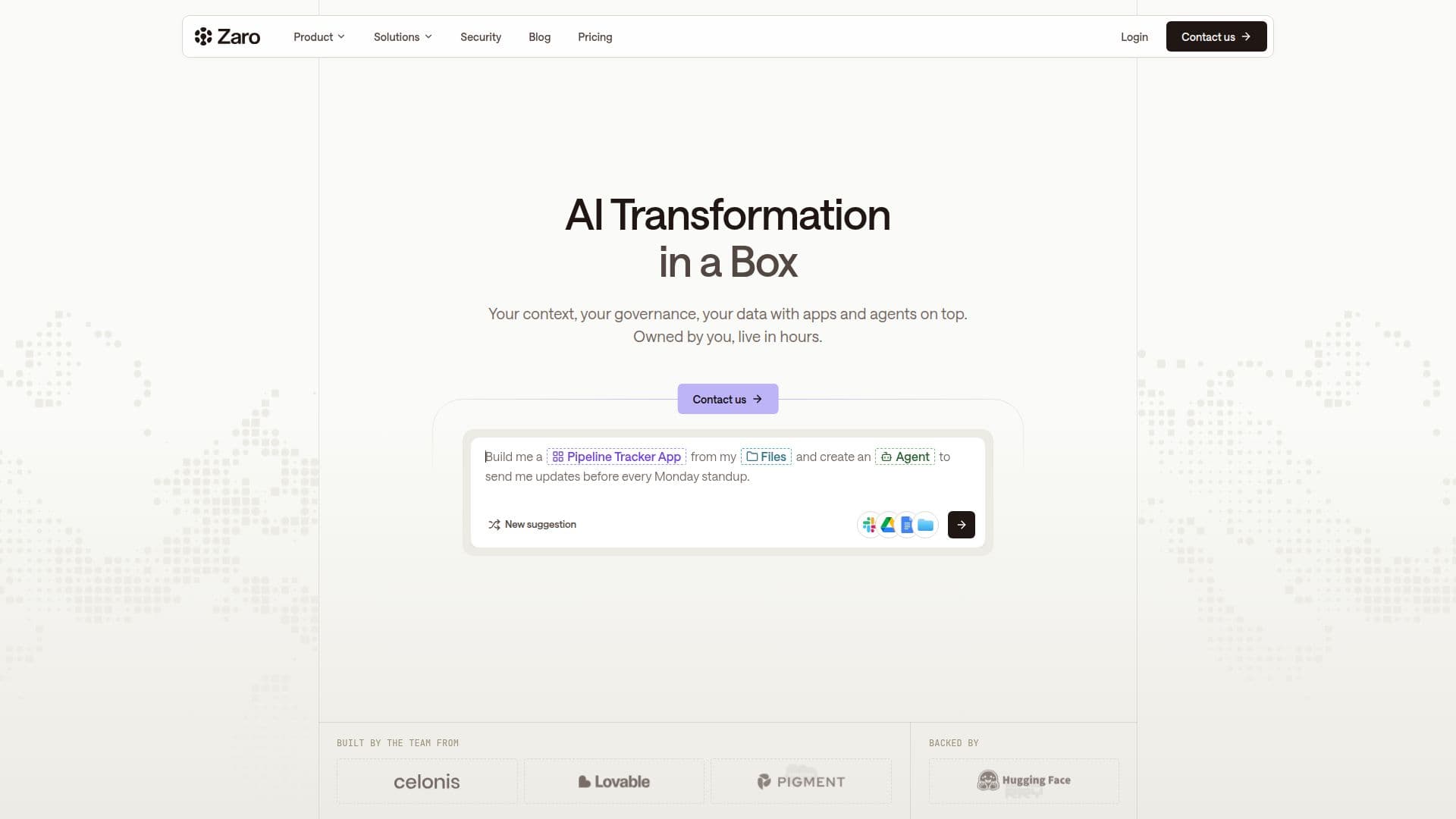
Description
Zaro is a platform for keeping one current, attributable account of how a company actually runs. It positions itself against three earlier approaches to giving AI access to company knowledge: a data warehouse, which made structured numbers queryable but left out most of what a company actually knows; a per-person AI assistant, which gave everyone a tool but no shared memory; and a knowledge graph, which is accurate on the day it is built but goes stale because it never writes back to reflect what changes afterward.
Read More
Zaro's alternative keeps company context as a set of versioned files that the work itself writes to as things change, rather than a static index rebuilt occasionally. Every answer Zaro gives names the specific file it came from, and opening that file shows which version was read and who last changed it, so an answer can be checked rather than taken on faith. Version history is kept automatically as files update.
A security and governance layer sits underneath: access to files, tools, apps and actions is scoped, activity stays visible, and important actions leave a trail. Three examples the company gives of how this is used in practice: a retailer joining sales, footfall, pricing and customer feedback across stores to explain why one location outperforms its region; a sales team reading calls, emails and deals to surface what its best performers do differently and turning that into a playbook; and a manufacturer comparing scheduling and sourcing decisions across multiple plants so a discovery at one location becomes every plant's playbook.
Zaro was built by a team with backgrounds from Convergence, PolyAI, Salesforce, Celonis, Lovable and Pigment, and people from Imperial College London, the University of Cambridge and the University of Oxford, and is backed by Cherry and Hugging Face.
Pricing is not published; there is no self-serve signup, and engagement starts with a conversation with the Zaro team. It is aimed at companies whose knowledge is spread across many people, systems or locations, multi-store retailers, sales organizations and multi-plant manufacturers among them, rather than small, single-location businesses.
- CategoryAI Agent Builders
- Pricing ModelFreemium
- DeploymentCloud
- PlatformsWeb
Zaro's Core Features
Company knowledge stored as versioned files that update as the work itself changes
Every AI answer names the specific file it drew from
File-level version history showing what changed and who changed it
Access to files, tools, apps and actions is scoped, with a trail for important actions
Cross-functional analysis across sales, footfall, pricing and customer feedback data
Surfaces what top-performing reps or teams do differently from call, email and deal data
Compares decisions and outcomes across multiple locations or plants
Built by a team with backgrounds from Convergence, PolyAI, Salesforce, Celonis, Lovable and Pigment
How to use Zaro?
Talk to the team: Start with a conversation to scope your company's data and systems.
Connect your sources: Bring in the files, systems and work streams Zaro should read from.
Let it build the record: Zaro turns that work into a versioned, current account of your business.
Ask questions: Query the system for answers sourced back to a specific file.
Review the source: Open the file behind any answer to check who last changed it and when.
Set access and governance: Scope who can read, call or change each file or tool.
Zaro's Use Cases
- Retail performance analysis
- Sales coaching from real data
- Manufacturing coordination
- Governed company knowledge