Description
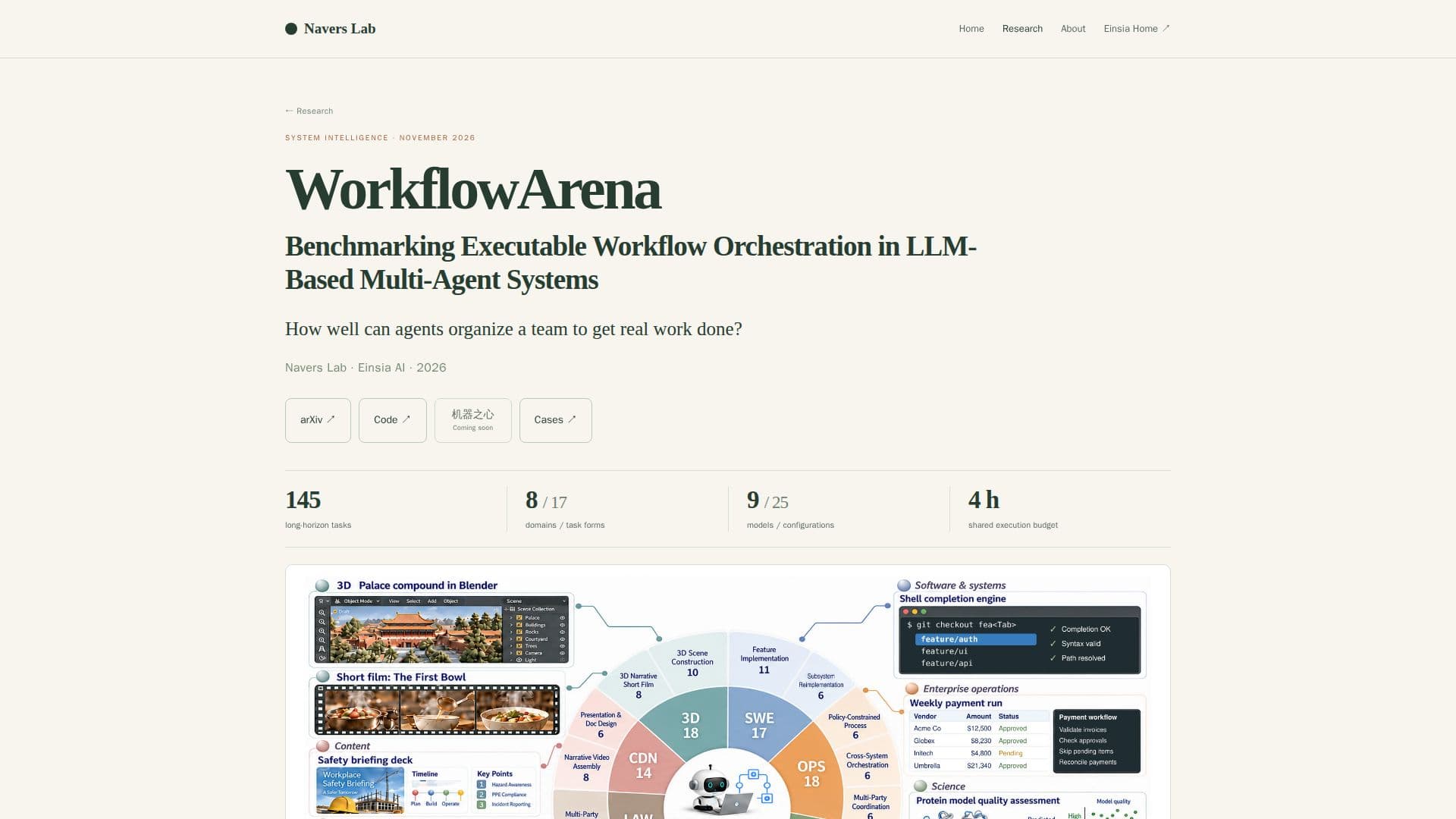
WorkflowArena serves as a rigorous benchmarking platform designed to evaluate the capabilities of LLM-based multi-agent systems in orchestrating complex, executable workflows. The benchmark encompasses 145 long-horizon tasks spanning eight distinct professional domains, including Software & Systems, Enterprise Operations, Science, Formal Mathematics, Finance, Law, Content Design, and 3D Production. Each task is structured with an initial workspace, a clear deliverable contract, and hidden evaluation criteria, ensuring that components must fit together and satisfy specific constraints, such as code passing regressions or accounts reconciling.
Read More
The platform assesses how well agents can organize a team to accomplish real work, focusing on the effectiveness of delegation and workflow quality. It provides insights into how different systems organize tasks, observing patterns like Claude systems delegating less frequently in larger worker groups compared to GPT systems making more workflow calls with fewer workers. WorkflowArena also investigates the transferability of workflow quality, demonstrating that Opus-authored static workflows can significantly improve the performance of various executors on challenging tasks.
Key metrics include "Overall Resolved," which measures the mean of resolved rates across all eight domains, requiring every acceptance criterion to be met. "Overall Score" provides a continuous score on a 0–100 scale, crediting progress even when full acceptance is not achieved. Users can explore detailed results, comparing model-harness systems by full acceptance or partial progress, and analyze performance across different domains and configurations.
WorkflowArena's construction involves a shared budget and an open workflow, allowing agents to choose whether and how to delegate tasks. Each task begins in a clean container with public inputs and tools, while hidden tests and reference answers remain separate. Up to 16 concurrent workers share a four-hour deadline, with the agent deciding what information to pass through the recorded Workflow interface. Hidden verifiers then assess the integrated deliverable, requiring correct components and valid action histories for operational tasks.
The benchmark also delves into the efficiency and cost implications of different configurations, comparing resolved rates against estimated costs per task. It highlights that strong solo performance is not always sufficient, as workflow quality and effective delegation play crucial roles. The platform offers case replays to observe parallel work and provides detailed studies on workflow plans for various complex scenarios, establishing workflow organization as a measurable contributor to deliverable quality.
- CategoryMachine Learning & Data Science
- DeploymentCloud
- PlatformsWeb
WorkflowArena's Core Features
Benchmarks executable workflow orchestration in LLM-based multi-agent systems
Evaluates performance across 145 long-horizon tasks
Covers 8 professional domains: Software & Systems, Enterprise Operations, Science, Formal Mathematics, Finance, Law, Content Design, 3D Production
Compares results from 9 models and 25 configurations
Measures "Overall Resolved" rate for full task acceptance
Calculates "Overall Score" for continuous progress assessment (0-100 scale)
Provides detailed performance metrics across domains for various models (e.g., Claude Opus, GPT-6, Kimi K3.1 Pro)
Analyzes delegation frequency and worker group size in workflows
Investigates workflow quality transferability across executors
Tasks include initial workspace, deliverable contract, and hidden evaluation
Features a shared execution budget and open workflow design
Supports up to 16 concurrent workers with a four-hour deadline
Utilizes hidden verifiers to assess integrated deliverables and action histories
Offers case replays to observe parallel work and workflow execution
Provides insights into cost-effectiveness of different model configurations
How to use WorkflowArena?
Explore Results: Navigate the platform to view benchmark results for various models and configurations.
Compare Performance: Select metrics and configurations to compare domain profiles and model performance.
Analyze Data: Examine resolved rates, continuous scores, and delegation patterns across different systems.
Review Case Studies: Watch case replays to observe how workflows unfold and analyze specific task executions.
Read Full Study: Access the complete research paper for in-depth methodology, findings, and references.
WorkflowArena's Use Cases
- Benchmarking AI Agent Orchestration
- Comparing LLM Performance
- Researching Multi-Agent Systems
- Analyzing Workflow Efficiency
- Evaluating AI for Software Engineering
- Assessing AI in Enterprise Operations
- Testing AI for Scientific Research
- Benchmarking AI in Finance