
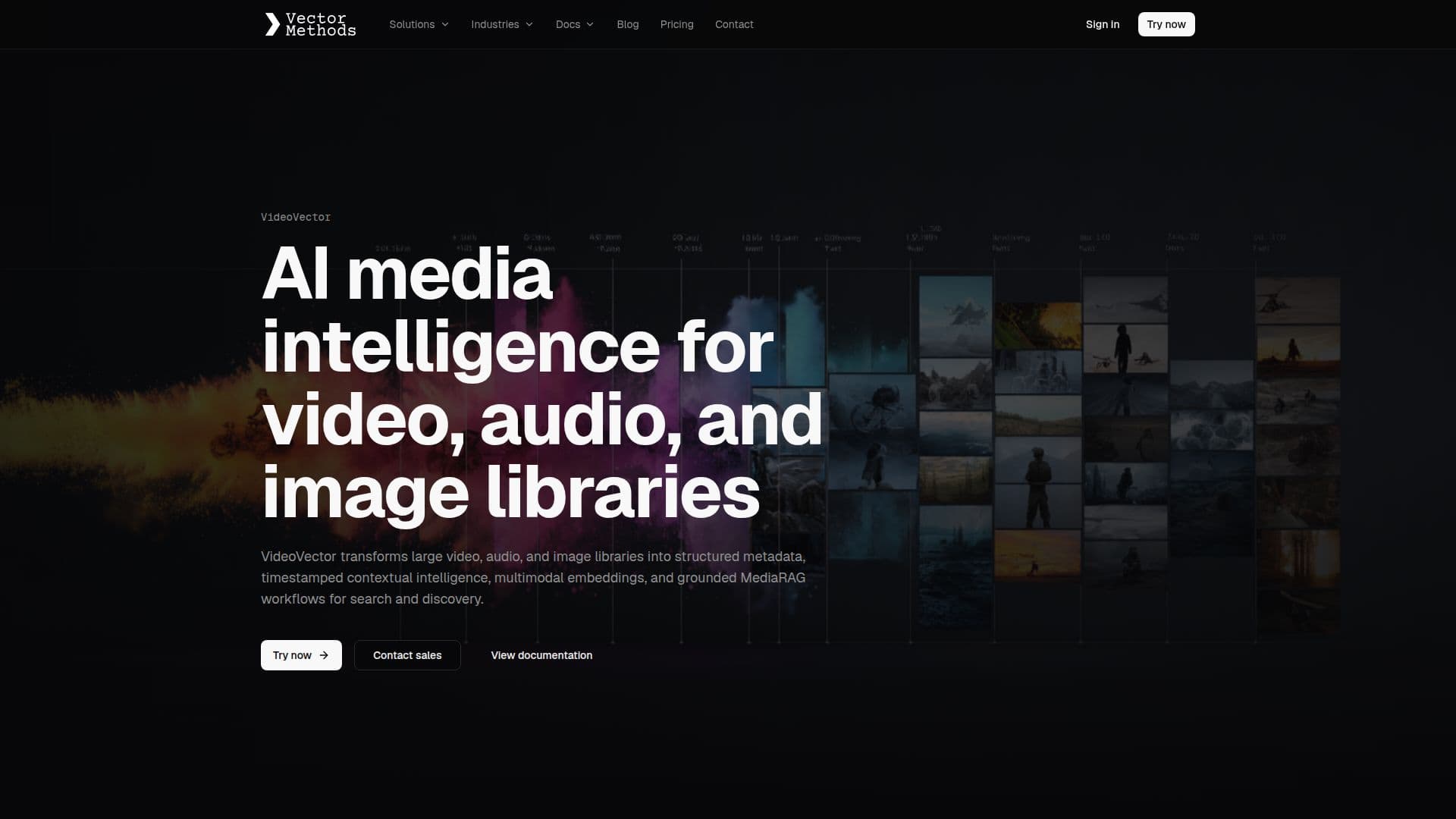
Description
VideoVector is a comprehensive tool designed to convert extensive video, audio, and image libraries into structured metadata and timestamped contextual intelligence. It supports multimodal embeddings and MediaRAG workflows, enabling efficient search and discovery. Users can define their own extraction schemas, allowing for tailored outputs that align with specific taxonomies, compliance fields, or editorial tags.
Read More
The platform facilitates seamless integration with downstream systems through APIs, SDKs, exports, and webhooks. It offers both self-serve and enterprise deployment options, catering to teams of different sizes and requirements. Users can start with a free trial in the playground and scale up to enterprise solutions for larger archives and more complex integrations.
VideoVector's pricing model includes a free tier for core search and processing workflows, a Starter plan at $49 per month for teams transitioning to production, and a Pro plan at $149 per month for larger credit allocations and priority support. Enterprise plans offer custom terms for governed deployments with extensive integration and infrastructure needs.
The tool is particularly beneficial for industries such as media, sports, security, legal, insurance, education, healthcare, and industrial operations. It enables users to organize recordings into meaningful moments, facilitating search and discovery, analysis, monitoring, and content generation. VideoVector supports various model providers, including GCP Vertex AI, AWS Bedrock, Azure AI, and Hugging Face, offering flexibility in model choice and deployment.
- CategoryData & Analytics
- Pricing ModelFreemium
- DeploymentCloud, On-Prem, Private Cloud
- PlatformsGCP, AWS, Azure, Hugging Face
VideoVector's Core Features
Custom extraction schemas
API and SDK integration
Self-serve and enterprise deployment
Free tier available
Multimodal embeddings
Timestamped contextual intelligence
MediaRAG workflows
Support for various model providers
How to use VideoVector?
Define: Set extraction schema and fields
Ingest: Index media with source identity
Analyze: Execute engine for segment results
Deliver: Export results via API and webhooks
Search: Query indexed results with semantic search
VideoVector's Use Cases
- Media Analysis
- Custom Schema Design
- Integration
- Enterprise Deployment
- Multimodal Embeddings