
Description
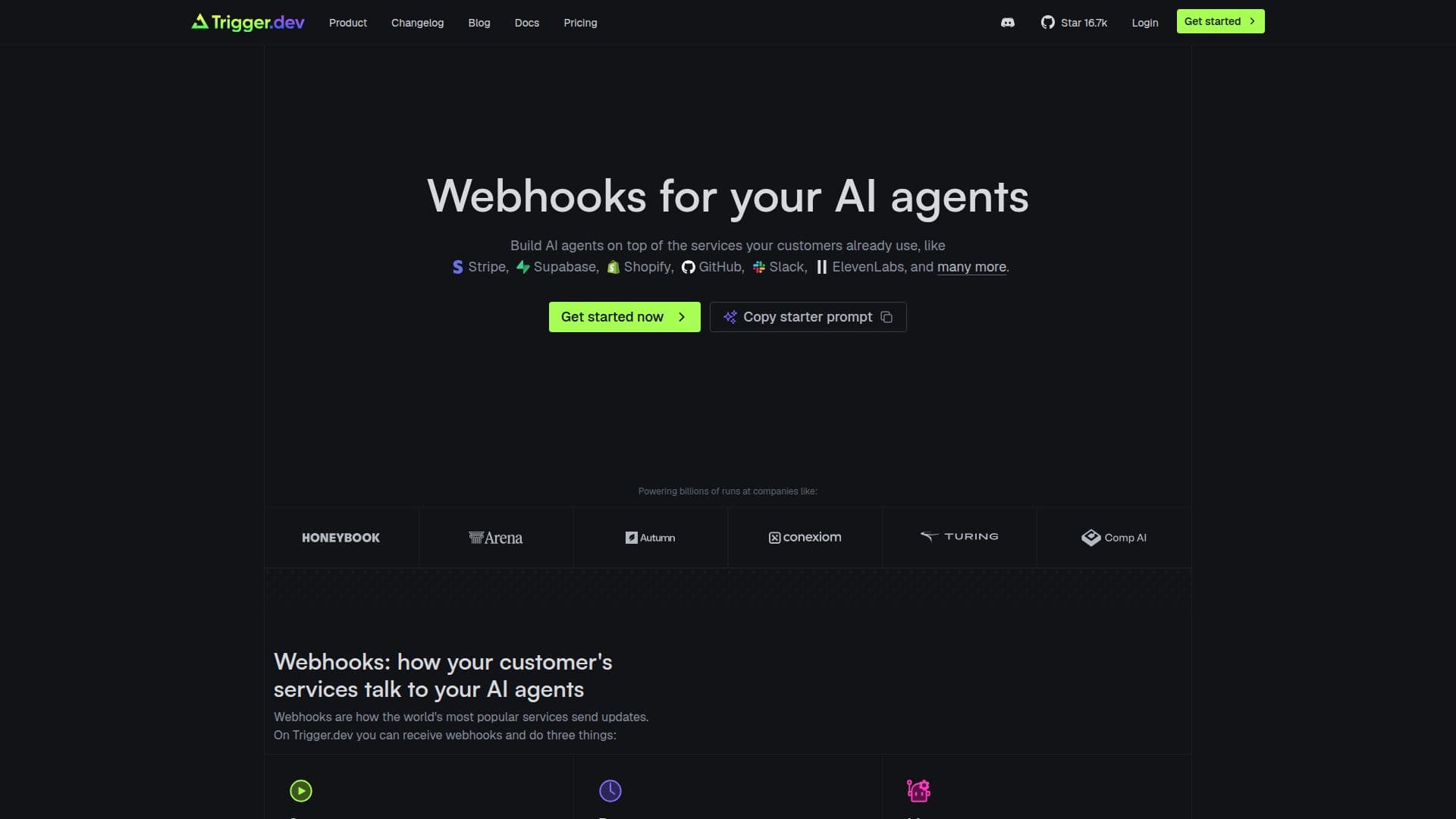
Trigger.dev offers a robust solution for managing durable webhooks in TypeScript, designed to facilitate the creation and integration of AI agents with various customer services. The platform allows developers to declare webhook endpoints directly in code, ensuring that every incoming request is thoroughly verified, deduplicated, and durably recorded before any processing begins. This approach guarantees that no webhook is lost, even in the face of retries or temporary service interruptions.
Read More
The core functionality revolves around three main actions for AI agents: starting an agent, resuming a paused agent, or messaging an agent with full context. For instance, a GitHub pull request or a Stripe payment can initiate a new agent run, while a webhook arrival can resume a run that was paused awaiting payment or approval. Events can also be routed directly to an agent's conversation, providing all necessary context for it to act appropriately.
Trigger.dev supports a wide array of integrations with popular services such as Attio, Stripe, Supabase, Shopify, GitHub, Slack, ElevenLabs, and many more. It includes native integrations for Linear and Slack, offering custom packages that simplify building agents for these platforms. This includes handling Slack messages, @mentions, button clicks, and file shares, as well as Linear issue assignments, @mentions, and follow-up prompts.
The platform emphasizes reliability and observability. Webhooks are stored before processing, and retries are deduplicated using provider-specific event IDs. Rate limits are applied per endpoint and environment, with a 429 Retry-After response to prevent event loss. Users gain full observability over every webhook delivery, function execution, and tool call, with detailed traces for agent runs, including LLM calls, tokens, and costs. Failed deliveries can be inspected and replayed for debugging.
Security features include built-in signature verification for numerous providers like Stripe and GitHub, and support for custom authentication schemes such as HMAC, shared secrets, or public keys. Replay protection and encrypted, rotatable secrets further enhance the security posture. Trigger.dev is also open source, allowing for self-hosting or deployment on Trigger.dev Cloud, and adheres to standards like SOC 2, HIPAA, and GDPR.
- CategoryAI Agent Builders
- Pricing ModelFreemium
- DeploymentCloud, Self-hosted
- PlatformsWeb
Trigger.dev's Core Features
Durable webhook endpoints declared in TypeScript code
Automatic verification, deduplication, and recording of every webhook request
Ability to start, resume, or message AI agents based on webhook events
Integrations with numerous services including Stripe, GitHub, Slack, Shopify, and ElevenLabs
Native integrations for Linear and Slack with custom packages for agent development
Support for custom webhook sources with HMAC, shared secret, or public key authentication
Webhooks stored before processing to prevent loss
Deduplication of retried webhooks using provider event IDs
Rate limiting per endpoint and environment with Retry-After responses
Full observability with recorded deliveries, filtered event reasons, and agent run traces
Tracing of LLM calls and tool calls with model, tokens, and cost information
Ability to replay failed webhook deliveries
Signature verification for incoming requests
Replay protection with timestamp tolerance
Encrypted and rotatable secrets for enhanced security
Open-source project available for self-hosting
How to use Trigger.dev?
Declare Endpoint: Define a webhook endpoint in your TypeScript code.
Run Trigger.dev: Execute `trigger dev` to start your local environment.
Paste URL: Copy the generated webhook URL and paste it into your service provider's settings.
Receive Webhooks: Trigger.dev will receive, verify, and process incoming webhooks.
Orchestrate Agents: Use webhooks to start, resume, or message your AI agents.
Monitor Activity: Observe webhook deliveries and agent run traces in the dashboard.
Trigger.dev's Use Cases
- Code Review Agent
- Bug-Fixing Agent
- AI SRE
- AI SDR
- Meeting Prep Agent
- Voice Agent Follow-ups
- Support Triage Agent
- Customer Success Agent
- Onboarding Agent
- Billing Ops Agent
- Fraud Review Agent