
Description
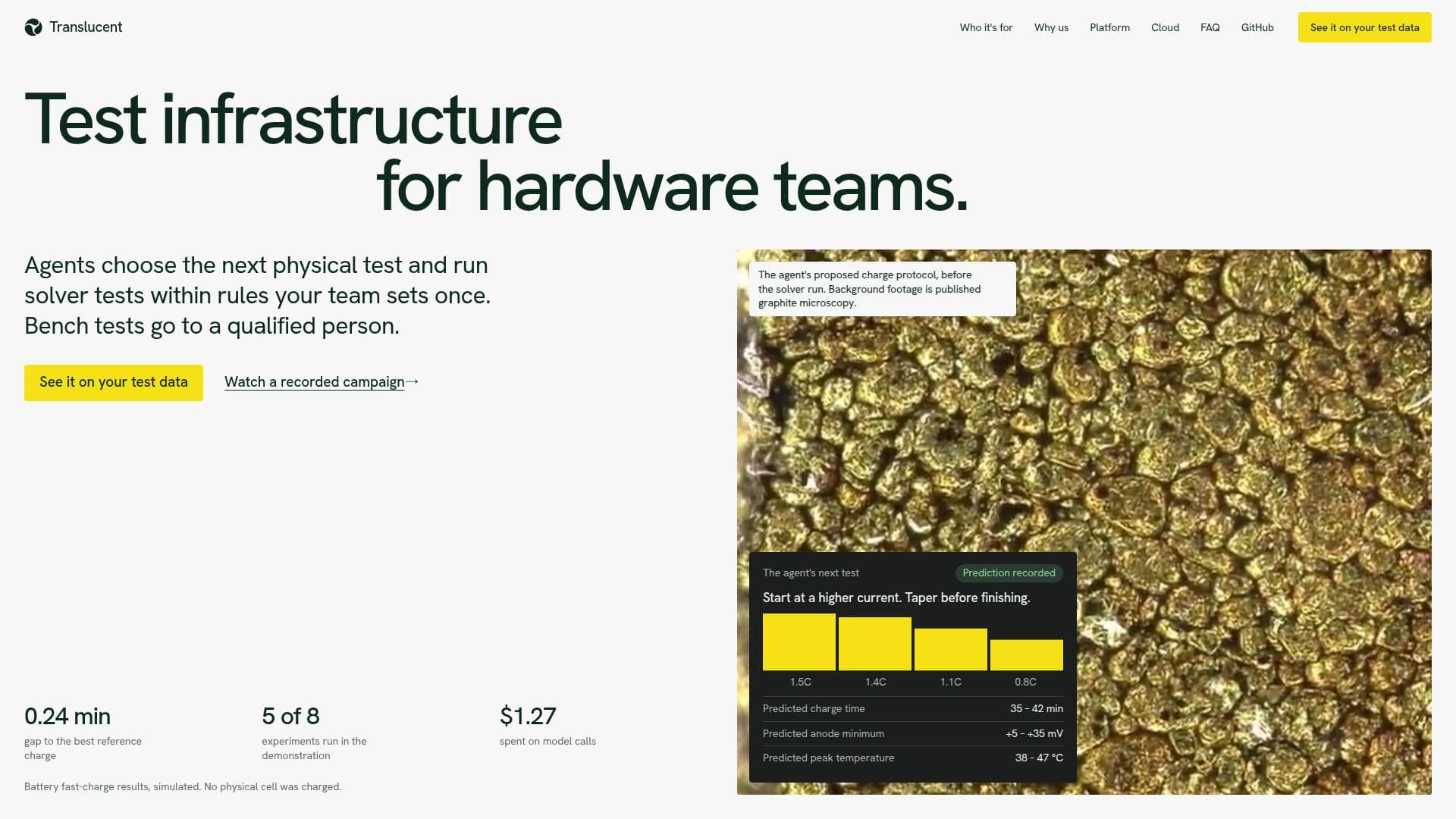
Translucent offers a sophisticated test infrastructure designed to help hardware teams manage and accelerate their experimental investigations. As hardware designs rapidly outpace traditional lab capacity, Translucent agents step in to intelligently select the next physical test and execute solver tests, all while adhering to limits and rules established by the team. This system is particularly beneficial for US hardware teams where bench time often creates bottlenecks, leading to ever-growing test queues.
Read More
The platform is currently live for battery fast-charge campaigns and plans to expand into other critical areas such as data-center hardware, robotics, and power electronics. It addresses common challenges faced by teams, including the reliance on fixed test matrices despite increasing design complexity, and the need for dynamic adjustment of test plans based on earlier results. Translucent ensures that when a result changes what needs to be learned, the agent adapts the subsequent test accordingly.
Key capabilities include connecting models to solvers, allowing each result to inform the next test choice. Unlike models operating in isolation, Translucent's integrated approach means agents choose the next test, predict expected ranges for changing quantities, run solver tests within standing rules, and send bench requests to qualified personnel. It also checks results against pre-set criteria and reads earlier results to inform future test planning, providing a comprehensive and traceable record of the experimental process.
Translucent emphasizes control and transparency. Teams can set spending, runtime, and run-count caps for solver tests, ensuring eligible runs proceed autonomously. For physical bench tests, a qualified person carries out the request and uploads the result. The system also allows for fixed pass criteria to be applied before a run, and all supporting evidence is maintained for offline re-checking. This ensures that every limit is checked and results are compared against baselines.
Furthermore, Translucent supports the integration of various agents over a common protocol (MCP), ensuring they operate under the same rules and tools, and no agent can approve its own work. The platform is also developing Translucent Cloud, which will allow fine-tuning of open-weight models on user campaigns with explicit permission, aiming to further improve test choices for hardware development. This holistic approach helps teams make informed decisions, keep limits consistent even when models change, and revisit earlier results for comparison.
- CategoryScientific Discovery & Lab Tools
- Pricing ModelUsage-based
- DeploymentCloud (in development)
- PlatformsWeb
Translucent's Core Features
Autonomous Test Selection by Agents
Solver Test Execution within Defined Limits
Dynamic Adjustment of Test Plans
Connection of Models to Solvers
Prediction of Expected Result Ranges
Enforcement of Spending and Runtime Caps
Fixed Pass Criteria Application
Offline Re-checking of Campaign Data
Integration of External Agents via MCP
Comprehensive Record Keeping of Tests and Results
Bench Request Generation for Physical Tests
Comparison of Predictions with Actual Outcomes
Re-evaluation of Earlier Results Against New Limits
Support for Battery Fast-Charge Campaigns
Development of Cloud-based Model Fine-tuning
How to use Translucent?
Define Rules: Set spending, runtime, and run-count limits for solver tests, along with pass criteria.
Connect Systems: Integrate your solver and define its allowed parameters for agent proposals.
Initiate Campaign: Start a test campaign, allowing Translucent agents to choose and run solver tests.
Execute Physical Tests: Qualified personnel carry out bench requests generated by the agent and upload results.
Review Results: Translucent checks results against preset criteria and records all evidence.
Verify Offline: Recompute requests and check file hashes offline to verify campaign integrity.
Iterate and Optimize: Agents use earlier results and reasoning to plan subsequent tests, continuously refining the process.
Translucent's Use Cases
- Accelerating Hardware Design
- Battery Fast-Charge Optimization
- Data-Center Hardware Load Testing
- Robotics Actuator Wear Testing
- Power Electronics Efficiency Checks
- Managing Growing Test Queues
- Ensuring Test Plan Adaptability
- Reproducing Experimental Campaigns