
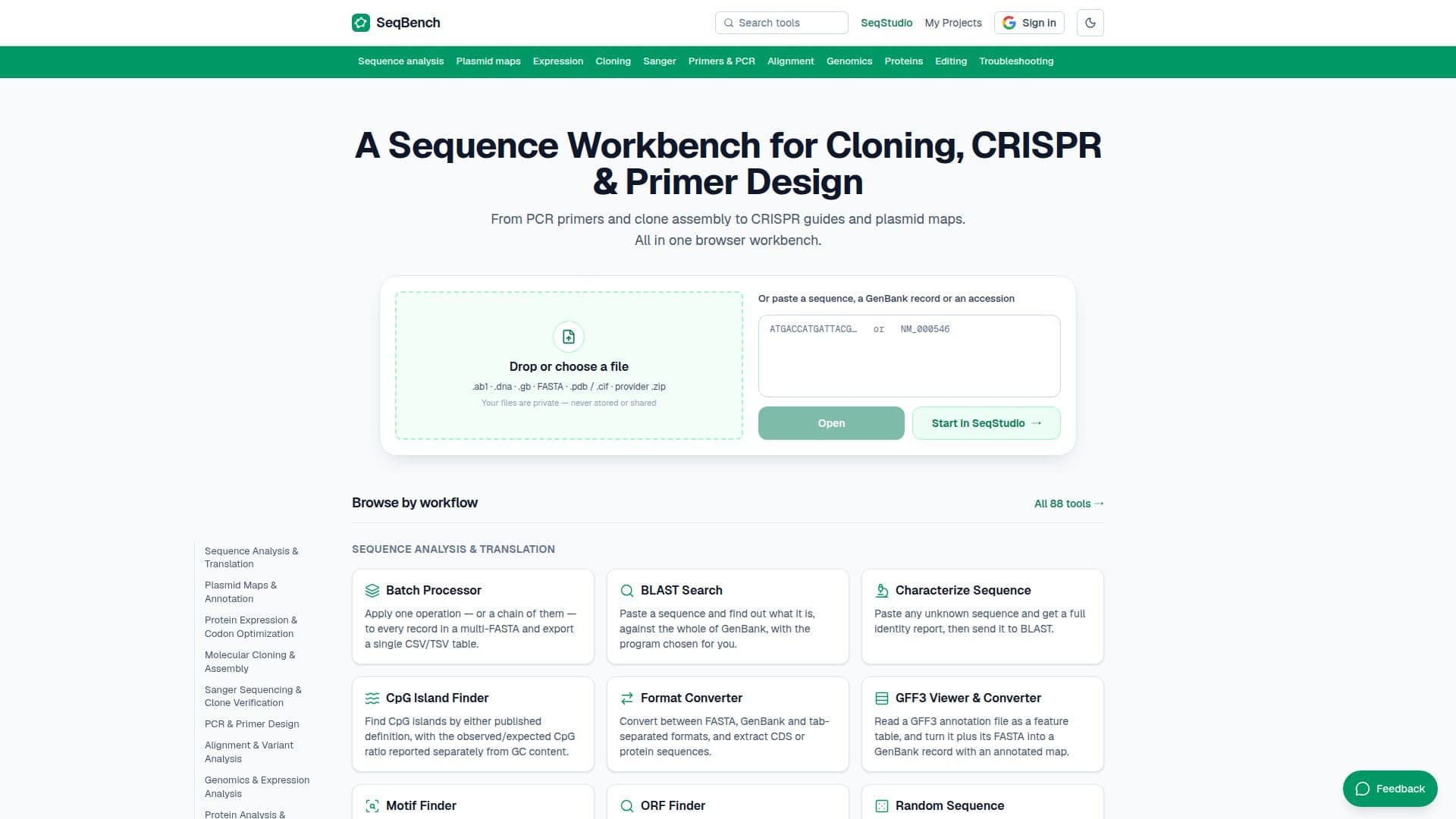
Description
SeqBench provides a unified browser-based workbench designed to streamline everyday molecular biology workflows. It integrates a wide array of bioinformatics tools, allowing scientists to move seamlessly from sequence inspection and annotation to primer design, cloning, gene editing, and experimental verification without losing context. The platform aims to reduce mechanical work while keeping the scientist in control of biological judgment, ensuring inputs remain visible, assumptions are stated, and outputs can be independently reviewed.
Read More
The workbench is organized around real laboratory workflows rather than a mere catalogue of features. Individual tools address focused questions, connecting tasks such as sequence editing, construct design, cloning, primer and oligo work, CRISPR planning, file inspection, and result verification. This approach eliminates the need to repeatedly rebuild data, fostering a coherent and efficient research process. SeqBench supports interactive pages, batch processing, and programmatic access, ensuring consistent results and terminology across different modes of use, whether checking a single construct or automating a workflow.
Key capabilities include comprehensive sequence analysis and translation, allowing users to apply operations to multi-FASTA records, identify unknown sequences against GenBank, find CpG islands, and convert between various sequence formats. It also offers robust plasmid mapping and annotation features, including auto-detection of promoters, tags, origins, and resistance markers, and direct sequence editing with live feature remapping. For protein expression, SeqBench provides tools for codon optimization, translation initiation rate prediction, and RNA secondary structure folding.
In molecular cloning and assembly, the platform facilitates fragment assembly for Gibson, Golden Gate, restriction, LIC, and SLIC cloning. It includes calculators for DNA/RNA conversions, restriction enzyme selection, and gel band sizing. CRISPR and genome editing tools enable the design of gRNAs, knock-in donors, SDM primers, and pegRNAs for various edits. Furthermore, SeqBench supports Sanger sequencing and clone verification, allowing users to inspect chromatograms, align reads to references, and diagnose experimental results. The platform also features PCR and primer design tools, alignment and variant analysis, genomics and expression analysis, and protein analysis and structure prediction.
SeqBench emphasizes scientific quality, grounding results in published formulas, reference tables, and named conventions. Calculations are rigorously tested, and predictive tools clearly state their limitations and validation evidence. The platform adopts a local-first approach to data handling, with project history stored on the user's device unless optional account sync is enabled. Public-record lookups only send necessary identifiers. SeqBench is intended for research, education, and general molecular biology workflows, explicitly stating it is not a clinical system and does not replace experimental validation or professional judgment.
- CategoryScientific Discovery & Lab Tools
- Pricing ModelFree
- DeploymentCloud
- PlatformsWeb
SeqBench's Core Features
Edit plasmids and SnapGene .dna files
Design PCR primers and KASP/ARMS SNP-genotyping primers
Simulate molecular cloning (Gibson, Golden Gate, restriction, LIC, SLIC)
Find CRISPR guides for SpCas9, SaCas9, Cas12a, CBE, ABE, and pegRNAs
Verify Sanger sequencing results and inspect chromatograms
Perform sequence analysis and translation (GenBank, BLAST, CpG islands, ORF, motif search)
Generate annotated circular or linear plasmid maps
Optimize protein or coding sequences for expression in various hosts
Analyze and fold RNA to its minimum-free-energy secondary structure
Convert between mass, moles, molarity, and copy number for DNA/RNA
Predict restriction fragments and simulate agarose gels
Align DNA or protein sequences and build phylogenetic trees
Summarize and validate FASTA/FASTQ files for quality control
Look up variants by rsID, chrom:pos:ref:alt, or HGVS with ClinVar, gnomAD, SIFT, AlphaMissense scores
Design knockdown reagents (siRNAs, shRNA cassettes, ASO gapmers)
How to use SeqBench?
Paste Sequence: Input DNA, RNA, or protein sequences in various formats (FASTA, GenBank, plain text).
Select Tool: Choose from a wide range of molecular biology tools for analysis, design, or simulation.
Configure Parameters: Adjust settings like mismatch tolerance for PCR, expression host for codon optimization, or enzyme selection for cloning.
Run Analysis: Execute the chosen tool to process your sequence data and generate results.
Review Output: Examine annotated maps, sequence reports, simulated gels, or tabular data.
Export Results: Download data in formats like GenBank, FASTA, CSV, or TSV for further use or documentation.
SeqBench's Use Cases
- Molecular Cloning Simulation
- CRISPR Guide Design
- Primer Design & PCR Planning
- Sanger Sequencing Verification
- Plasmid Map Generation
- Protein Expression Optimization
- Batch Sequence Analysis
- Solution Preparation Calculation
- Variant Analysis
- Genomics Quality Control