Description
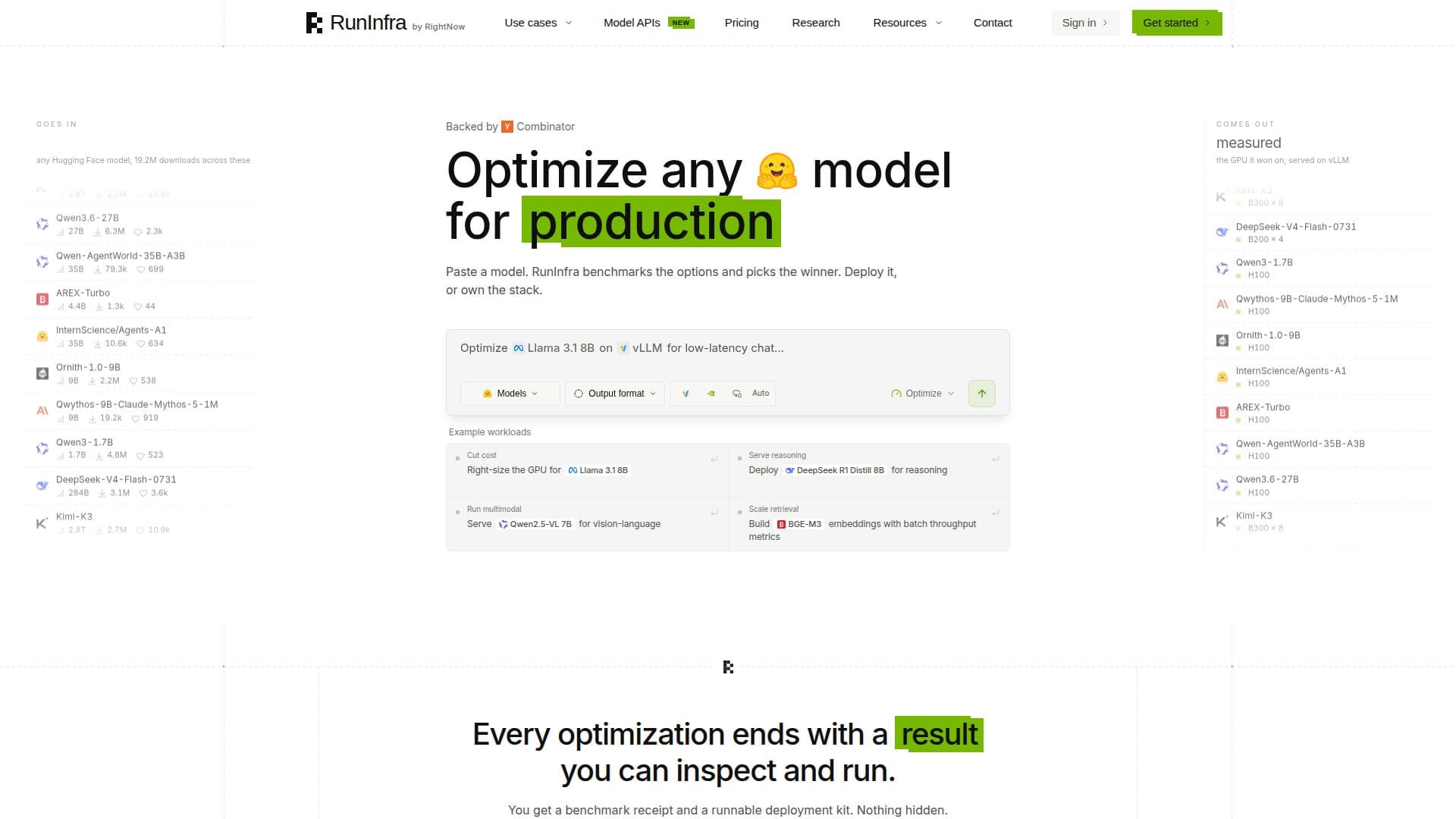
RunInfra lets developers call open-source AI models through a single, OpenAI- and Anthropic-compatible API, instead of hosting and optimizing model infrastructure themselves.
Read More
RunInfra hosts a small library of open models, including Nemotron 3.5 Lightning 30B, Qwen3.8 27B, and Ornith 1.5 35B at the time of writing, behind one gateway, reachable with the OpenAI or Anthropic Python and Node SDKs by pointing the base URL at RunInfra's API. Requests are billed per input and output token, with a separate, lower price for cached input tokens. To improve cache hits, RunInfra uses session-aware routing: it keeps a given agent session pinned to the same backend replica across repeat calls, so context that was already loaded stays warm, rather than landing on a random replica each time. Cache hit rates are measured and published per model, over 95% for some models in a recent 24-hour window, and hits are billed at the cached rate, though the company describes cache hits as best effort.
Key capabilities include an OpenAI- and Anthropic-compatible chat completions API; per-model pricing with published cache-hit and output-speed benchmarks; tool calling, JSON mode, streaming, and image input depending on the model; a CLI that connects RunInfra-hosted models to coding agents including Claude Code, Codex, OpenCode, Cline, Droid, and Grok Build; and a request-a-model option for models not yet hosted.
Model usage is billed per token, for example $0.05 per 1M input tokens and $0.15 per 1M output tokens for one hosted model, with cached input billed separately at a lower rate, as low as $0.01 per 1M cached tokens. Coding-agent plans start at $10 a month.
On security, RunInfra states its hosted Model APIs don't store prompts by default (zero data retention), encrypts data with TLS in transit and AES-256 at rest, offers workspaces with roles and row-level security, doesn't train on customer prompts or completions, and holds a SOC 2 Type II attestation.
RunInfra is built for developers and teams building AI agents or coding-agent workflows who want open-model inference without managing their own GPU infrastructure; the company, part of RightNow, is Y Combinator-backed. Its hosted model library is small, three models at the time of research, though a request-a-model option exists for teams that need something else.
- CategoryMLOps & Model Deployment
- Pricing ModelPay-as-you-go
- DeploymentManaged and self-hosted
- PlatformsCloud
RunInfra's Core Features
One API key compatible with both the OpenAI and Anthropic SDKs
Hosts open models including Nemotron, Qwen, and Ornith
Session-aware routing that keeps repeat agent calls on the same warm replica
Published per-model pricing, cache-hit rate, and output-speed benchmarks
Tool calling, JSON mode, streaming, and image input support by model
CLI integration with coding agents including Claude Code, Codex, OpenCode, Cline, Droid, and Grok Build
Zero prompt retention by default, with SOC 2 Type II attestation
Workspaces with roles and row-level security
How to use RunInfra?
Get an API key: sign up on RunInfra and generate a gateway API key
Point your SDK at RunInfra: set the base URL to RunInfra's endpoint in the OpenAI or Anthropic SDK
Pick a model: choose from the hosted model library based on capability and price
Call the model: send chat completion requests using your existing SDK code
Connect coding agents: install the RunInfra CLI to route agents like Claude Code or Cline to RunInfra-hosted models
Monitor cost and cache hits: check published pricing and cache-hit rate per model to manage spend
RunInfra's Use Cases
- Open-model API access
- AI agent inference
- Coding-agent backend