
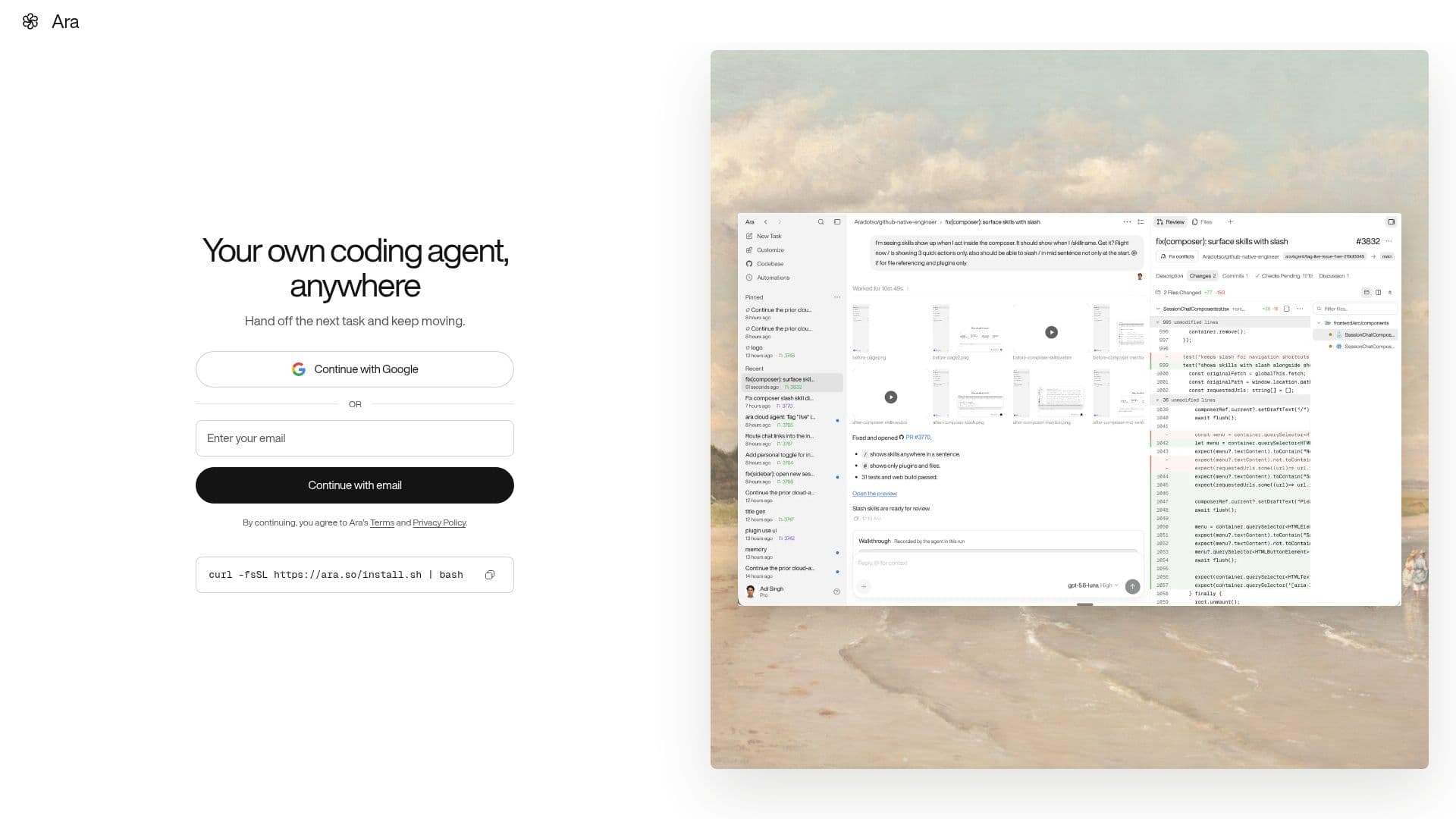
Description
Reason, made by Reason Machines, describes itself as "your team's autonomous software engineer." It is a rebrand of a product formerly known under the domain ara.so, which now redirects to reasonmachines.com; the current site markets the coding agent simply as Reason.
Read More
A user gives Reason a task in plain language, from the web app, a desktop app, a mobile client, or by mentioning it in a Slack channel. Reason can then work on the user's own Mac, a teammate's computer, or a cloud machine (Linux or macOS, with configurable memory and vCPUs), keeping code, tools and session context together wherever the work happens. Before starting, a user can choose a model and a thinking level: options shown on the site include bringing your own API key, or using Amazon Bedrock, Azure OpenAI, a Claude API key, several GPT-6 variants, Opus and Gemini, with thinking levels from Light to Max.
When Reason finishes a task, it opens a pull request rather than just returning a diff. The PR carries automated checks, shown on the site as typecheck, regression tests, build and a preview deployment, all passing before a human reviews the change. For larger investigations, Reason can run long-horizon codebase analyses to find and fix issues on its own, for example tracing an authentication flow, reproducing a cross-tenant access bug, and opening a pull request with regression tests attached. Recurring work can be turned into scheduled workflows, such as a weekday compliance check, an hourly latency benchmark, or a weekly dependency audit, each with its own history of past runs.
A Codebase view keeps repositories, pull requests, permissions and secrets in one place, and Reason connects to external tools including GitHub, Slack, Linear, Figma, Google Drive, Notion, Sentry, Jira, GitLab, Supabase, PostHog and, per the site, 300+ more integrations. A dedicated comparison page contrasts Reason with other coding agents, including Devin, Cursor, Factory AI, Instinct, Grokbot and Muse.
On security, Reason states it applies zero data retention by default, with no extra configuration needed. SOC 2 Type II is described as in progress, with compliance status and documentation available through a trust center, and a Q3 2026 penetration test report available on request. GDPR-related policies and processes are described as established. The site does not display specific prices; enterprise features and a Pricing page are linked separately, and current and alumni Y Combinator companies are offered $1,000 in credits.
Reason Machines is based in San Francisco and is backed by Y Combinator. It is aimed at engineering teams that want an agent to handle migrations, bug fixes, dependency work and recurring maintenance, while keeping a human review step before anything merges.
- CategoryAI Coding Assistants
- Pricing ModelFreemium
- DeploymentCloud, Self-hosted
- PlatformsWeb, Desktop, CLI, Mobile
Reason's Core Features
Works across local and cloud machines (your Mac, a teammate's machine, or cloud Linux/macOS) with shared context
Opens pull requests with typecheck, regression test, build and preview-deployment checks attached
Model choice: bring your own key or use Amazon Bedrock, Azure OpenAI, Claude, GPT-6 variants or Gemini, with adjustable thinking level
Scheduled workflows for recurring tasks such as compliance checks, latency benchmarks or dependency audits
Slack integration: mention Reason in a channel to start or continue a task
Web, desktop and mobile clients for following and steering sessions from anywhere
Codebase view for managing repositories, pull requests, permissions and secrets in one place
300+ integrations including GitHub, Linear, Figma, Notion, Jira, GitLab, Supabase and Sentry
Zero data retention by default, with SOC 2 Type II and GDPR processes in progress
How to use Reason?
Sign in: create an account or request a demo on reasonmachines.com.
Connect your codebase: link GitHub and choose which repositories Reason can work in.
Give it a task: describe the work in plain language, on web, desktop or in Slack.
Pick where it runs: choose your Mac, a teammate's machine, or a cloud machine, and a model.
Review the pull request: check the diff, logs and passed checks before merging.
Automate recurring work: set up a scheduled workflow for tasks like compliance or dependency audits.
Reason's Use Cases
- Codebase migrations
- Bug and vulnerability fixes
- Recurring engineering maintenance
- Cross-team task handoff