
Description
QuantumLayers is an AI-native data integration, analysis, and visualization platform designed to empower business users with automated insights. It simplifies the complex process of data analysis by allowing users to connect diverse data sources, including SQL databases, cloud warehouses (MySQL, PostgreSQL, SQL Server, Amazon Redshift, Azure Synapse, ClickHouse, Google BigQuery, Databricks), REST APIs, Google Sheets, CSV, and Excel files, as well as SFTP servers and Kaggle datasets. The platform eliminates the need for ETL pipelines or data engineers, making advanced analytics accessible to non-technical individuals.
Read More
Unlike traditional BI platforms that require extensive setup and dashboard configuration, QuantumLayers connects to data sources in place, merges them, and performs a comprehensive suite of statistical tests. This includes Pearson correlation, ANOVA, distribution and outlier analysis, time-series analysis (ADF stationarity, CUSUM structural breaks, trend, autocorrelation, STL seasonal decomposition, Holt-Winters, SARIMA forecasts), linear regression, categorical entropy, chi-square, lagged cross-correlation, and VIF multicollinearity checks. A Benjamini-Hochberg false-discovery-rate correction ensures that only statistically validated results are passed to the AI model.
The AI model then interprets these validated statistical findings, explaining patterns in plain language and recommending appropriate charts for visualization. This unique "statistics first, AI second" approach significantly reduces token costs and improves the accuracy of AI insights, as the LLM focuses on interpreting preprocessed, meaningful patterns rather than raw, voluminous data. This architecture allows QuantumLayers to provide consistent, predictable costs and rapid analysis times, regardless of dataset size.
QuantumLayers supports multi-source merging, automated chart selection, and continuous monitoring for emerging patterns. It also offers QL-Agent for workflow automation through natural language prompts and scheduled reports delivered directly to users. The platform is built for various teams, including Growth & Marketing, Finance & Accounting, E-Commerce & Retail, Consulting, Manufacturing, Energy & Utilities, and Agriculture, providing tailored analytics solutions for diverse business needs.
- CategoryAI Data Analysis
- Pricing ModelFreemium
- DeploymentCloud, On-premise (Enterprise)
- PlatformsWeb
QuantumLayers's Core Features
No-code data integration
Multi-source data merging without ETL pipelines
Automated statistical analysis
AI-generated business insights in plain language
Automated data visualizations
Scheduled reports and continuous monitoring
QL-Agent for workflow automation with natural language
Connects to SQL databases and cloud warehouses
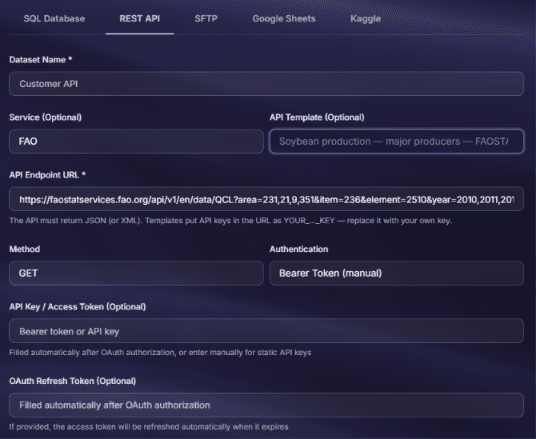
Connects to REST APIs with built-in templates
Connects to CSV, Excel, Google Sheets, SFTP, and Kaggle datasets
Schema detection and alignment
Nine-step statistical testing pipeline
Benjamini-Hochberg false-discovery-rate correction
On-premise deployment available (Enterprise plan)
Organization dashboard and member management
How to use QuantumLayers?
Connect Data Sources: Link SQL databases, REST APIs, Google Sheets, CSVs, and other sources through a guided interface.
Merge Datasets: Automatically merge data from multiple sources on shared columns without manual schema work.
Analyze Data: QuantumLayers runs a full battery of statistical tests to find significant patterns.
Generate Insights: AI explains the meaning of patterns in plain language and suggests relevant charts.
Automate Reports: Schedule reports and monitors to continuously watch data for emerging patterns.
Automate Workflows: Use QL-Agent to set up connections and automate tasks with natural language.
QuantumLayers's Use Cases
- Cross-Channel Marketing Attribution
- Financial Performance Analysis
- E-commerce Sales Optimization
- Consulting Data Insights
- Manufacturing Process Improvement
- Energy Consumption Analysis
- Agricultural Yield Optimization
- Lead Scoring & Funnel Velocity
- A/B Testing Significance
- Lifetime Value by Acquisition Source