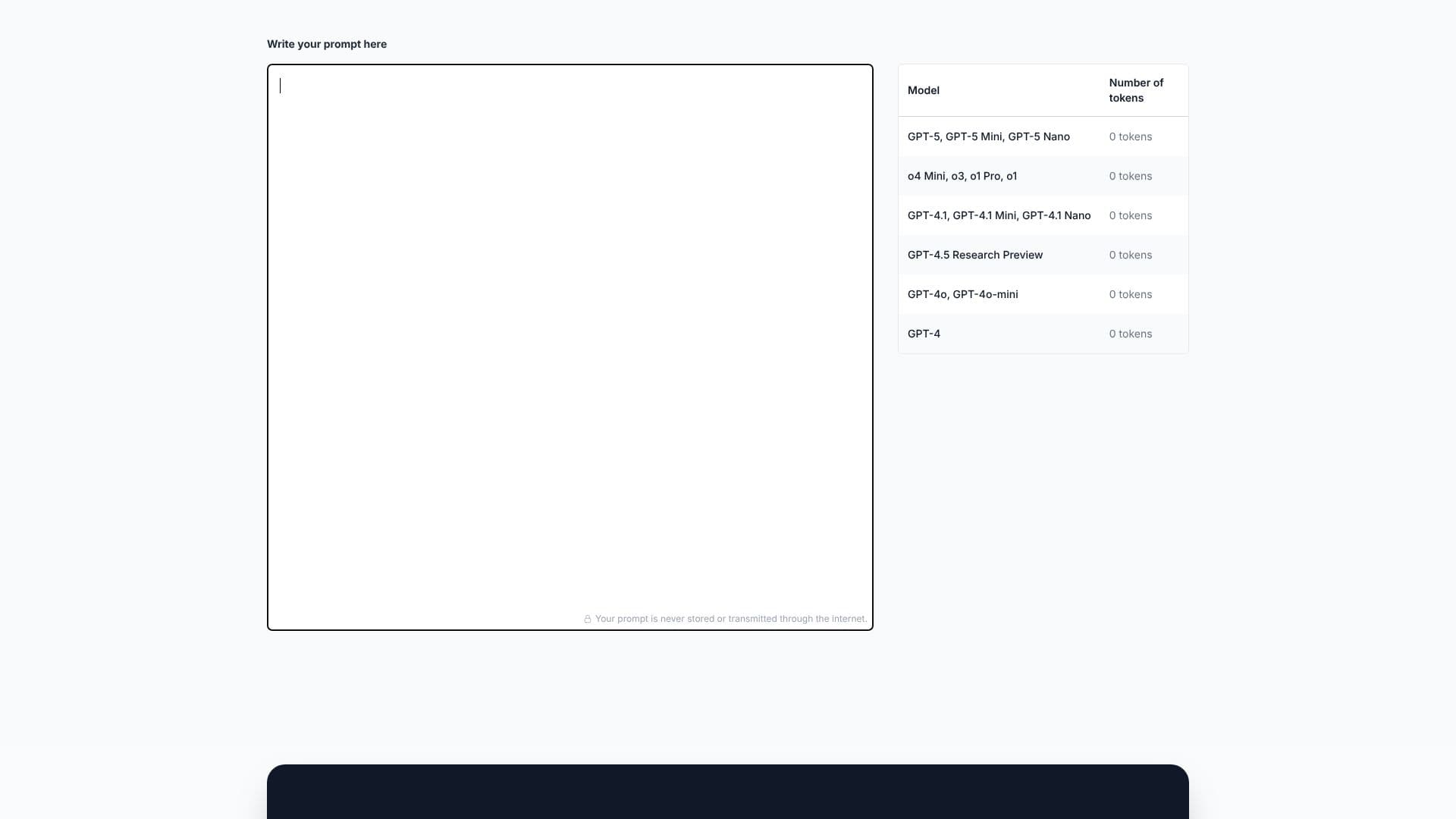
Description
The Prompt Token Counter for OpenAI Models is an essential online utility designed to assist users in managing their interactions with large language models. When working with AI models such as OpenAI's GPT-3.5, understanding and adhering to token limits is crucial. These limits dictate the maximum amount of text, comprising both input prompts and output responses, that a model can process in a single interaction. This tool provides a straightforward way to count tokens in your prompts, helping you stay within these boundaries.
Read More
Tokens are the fundamental units of text that language models process. They can represent words, parts of words, characters, or punctuation, depending on the specific tokenizer employed by the model. Each token consumes computational resources and contributes to the overall token count. Exceeding a model's token limit can lead to requests being rejected or responses being truncated, hindering effective communication with the AI.
The Prompt Token Counter is vital for several reasons. Firstly, it ensures that your prompts remain within the maximum token limits of the OpenAI models you are using, preventing errors and ensuring successful query execution. Secondly, it aids in cost control, as many AI models charge based on the number of tokens processed. By accurately tracking token usage, users can manage expenses more effectively and avoid unnecessary costs. Thirdly, it assists in response management; by estimating the token count of potential responses, users can adjust their prompts to accommodate desired output lengths. Finally, it promotes efficient communication by encouraging concise and clear prompts, ensuring that the model accurately understands the user's intent without verbosity.
To effectively use a token counter, users should first familiarize themselves with the token limits of their chosen OpenAI model, such as GPT-3.5-turbo's 4096-token limit. It is recommended to preprocess prompts using similar tokenization techniques as the model itself, often facilitated by libraries like the OpenAI GPT-3 tokenizer. After tokenization, the number of tokens can be counted, remembering that punctuation, spaces, and special characters also contribute. Users must also account for the expected token count of the model's response and iteratively refine their prompts if they exceed the allowed limits. This iterative process ensures that prompts are optimized for both length and clarity, leading to a smoother and more cost-effective AI interaction experience.
- CategoryPrompt Engineering Tools
- Pricing ModelFree
- DeploymentCloud
- PlatformsWeb
Prompt Token Counter's Core Features
Counts tokens for OpenAI models
Helps users stay within model token limits
Aids in prompt optimization
Supports cost control for AI interactions
Prevents prompt rejection due to excessive tokens
Facilitates effective communication with AI
Tracks prompt token usage
Assists in managing response token allocation
Provides a clear understanding of tokenization
Online tool for immediate use
Ensures prompts fit model constraints
Supports efficient AI query management
How to use Prompt Token Counter?
Input Prompt: Write your prompt text into the provided field.
Select Model: Choose the relevant OpenAI model for token counting.
Count Tokens: The tool automatically calculates the number of tokens.
Review Count: Check the token count against the model's limit.
Optimize Prompt: Adjust prompt length if it exceeds the token limit.
Iterate: Refine the prompt and recount tokens until it fits.
Prompt Token Counter's Use Cases
- Prompt Length Management
- Cost Optimization
- Response Prediction
- AI Interaction Efficiency
- Preventing Errors
- Prompt Refinement