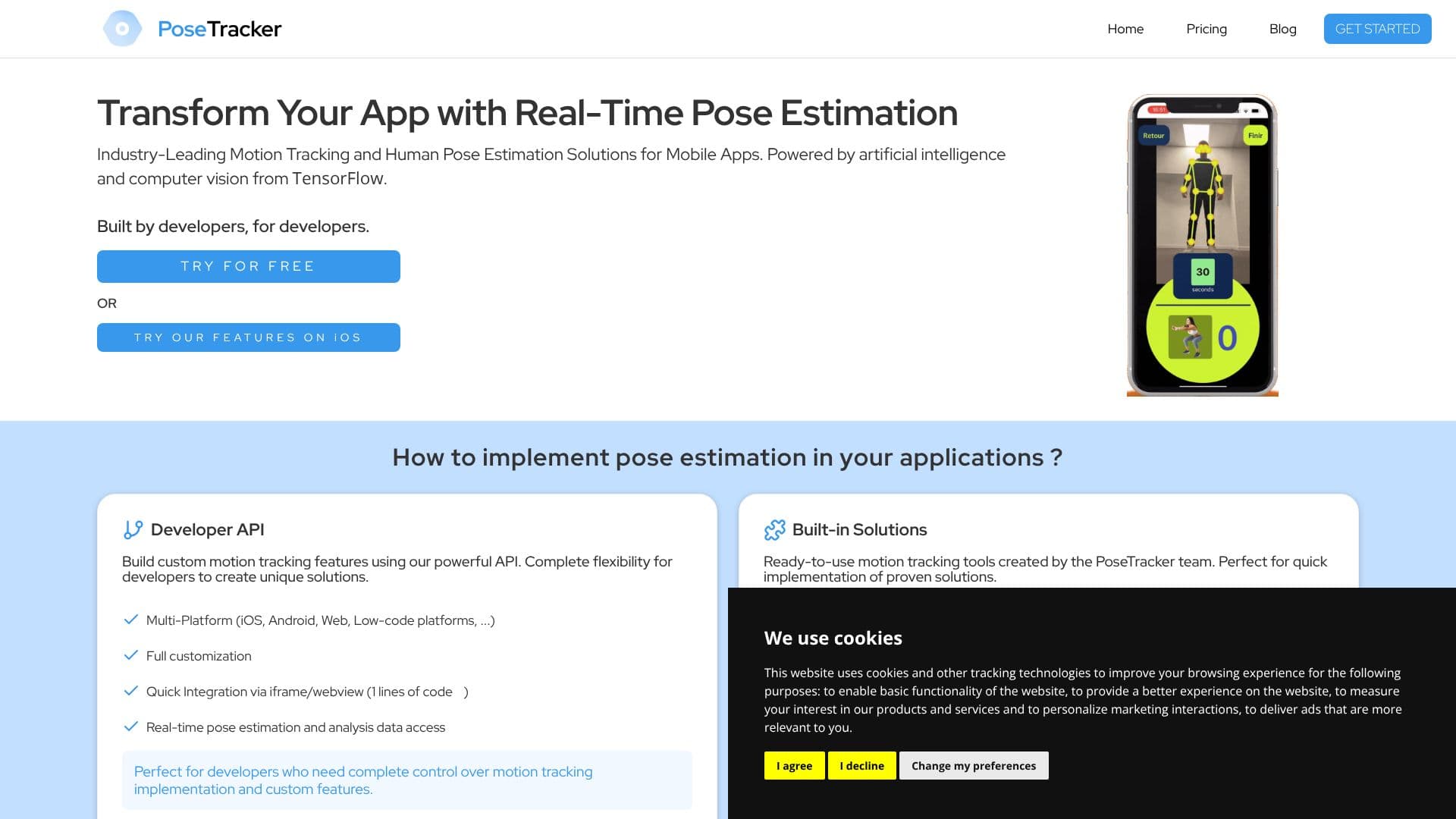
Description
PoseTracker provides on-device pose estimation for mobile and web applications, aimed at teams building fitness, home-workout, and physical-therapy products. It runs on TensorFlow's MoveNet model and gives an app the ability to read a user's movement from a phone camera rather than relying on wearable sensors. The company frames its own value proposition around a simple question: would you trust a trainer, coach, or physiotherapist who could not actually see you move? Most fitness and rehab apps, it argues, still coach blind, relying on a video, a plan, or a chat rather than watching the person do the exercise.
Read More
Once integrated, PoseTracker can track things like squat and push-up repetitions, joint angles, jump height, flexibility holds, and range of motion, and turn them into a form score. The company positions this around three product scenarios: correcting exercise form that a text or video cue can't see, running a home workout that actually watches the person doing it, and supporting virtual physical therapy where a remote protocol needs to see range of motion and compensation patterns, not just hear a description of them.
PoseTracker offers a few integration paths. A developer SDK for React Native (including Expo Go), iOS, Android and the web provides free on-device keypoint tracking (17 points), with an optional API key unlocking the exercise engine (reps, angles, form score). A WebView/iframe integration embeds the camera and analysis directly into an existing web view with a single line of code. Built-in, ready-to-use motion-tracking tools are also available for teams that want a working feature without custom development. PoseTracker's React Native and JavaScript SDKs are also published as open-source repositories on GitHub.
The site also includes a public Assistant, described as a purpose-built LLM for pose estimation and motion tracking: a developer describes a movement they want to track, and it turns the description into a React Native, Expo, or web integration snippet. PoseTracker is built by Movelytics and is intended for product and engineering teams that want to add movement tracking without building a computer-vision team of their own.
- CategoryComputer Vision Tools
- Pricing ModelFreemium
- DeploymentCloud
- PlatformsiOS, Android, Web, Low-code
PoseTracker's Core Features
On-device pose estimation running on TensorFlow MoveNet
Tracks squat/push-up reps, joint angles, jump height, flexibility holds and form score
React Native (Expo Go), iOS, Android and web SDK support
Free on-device keypoint tracking (17 points); optional API key unlocks the exercise engine
WebView/iframe integration for embedding the camera and analysis in one line of code
Ready-to-use, built-in motion-tracking tools for teams that don't want custom development
Public Assistant (LLM) that turns a movement description into integration code
Open-source React Native and JavaScript SDK repositories on GitHub
How to use PoseTracker?
Describe the movement: Tell the Assistant what you want to track (e.g. squat reps, jump height, a custom movement).
Get an integration snippet: The Assistant turns the description into React Native, Expo, or web code.
Install the SDK: Add the React Native or web pose-estimation package to your app.
Add an API key (optional): Unlock reps, angles, and a form score beyond free on-device keypoints.
Embed via WebView (alternative): Use the iframe/WebView integration if you already embed a web view.
PoseTracker's Use Cases
- Exercise form correction
- Home workout apps
- Remote physical therapy
- Fast prototyping